
Checking a Rental Helmet in Vietnam: Fit, Condition and Standards
To check a rental scooter helmet, do three things before you ride: confirm it fits snugly and stays put when you shake your head, look it over for cracks, a crushed liner, a frayed strap and a scratched visor, and find the Vietnamese CR conformity mark on it. The whole check takes about two minutes. If the helmet fails any step, ask for a different size or model before you leave. Helmets are by agreement at HANOI MOTO, so confirm what can be arranged when you book.
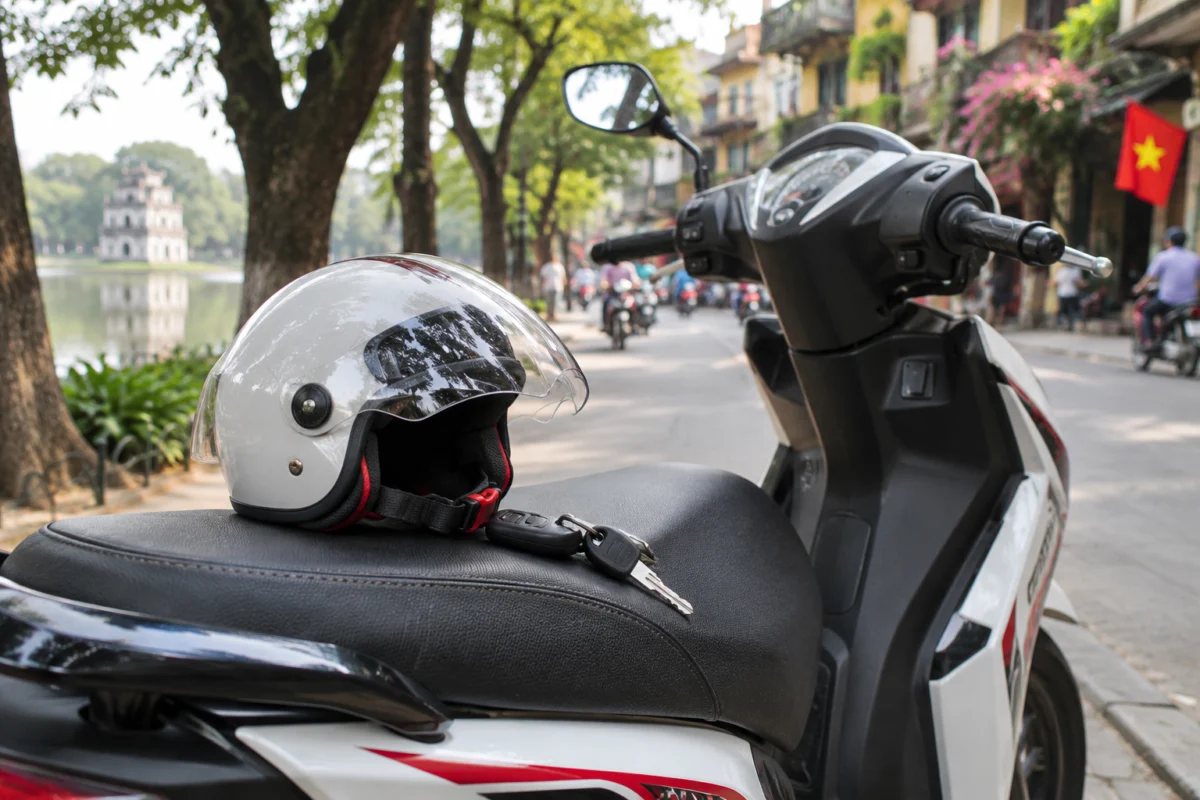
Why the helmet check matters as much as the bike check
You test the brakes and tires of a bike you did not choose; the helmet is essential head protection, and it deserves the same attention as other protective riding gear. This page covers the helmet only. For the bike, use the pre-ride bike inspection checklist, and see the Hanoi motorbike rental guide for the wider picture.
What the law requires, in brief
Under Decree 168/2024/ND-CP, as amended by Decree 238/2026/ND-CP, a rider with no helmet, or with one that is not fastened properly, faces a fine of 400,000–600,000 VND (Article 7; Decree 238 did not change this helmet-penalty provision). The same range applies to a rider carrying a passenger without a helmet and to the passenger (Article 12(5)(b)). Separately, since 1 January 2024, helmets made or imported for sale in Vietnam must meet the national regulation QCVN 2:2021/BKHCN. Full rules are in the Vietnam helmet law guide. Figures here are as of November 2026.
What the law does not guarantee
A fine schedule says what is punished, not whether a helmet fits; a compliant helmet one size too large can still shift or come off in a crash (Snell Foundation). This guide also could not verify whether Vietnam fines a helmet that lacks the conformity mark; the fines above concern not wearing a helmet or not fastening it. Treat the mark as a minimum signal and do the checks yourself.
The two-minute fit test
Run these four checks at handover, before the paperwork is finished.
Size: snug without pressure points
Vietnam’s regulation defines nine sizes by head circumference, from 460 mm to 620 mm in 20 mm steps. A correctly sized helmet feels a little tight, with even pressure and no sore spots, and does not move when you shake your head (NHTSA). Keep it on for 5–10 minutes while you sign and ask questions, Snell’s suggestion for spotting discomfort; a pressure point or a forehead ache means try another size or shape.
Strap: two-finger rule and buckle
Fasten the buckle and tighten the strap until it is snug under the chin: Snell’s rule is that no more than two fingers should fit between strap and chin. Click the buckle two or three times; it should lock firmly and stay shut when you pull. An unfastened or badly fastened helmet is exactly the offense behind the fine above.
Roll-off and shake test
With the strap fastened, shake your head side to side and nod: the helmet should move with it. Pull the lower back edge forward while pushing the front rim backward; if it slips off either way, it is too large (Snell). Then reach behind your head and try to roll the helmet forward over your face; if it comes off or nearly does, it fails. The Ohio guide says this matters most for half and three-quarter helmets.
Glasses and field of view
If you wear glasses, check the fit with both helmet and glasses in place, using the order recommended for your helmet model; the arms must not dig in or obstruct the strap. Turn your head fully left and right: the rim, peak or cheek pads should not block your view over either shoulder or hide your mirrors.
Condition check: shell, liner, strap and visor
Cracks, dents and deep scratches
Check the whole outer shell, including the rim and the back. A crack, a dent or a spot that flexes under your thumb means ask for another helmet; paint scuffs are cosmetic. Ask whether it has been in a fall: the Ohio guide says to replace any helmet that has taken an impact.
Compressed liner and loose padding
Press the stiff foam liner beneath the padding where you can reach it. Dents, crushed patches or crumbling foam suggest it has absorbed a hit. Snell says worn-out pads can make a helmet behave like one to two sizes too big, and it recommends replacing a helmet after five years of normal use, so ask its age and look for a manufacture date on the label, if there is one. Never hang a helmet on a mirror or handlebar; Snell warns that hard objects can damage the inner foam.
Worn buckle or frayed strap
Look for fraying, pulled stitching, cracked plastic and a buckle that sticks or opens under a tug. NHTSA’s guidance on unsafe helmets points to weak plastic buckles that can break in a crash. If the strap or buckle looks tired, swap the helmet.
Scratched visor for night and rain
Check a visor or face shield for scratches, cracks, chips and loose or broken hinges (Ohio guide). Scratches scatter headlights and street lights at night and in rain. Choose a clear visor for night and ask for another helmet if it is badly marked. See riding a scooter in Hanoi rain for more on visibility.
Before you ride off, photograph the helmet outside and inside; the pickup photo guide explains which records to keep.
Helmet types you will see in Hanoi
Vietnam’s 2021 regulation recognizes four types: half-head, three-quarter head, full head and ears, and full head, ears and jaw (TCVN portal). Shop names do not map one-to-one onto these, so ask which types a shop can supply.
| Type | Coverage |
|---|---|
| Half-face | Top and back of the head; ears, face and jaw uncovered |
| Open-face (three-quarter) | Covers the sides of the head and ears; face and jaw uncovered |
| Full-face | Whole head, including a chin bar over the jaw |
Which suits city riding vs day trips
A half-face or open-face helmet with a clear visor can suit slow city streets in daylight. For faster roads, rain, mountain bends and long days, a full-face helmet covers the face and jaw that the others leave open; ask whether one can be arranged. None of the fines verified for this guide depends on helmet type. For routes, see day trips from Hanoi by motorbike.
The Vietnamese helmet standard and conformity mark
QCVN 2:2021/BKHCN is Vietnam’s national technical regulation on protective helmets for motorcycle and moped users, issued under Circular 04/2021/TT-BKHCN on 15 June 2021. Helmets made or imported for sale have had to meet it since 1 January 2024; stock certified under the older QCVN 2:2008 could stay on the market until 31 December 2024. This guide found no rule on how long riders may keep using an older helmet.
What the label should show
Section 2.3 of the regulation describes the CR conformity mark: clear and easy to recognize, printed on the helmet or on waterproof material fixed to it, and not peeling, torn or faded. It must appear with at least the certification body’s abbreviation (a logo may be added) and the certificate number, and the original label must stay intact. A news summary says the 2021 version adds origin, helmet type and usage instructions. Look outside and inside the shell. In the shop, check for:
- A sharp CR mark, not peeling or faded
- A certifier abbreviation and a certificate number shown with it
- The original label, attached and readable
A bare “CR” with no abbreviation or number does not match this description. The mark is also a compliance label: it says nothing about fit, and a helmet that has been in a fall can still carry it.
Why novelty helmets are a risk
The Ohio guide warns that “beanie” style helmets can look like half helmets but lack the impact-absorbing liner and give no protection in a crash. NHTSA’s guidance on spotting unsafe helmets points to helmets under an inch (about 2.5 cm) thick that usually lack a stiff foam liner (both are US sources). If you are handed a thin shell with little or no foam, or with no CR mark, ask for another.
Passenger helmets
The helmet rule applies to passengers too. A passenger without a helmet faces the 400,000–600,000 VND fine under Article 12(5)(b), and the rider is fined the same range for carrying one (Article 7). Children under 6, emergency patients and escorted persons are exempt. The passenger rules guide covers numbers and children.
Fitting a helmet for a second person
Run the whole fit test on the passenger’s head; head sizes differ widely, so one size cannot be assumed to suit both. Tell HANOI MOTO both head sizes when you ask about helmets, since passenger helmets are by agreement.
Children and the under-6 exemption
The exemption removes the fine; it does not make a bare head safe. The regulation’s sizes start at 460 mm, which the TCVN portal says covers children as well as adults, but whether a child-size helmet can be arranged is by agreement. An adult helmet that is too big will shift or come off a small head.
Hygiene: liners, balaclavas and cleaning
Padding is shared headgear: ask how shared helmets are cleaned and whether the pads come out, as this guide cannot say how any shop does it. A thin cotton cap or balaclava adds a barrier, but repeat the fit test with it on.
When to ask for another helmet or buy your own
If a helmet fails the fit or condition check, say so at handover; a swap is far easier before you ride away than mid-trip. Handover is by appointment (see how renting works), and helmet options are by agreement, so confirm when you book.
Questions to ask at handover
- Which sizes and models can be arranged, and can I try more than one?
- Is a passenger or child-size helmet available, and how is it handled in the quote? (See what a rental price includes.)
- Does this helmet show a CR mark with a certifier abbreviation and number?
- How old is it, has it been in a fall, and how are shared helmets cleaned?
What to check when buying in Hanoi
This guide could not verify specific shops, prices or stock, so it names none. Wherever you buy, look for the CR mark with a certifier abbreviation and number, measure your head with a cloth tape (NHTSA) and match it to the millimeter sizes, and try several models. NHTSA suggests wearing a new helmet for 30–45 minutes to reveal pressure points before riding, so ask about exchanges before you pay.
Before handover, tell HANOI MOTO your head size and whether you need a passenger helmet, and ask which helmet options can be arranged. You can reach HANOI MOTO through the contact page, on Zalo at +84 857 255 868 or by email to motoopen12@gmail.com.
Frequently asked questions
Is a half-face helmet legal in Vietnam?
Half-head helmets are one of the four types recognized by QCVN 2:2021/BKHCN, so a compliant one with the CR mark is a recognized type. The helmet fines verified for this guide apply to not wearing or not fastening a helmet, not to the type. Covering less of your face and jaw is a protection question, not a legal one.
What is the fine for wearing an unfastened helmet in Vietnam?
Decree 168/2024/ND-CP, Article 7, sets 400,000–600,000 VND for a rider who wears no helmet or does not fasten it properly. This guide could not verify a separate fine for a helmet that lacks the CR mark.
Does my passenger need a helmet too?
Yes. A passenger without a helmet faces 400,000–600,000 VND (Article 12(5)(b)), and the rider faces the same range for carrying one. Children under 6, emergency patients and escorted persons are exempt. Passenger helmets are by agreement, so ask before handover.
Can I bring my own helmet from home?
This guide found no rule against it, and a helmet already fitted to your head has real safety value. It could not verify how a roadside check treats a foreign-certified helmet, because the regulation covers helmets made or imported for sale. If you bring one, fasten it snugly on every ride.
What should I do if the rental helmet does not fit?
Ask for a different size or model before you leave. If nothing else is available, ask HANOI MOTO what can be arranged, or buy one that fits using the checks above. Do not ride in a helmet that moves when you shake your head.
Sources and last checked
- LuatVietnam (English), Circular 04/2021/TT-BKHCN on protective helmets, accessed November 2026
- Thu Vien Phap Luat, QCVN 2:2021/BKHCN, protective helmets for motorcycle and moped users (Vietnamese), accessed November 2026
- TCVN portal (national standards body), New points in QCVN 2:2021/BKHCN (Vietnamese; title translated), accessed November 2026
- Economic and Urban newspaper via Baomoi, Tightening rules on helmet quality checks (Vietnamese; title translated), 31 July 2024, accessed November 2026
- Thu Vien Phap Luat, Decree 168/2024/ND-CP (English), accessed November 2026
- Thu Vien Phap Luat, Decree 238/2026/ND-CP amending Decree 168/2024/ND-CP (English), accessed November 2026
- Snell Foundation, Helmet certification FAQ, accessed November 2026
- US NHTSA, Choose the Right Motorcycle Helmet, accessed November 2026
- Ohio Department of Public Safety, MORE Basic Riding Skills Rider’s Guide (PDF), accessed November 2026
Part of the guide: Hanoi Riding Preparation and Day-Trip Planning
Conversation