
Pre-Ride Scooter Inspection: Lights, Horn, Tires and Brakes
Featured image: original AI-generated editorial illustration, not a photograph of HANOI MOTO premises or inventory.
Before every ride on a rental scooter in Hanoi, spend about two minutes checking the tires, both brakes, the lights, the horn, the steering and the mirrors, then glance at the fuel gauge and dashboard lights. Do a longer version with the shop at handover. Do not ride if a brake, tire, headlight, brake light, throttle or the steering is faulty: report it to the shop first. Your job is to spot and report faults, not repair them.
The rider carries the risk. Compulsory civil-liability insurance (Decree 67/2023/ND-CP, as amended by Decree 220/2026/ND-CP) covers third parties only, not the rider or the rider’s own bike. This visual and functional check does not certify the bike. It is written for gasoline bikes; electric scooters share most of it.
Want a clear scooter handover check? Message HANOI MOTO on WhatsApp to confirm your model and arrange an inspection of brakes, tires, lights and other controls before accepting the rental bike. Do not ride a vehicle with unresolved safety faults.
The two-minute check before every ride
Use the same order every time. After a few days the whole routine takes about two minutes.
Walk-around: tires, leaks and loose parts
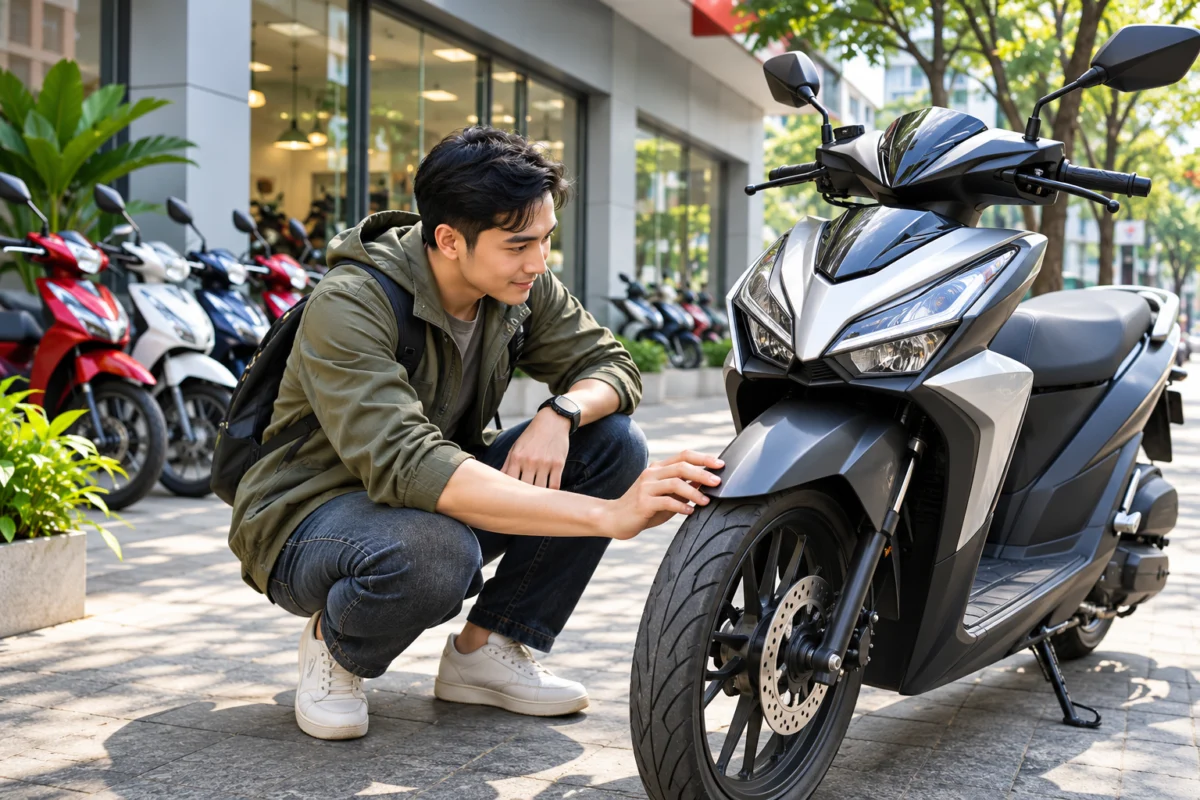
Walk a full circle with the bike on its stand. Look at both tires, at the ground under the engine for a fresh wet patch, at the mirrors, panels and seat for anything cracked or loose, and at the handlebar cables.
Controls: brakes, throttle return and stands
With the engine off, squeeze each brake lever and press the rear pedal if there is one: each should firm up well before the grip. Twist the throttle and let go; it must snap shut with the bars straight and turned both ways. Fold the stands up and nudge them.
Electrics: lights, indicators and horn
Turn the key on and run the lights-and-horn sequence in the next section. It takes under a minute.
Dashboard: fuel level and warning lights
Warning lights flash at key-on and mostly go out once the engine runs; ask the shop which should. A light that stays on, such as engine, battery or ABS, is a report item. Treat the fuel gauge as a rough guide and refuel early. On an electric scooter, check battery charge instead.
Daily lights and horn check, and why it matters in Hanoi traffic
Other riders react to what your bike shows them: the brake light says you are slowing, an indicator says you are moving across, and a short tap of the horn tells people near a blind corner or alley mouth that you are there. In Hanoi the horn is mostly an “I am here” signal, not anger. To see your own tail light, use a shop window or ask someone to watch.
Headlight high and low beam
Switch the headlight on (some scooters light it automatically at start) and flick the dimmer, usually on the left handlebar, between low and high beam. The beam should visibly change. A cracked or moisture-filled lens, or a beam that flickers when you turn the bars, goes in your report.
Brake light from both brake controls
Squeeze the front lever, then the rear control, one at a time; the brake light should come on for each. The two controls have separate switches, so one can fail alone.
Front and rear turn signals
Switch on the left signals, then the right: all four lamps should flash steadily and stop when cancelled. On many bikes a much faster blink means a bulb on that side has failed.
Horn test before moving off
Give the horn one short tap. It should sound clearly every time. A weak, rasping or on-and-off horn is a fault, even if it worked yesterday.
Tires and brakes: what a rider can check without tools
You cannot measure pad thickness or tire pressure by eye, but you can spot warning signs. Honda’s PCX150 owner’s manual lists brakes, tires, throttle, lights and horn among its routine pre-ride checks.
Tread, cuts and bulges
Look around each tire, sidewalls included, for cuts, cracks, bulges and embedded nails or stones; cord or fabric showing means do not ride. Honda’s manual says to replace a tire immediately once the tread wear indicators, small raised bars in the grooves usually marked TWI, become visible.
Spotting a soft tire
A soft tire is easy to ride away on. One that looks squashed where it meets the ground, or a front end that feels heavy at walking pace, is a warning. Ask the shop to check the pressure; the correct figure is in the owner’s manual and, on the Air Blade, on a tire and cargo label. It differs by model, so this guide gives none. A tire that needs air daily has a leak.
Lever travel and brake feel at walking pace
At rest, each lever should firm up before the grip, without a spongy feel. At walking pace on clear ground, try each brake alone: the bike should slow smoothly, with no pull to one side, shudder or grinding. A lever that reaches the grip is a stop. On a disc brake the handlebar reservoir should show fluid above the lower mark; never open it yourself.
Combined braking on automatic scooters
Many automatic scooters have a combined braking system (CBS), which Honda Vietnam’s Air Blade guide describes as sharing braking force between the front and rear wheels. On many Honda-style systems the left lever brakes the rear and part of the front, the right lever the front alone. Ask the shop which does what. The automatic scooter controls guide has more.
Mirrors, steering and stands
Setting mirrors for your height
Sit in your riding position with the bike on its wheels and set each mirror to show the lane behind you with a sliver of your own arm. Do it before you move off. A mirror that flops or has cracked glass is a report item; do not force it.
Steering lock and free movement
Turn the handlebars slowly lock to lock: movement should be smooth, with no tight spots or catching cables. Hold the front brake and rock the bike back and forth: a knock from the front end, or oil on the fork tubes, goes in your report.
Side stand and center stand springs
Flip each stand up and down. It should snap up on its spring and stay up when nudged, since a stand that drops in a turn can dig in. Some scooters also cut the engine if the side stand is down, as Honda Vietnam’s Air Blade guide describes; ask whether yours does, and never defeat it.
The longer handover inspection
The handover check is the daily check plus what you can only do once: matching the bike to the agreement, recording existing damage and learning how this bike works. Handover at HANOI MOTO is by appointment and the premises at 114 Nguyen Van Cu, Bo De Ward, are open 09:00 to 21:00, so ask for a daylight slot and allow 15 to 20 minutes. Not booked yet? See how to rent a motorbike in Hanoi and the Hanoi motorbike rental guide.
Papers that should travel with the bike
Ask which papers belong with the bike and where they will be (original, copy or digital), and check that the plate matches the agreement. What you need as the rider is in the documents checklist. If the bike differs from the one confirmed, settle suitability, papers, price and terms before accepting a substitute.
Recording existing marks with the shop
Walk around once with the shop and point at every scratch, dent, crack and worn part. Photograph each wide and close, plus the odometer and fuel gauge. Keep identity documents and bystanders out of the frame. Send the photos by Zalo or email so the record is dated, and do not accept a fault on the promise that it will not matter later. Repeat the walk-around at return.
Starting the engine and checking idle
Start the engine with the shop beside you. It should fire within seconds, idle steadily and keep running when you touch the throttle. Listen for knocking or scraping and look under the bike after a minute for drips. White vapor on a cool morning is normal; steady blue or black smoke is not. On a semi-automatic Honda Wave, also check the chain for rust or sag and that you can find neutral.
Questions to ask before you leave
- Which fuel does it take, and at what level does it come back?
- Where is the correct tire pressure listed?
- Who do I message if something fails? Do not assume a phone number means free recovery; the next step is agreed.
- Where, when and how is the bike checked at return?
50cc scooter condition checklist for a handover
HANOI MOTO’s fleet includes 50cc automatic scooters (see the 50cc scooter rental page). Do the full handover inspection, then add these four checks.
Confirming it is really a 50cc moped
Under Law 36/2024/QH15 (Articles 34, 56 and 59), a moped has a design speed up to 50 km/h and a combustion engine up to 50 cc, or an electric motor up to 4 kW; its rider must be 16 or older and needs no license, and it is registered with a plate. Anything bigger is a motorcycle needing a valid license and a rider aged 18 or over. Ask the shop to confirm in writing that the bike is a 50cc moped. The 50cc classification guide has the full rules.
Speed and power expectations
A 50cc moped is designed for speeds up to 50 km/h: fine for short, quiet trips, with little reserve on hills or with a passenger. Pull away and brake once in a clear space; slow is expected, hesitation or smoke is a fault.
Passenger and load suitability
Ask how much load the bike is meant to carry; the label on the bike states the limit. Two adults and luggage on a small engine accelerate and brake noticeably worse, so decide before you leave.
Lights and brakes on smaller scooters
A small scooter needs the same working lights, horn and brakes as a large one, and some have smaller wheels that drop harder into potholes, so check tires and rims closely.
Stop, ride or report: a decision table
Sort what you find into stop (do not ride until the shop fixes or swaps the bike), report (tell the shop now; ride only if they agree) or record (note it and carry on).
| What you notice | Outcome | What to do |
|---|---|---|
| Brake goes soft, reaches the grip or does nothing | Stop | Do not ride; film the lever for the shop |
| Tire flat, soft, cut, bulging or showing cords | Stop | Do not ride; ask for a check or another bike |
| No headlight, or no brake light from either control | Stop | Do not ride until fixed or swapped |
| Throttle sticks, steering binds or feels loose, or a stand does not stay up | Stop | Do not ride; describe the problem |
| Fuel, oil or brake fluid dripping | Stop | Do not ride; photograph the drip |
| Horn dead or a turn signal out | Report | Ask for a fix or swap before riding in traffic |
| Warning light stays on, rough idle or a new noise | Report | Ask if it is safe to ride; wait for the answer |
| Mirror loose or cracked | Report | Ask for a fix; do not force it |
| New scratch, dent or crack | Record | Photograph it and message it the same day |
The stop rows share one thread: anything that affects stopping, steering, grip or being seen. A paid rental day is no reason to ride on one. For a report, the shop decides what happens next.
How to report a fault to HANOI MOTO
Report early and factually, before you ride on; a calm message is the best way to avoid a dispute at return.
- Stop somewhere safe before you look at the problem or use your phone.
- Photograph or film the fault. Do not attempt a roadside repair or accept work without agreeing it first.
- Message HANOI MOTO on Zalo (+84 857 255 868), by email (motoopen12@gmail.com) or through the contact page: say what you see, where the bike is and whether it is safe to move.
- Agree the next step and any cost in writing, and keep the receipts.
Extra checks after rain, a night outdoors or a long ride
After heavy rain
Wet brakes work less well; Honda’s manual advises applying them lightly at low speed to dry them. Do not start a bike that has stood in floodwater up to the engine or exhaust; message the shop instead.
After parking outdoors overnight
Look for a knock or tip-over: scuffs, turned mirrors, a bent lever. Check the tires, since a slow leak shows overnight, then run the lights-and-horn sequence. Report new damage straight away.
After a day trip
Check the tires for nails and stones, the mirrors for loosening and the ground for new drips. Whether you may leave the city is agreed with the shop in advance.
Printable pre-ride checklist
Daily version
- Walk around: tires, leaks, loose parts
- Brakes firm, throttle snaps shut, stands stay up
- Headlight low and high, brake light from both controls, four signals, horn
- Mirrors set, steering moves freely
- Fuel level checked, no warning lights on
- Report anything new before you ride
Handover version
- Plate, make and model match the agreement and papers
- Every existing mark photographed; odometer, fuel and equipment noted
- Full daily check done in front of the shop
- Engine started: steady idle, no drips, noises or heavy smoke
- Each brake tested alone at walking pace
- Tire pressure figure, fuel type, return time and fault contact agreed
- 50cc only: written confirmation that it is a 50cc moped
Found something that does not work at handover or during your rental? Message HANOI MOTO on Zalo at +84 857 255 868, by email to motoopen12@gmail.com or through the contact page before riding, so the next step can be agreed.
Frequently asked questions
How long does a pre-ride check take on a rental scooter?
About two minutes once it is a habit; the handover inspection takes 15 to 20 minutes with the shop. If the daily check keeps taking much longer, something probably needs attention.
Should I ride if the horn or a turn signal does not work?
No, not into city traffic. Signals and the horn are how riders around you know what you are about to do. Report it and agree a fix or swap first; a slow ride to a workshop is an option only if the shop agrees.
Can I adjust or repair a rental scooter myself?
Mirrors and your riding position are yours to set. Anything mechanical, such as brakes, tires, bulbs or the horn, is for the shop to do or approve. HANOI MOTO handles repairs by agreement, so ask before spending money.
Who do I contact if I find a fault during the rental?
Message HANOI MOTO on Zalo (+84 857 255 868), by email (motoopen12@gmail.com) or through the contact page, with a photo or video and your location. The next step is agreed case by case; no response time, repair or replacement is promised.
Sources and last checked
- Honda Motor Co., PCX150 Owner’s Manual (2019), Pre-ride Inspection, accessed November 2026
- Honda Vietnam, Air Blade owner’s guide (Vietnamese), accessed November 2026
- Office of the National Assembly, Official Gazette, Consolidated text 55/VBHN-VPQH of Law 36/2024/QH15 on Road Traffic Order and Safety, accessed November 2026
- LawNet (Thuvienphapluat), Decree 67/2023/ND-CP on compulsory civil liability insurance, accessed November 2026
- Vietnam Government e-Gazette, Decree 220/2026/ND-CP amending Decree 67/2023/ND-CP, accessed November 2026
- HANOI MOTO owner-confirmed business details (address, hours, contact, fleet), recorded 31 October and 1 November 2026
Part of the guide: Hanoi Riding Preparation and Day-Trip Planning
Conversation