
Carrying Bags, Phones and Rain Gear on a Rental Scooter
The short answer on how to carry bags on a scooter in Hanoi: keep the weight low and near the middle of the bike, keep your hands and feet free, and keep anything loose or flapping away from the wheels, the controls and the number plate. Carry heavy or fragile items only if they fit securely within an approved compartment or carrier and the bike’s load limit; never leave heavy luggage loose on the foot deck, a light day bag goes on your back, shopping goes on the hook only if it is light, and the phone goes in a mount you have tested, never in your hand. Racks, top boxes, phone mounts and rain covers from HANOI MOTO are by agreement, so ask what the bike you are offered actually has before you plan around it.
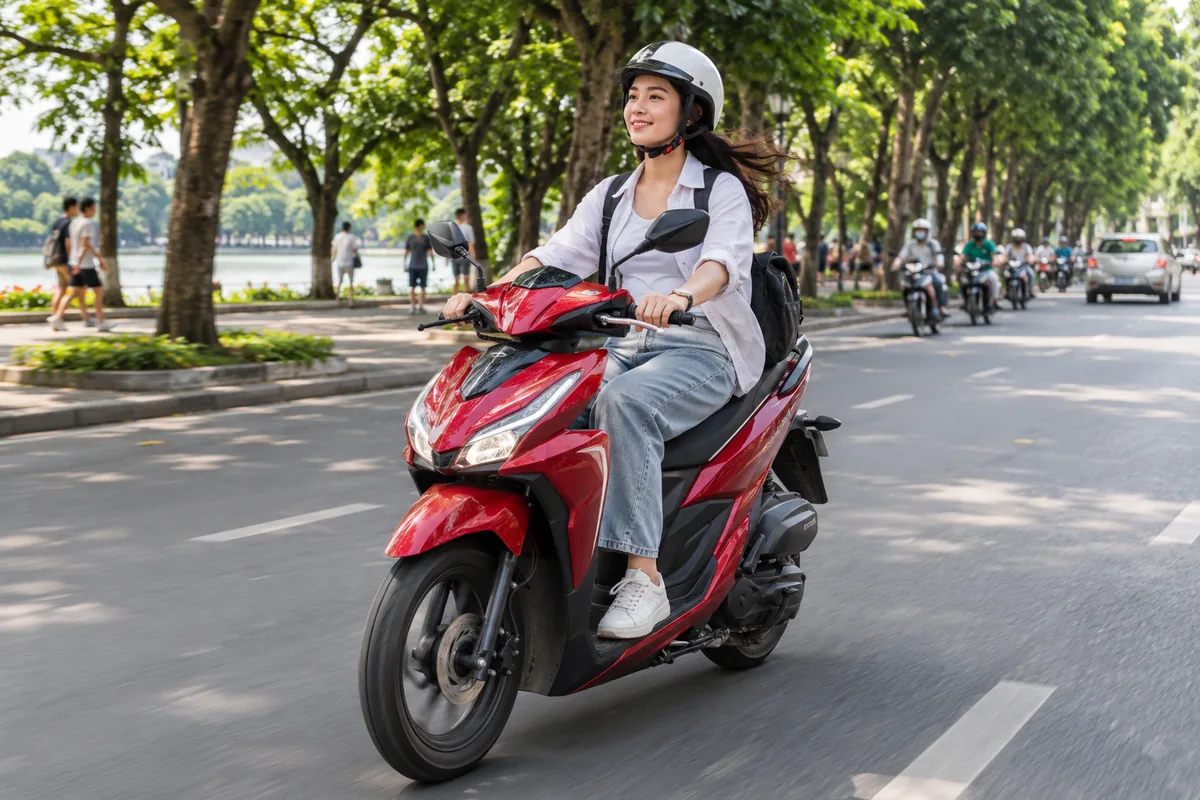
This guide covers everyday carrying on the bike. Airport suitcases and hotel storage are in scooter rentals and luggage in Hanoi, navigation technique is in navigating Hanoi on a scooter, and wet-weather riding is in riding a scooter in Hanoi rain.
Where things go on a scooter: a quick map
Under the seat, floor deck, hooks, rack, handlebar, your back
Each place you can put something does one job well and fails in one typical way. The rest of the guide fills in this map.
| Zone | Good for | Watch out for |
|---|---|---|
| Under the seat | Helmet (if it fits), rain gear, a small bag | Heat, water, a seat that will not latch, theft when parked |
| Front compartment (some models) | Small items you want quickly | Small size; the lid may not lock |
| Floor deck (flat-floor automatics) | One light, stable bag between your feet | Bag tipping into your feet or the steering |
| Front hook | Light shopping, short ride | Swing and weight on the steering |
| Rear rack or top box (by agreement) | A larger soft bag or lockable box | Rated load, a hidden plate or tail light, higher center of gravity |
| Handlebar mount | A phone you glance at for a route | Blocked controls, theft at stops, hand-held use |
| Your back | A light day pack | Weight on shoulders, a bag that shifts or soaks through |
What should never be carried loose
- Straps, cord ends and bag handles that can drop toward the wheels, the exhaust or the brake levers.
- Plastic bags hung from the grips or levers, which pull the steering and flap into the front wheel.
- An umbrella held in one hand, or a helmet dangling from the mirror instead of on your head.
- Anything that hides the number plate, tail light, brake light or indicators.
Underseat storage: checking helmet and bag fit
Under-seat space (cốp xe in Vietnamese) differs a lot between models, and maker figures describe the current model, not necessarily the bike you are handed. Honda Vietnam’s Air Blade 125/160 page lists a 23.2-liter compartment that Honda says holds up to two half-head helmets plus personal items. Its Vision page says the under-seat compartment fits a helmet and belongings but gives no volume. HANOI MOTO’s fleet also includes semi-automatic Honda Wave/RSX bikes, Honda Click or Yamaha Mio automatics, 50cc scooters and electric options; this guide states no storage volume for those, and you should not assume a semi-automatic has a luggage compartment. The motorbikes page shows the fleet; ask HANOI MOTO what your specific bike has.
Test with your own helmet at handover
Honda’s wording refers to half-head helmets, so do not assume a full-face helmet fits. Test the helmet you will actually wear (for fit on your head, see checking a rental helmet in Vietnam).
- Open the seat the way you will on the road, with the key, button or smart-key control the bike has.
- Put the helmet in and close the seat without pressing hard. If it only closes with force, it does not fit.
- Check the latch: press the seat down, then try to lift it by the rear edge.
- Add your usual extras, such as a rain jacket, and repeat. Look for dampness or grit and ask for it to be dealt with.
Items that should not go under the seat
The compartment is an enclosed box that can get hot, and a seat lock is a deterrent, not a safe. Keep out spare fuel, lighters, aerosols and anything flammable; heat-sensitive items such as medication and power banks; your passport, wallet and phone whenever the bike is parked; and the key or fob, since closing the seat on it risks a lockout. A seat that bulges or will not latch can shift under you.
Locking the seat before you walk away
Practice locking the seat at handover, then lift it to confirm it is shut. Assume the compartment is not fully waterproof, so keep electronics in a sealed pouch.
Luggage racks and top boxes: fit and weight checks
Many rental scooters have no rear rack. Treat any rack or top box as an accessory with its own limits, not free extra capacity.
Ask whether a rack or top box can be fitted (by agreement)
HANOI MOTO has not published a rack or top box offer. Whether one can be fitted to your bike, and on what terms, is by agreement, so ask before your handover date and keep the answer in your messages. Ask what the bike already has, whether an added rack is bolted or clamped, who fits it, whether it is removed at return, its rated load, and who is responsible if it is damaged. Do not bolt on, drill or glue your own accessory to a rental bike without agreement.
Rated load: find it, do not guess
There are two rated loads: the bike’s maximum, covering rider, passenger and cargo together, and the limit of the rack or box itself. This guide states neither for the fleet, because it needs maker data for the exact bike. Honda Vietnam’s Air Blade and Vision pages link a downloadable owner’s manual. If nobody can give you a figure, carry less.
Keep the number plate and lights visible
Decree 168/2024/ND-CP, Article 14(3)(b), as reworded by Decree 238/2026/ND-CP from 15 August 2026, fines a number plate that is hard to read at 4 to 6 million VND, plus 6 points off the licence (Article 14(8)(b)). The band already existed in Decree 168; Decree 238 reworded the point. The Decree 168 fines guide on this site lists it with the other rider fines. The decree does not name bags, covers or ponchos, so whether a load hiding the plate counts as “covered” is up to the officer, but obscured plates are among the cases it covers, so treat it as a real risk. After loading, ask someone to stand behind the bike and confirm they can read the plate and see the tail light, brake light and both indicators.
Loose luggage: secure it before moving
A load should stay put, stay clear of the wheels and leave your hands and feet free. A bag that shifts is a bag you will reach for.
Bungee cords and nets: hooks, tension and loose ends
- Put the heaviest item at the bottom, against the backrest or rack frame.
- Hook onto solid points such as rack rails, not plastic panels, mirror stalks, the exhaust or cables.
- Cross two cords or use a net so the load cannot slide. Keep your face clear when stretching a cord, because a slipped hook snaps back.
- Do a tug test with both hands; the bag should not shift or rotate.
- Tuck every loose end and hook tip away from the rear wheel and the exhaust, which can melt cord, and re-check at every stop.
Backpacks and shoulder bags while riding
Keep any day backpack light and securely fitted so it cannot obstruct your movement. Put items under the seat only if the compartment and total vehicle load ratings permit it; never assume that heavy cargo is safe there. Avoid single-strap shoulder bags, which slide and swing.
Floor-deck bags and your feet
On a flat-floor scooter, carry only a securely restrained light bag behind the leg shield if the model and shop allow it, never one that touches the front wheel or blocks the steering. Check that your feet can still move and that the bag will not tip when you brake. A semi-automatic has no flat floor, and its gear shifter and rear brake pedal sit where a bag would go.
Shopping bags on the hook: weight and swing
Use a front hook only if the manufacturer permits it for your specific scooter and the hook’s rated load is respected. Tie the handles together, keep liquids sealed and upright, and check that the steering feels the same. If it feels different, or the bag touches your knee, move the load under the seat.
Phone holders: fit, security and distraction
A phone mount must be secure and clear of the controls, and the law is about what you do with your hand. Whether HANOI MOTO can supply or fit a phone holder is by agreement.
Mount position clear of controls and mirrors
- Clamp it where it does not touch the brake lever, throttle grip, switches or horn.
- With the engine off, turn the bars lock to lock to confirm the phone clears the headlight, the body panels and the mirrors.
- Check that it hides neither the speedometer and warning lights nor your view in a mirror.
- Do a tug test, then try it on a quiet street. If the mount is your own, ask before attaching it, avoid adhesive on paint, and remove it cleanly at return.
Cables, vibration and theft at stops
A charging cable near the handlebar can snag on the controls; do not ride with a loose cable across the steering, and use only a secure setup approved for the bike. Honda Vietnam’s Vision page mentions a lidded front compartment with a USB-C port; other models may differ, so ask. Some phone makers warn about engine vibration, so check your maker’s guidance. At every stop, take the phone off the mount, since a parked bike with a phone on the handlebars is an easy target.
The hand-held phone fine
Under Decree 168/2024/ND-CP, Article 7, using a hand-held phone while riding a motorbike or moped is fined 800,000 to 1,000,000 VND plus 4 license points. Decree 238/2026/ND-CP did not change the phone-use penalty amounts discussed here, so the amounts are unchanged. This guide could not confirm how officers treat a phone fixed in a mount, so do not rely on a mount as a defense. Set your route before you start the engine. If you must check it, pull over where you do not obstruct traffic, since stopping or parking that obstructs traffic is itself fined 400,000 to 600,000 VND.
Rain protection for luggage without loose straps
Luggage rain gear fails when it leaks or when its loose parts blow into the wheels, controls or plate. Aim for sealed bags inside the bag rather than flapping covers outside it. This guide gives no rainy-season months, so check a current forecast.
Dry bags and liners
A roll-top dry bag, or a heavy plastic liner inside your backpack, keeps contents dry without an outer cover. Roll the top down several times and clip it, and keep a used poncho in its own bag.
Rain covers and trailing straps
Pull a backpack rain cover’s cord tight and tuck the ends; if the cover flaps against your helmet or mirror, it is too loose. A plastic sheet draped over a rack load will flutter, can cover the plate and tail light, and can wrap around the rear wheel, so put the dry bag under the net instead. Knot or cut any trailing strap.
Electronics and documents
Use a waterproof pouch for the passport, cash and any phone that is not mounted, and carry it on your body, not in a wet compartment. A waterproof pouch does not make holding a phone while riding legal. Photos of your documents are a backup, not a substitute for the originals.
Carrying rainwear without obstructing the controls
Where to keep a poncho so it is reachable
With an under-seat compartment, keep the poncho in a small pouch on top, where you can reach it without unloading. A front compartment, where the bike has one, can hold it too; otherwise use the outer pocket of a day pack. Do not hang it from the handlebar or mirror, where it can unfold onto the controls.
Putting it on safely off the road
Put rainwear on before the rain is heavy, and at a stop, never while moving. Choose a place off the carriageway where you are not obstructing traffic or pedestrians, and get the hood clear of your helmet and your view.
Poncho hems near wheels and brake levers
A long poncho can billow. Before moving, check that the hem stays clear of both wheels and the exhaust, that you can squeeze both brake levers fully with the sleeves or thumb loops in place, that the speedometer and indicators are visible, and that the rear of the poncho, or a passenger’s, does not cover the plate or tail light. A two-piece rain suit has no loose hem to catch, so it avoids most of these problems.
Day-trip and two-up loads
Passenger plus bags: rated load again
A passenger uses part of the maximum load you would otherwise spend on bags. Never squeeze a bag between rider and passenger. The passenger needs a helmet too: the fine is 400,000 to 600,000 VND under Decree 168/2024/ND-CP, Article 12(5)(b).
Balancing weight front and back
Keep heavy items low and near the middle, light items higher or farther back. Too much weight behind the seat makes the front feel light, and a load on one side makes the bike lean. Before setting off, check the manufacturer’s load limits and ensure steering, braking, lights and balance are unobstructed. If the load is uncertain or unstable, reduce it or arrange separate transport.
Questions to ask at handover
Raise storage questions when you book, not at the door. HANOI MOTO’s pickup premises are at 114 Nguyen Van Cu, Bo De Ward, Hanoi, open 09:00 to 21:00 daily, and handover is by appointment; the how to rent page covers the full sequence. Racks, top boxes, phone mounts, rain covers and cargo nets are all by agreement, so nothing here implies the shop has them.
| Ask or check | Why it matters |
|---|---|
| Does my helmet fit under the seat, and does the seat latch? | An unlatched seat is a hazard |
| Is there a hook, rack or front compartment, in what condition? | Shows where light and heavy items can go |
| Can a rack, top box or phone mount be arranged (by agreement)? | No accessory offer is published, so confirm first |
| What is the maximum load for this bike and any rack? | Rider, passenger and cargo all count |
| Is the number plate straight, clean and visible from behind? | Luggage should not add to a plate problem |
If you need to carry more than a day bag, ask HANOI MOTO through the contact page, on Zalo at +84 857 255 868 or by email to motoopen12@gmail.com what storage the bike on offer has and whether a rack, top box or phone holder can be arranged. The Hanoi motorbike rental guide links to the other rental and riding topics.
Frequently asked questions
Can I hang shopping bags from the handlebars?
It is better not to. Bags on the grips or brake levers pull the steering and can catch a lever. Use the front hook for a light bag with the handles tied, or put shopping under the seat.
Is a handlebar phone mount legal in Vietnam?
The fine under Decree 168/2024/ND-CP, Article 7, targets using a hand-held phone while riding. This guide did not find a rule that approves or bans a mount, and could not confirm how officers treat one, so set the route first and keep the phone out of your hand.
Can a top box be added to a rental scooter?
That is by agreement with HANOI MOTO, since no top box offer is published. Ask before your dates, and ask about its rated load, who fits it and whether it hides the plate or tail light.
Can a bag over the number plate get me fined?
A plate made hard to read is fined 4 to 6 million VND plus 6 points (Decree 168, Article 14(3)(b), as reworded by Decree 238/2026/ND-CP). The decree does not name bags, so whether one counts as “covered” is up to the officer; do not risk it: keep luggage, covers and ponchos off the plate and lights.
Where should I keep my passport and documents while riding?
Keep the documents you must carry in a zipped pocket or waterproof pouch on your body, reachable at a stop, and not under the seat or in a top box when you park. Which documents HANOI MOTO keeps or copies, if any, is by agreement, so ask and get a record.
Sources and last checked
- Honda Vietnam, Air Blade 125/160 product page, accessed November 2026
- Honda Vietnam, Vision product page, accessed November 2026
- LawNet, Decree 168/2024/ND-CP on penalties for road traffic violations, accessed November 2026
- LawNet (thuvienphapluat.vn), Decree 238/2026/ND-CP amending Decree 168/2024/ND-CP, accessed November 2026
Part of the guide: Rental Motorbike Models and Comparisons
Conversation