
Passenger Rules on Motorbikes in Vietnam (Including Children)
Vietnam’s motorbike passenger rules allow a rider to carry one passenger. A second passenger is lawful only in four listed cases: an emergency patient, a child under 12, an elderly or disabled person, or a person under escort. Two passengers outside those cases cost 400,000–600,000 VND, and three or more are never allowed (600,000–800,000 VND plus 2 license points). Helmet obligations and penalties are separate. Article 7(2)(i) of Decree 168/2024 exempts a rider from the specific offence of carrying an unhelmeted passenger in limited cases, including a child under 6; that is not a blanket exemption from every passenger provision. In ordinary cases, riders and passengers need correctly fastened helmets, and the applicable penalties depend on the circumstances.
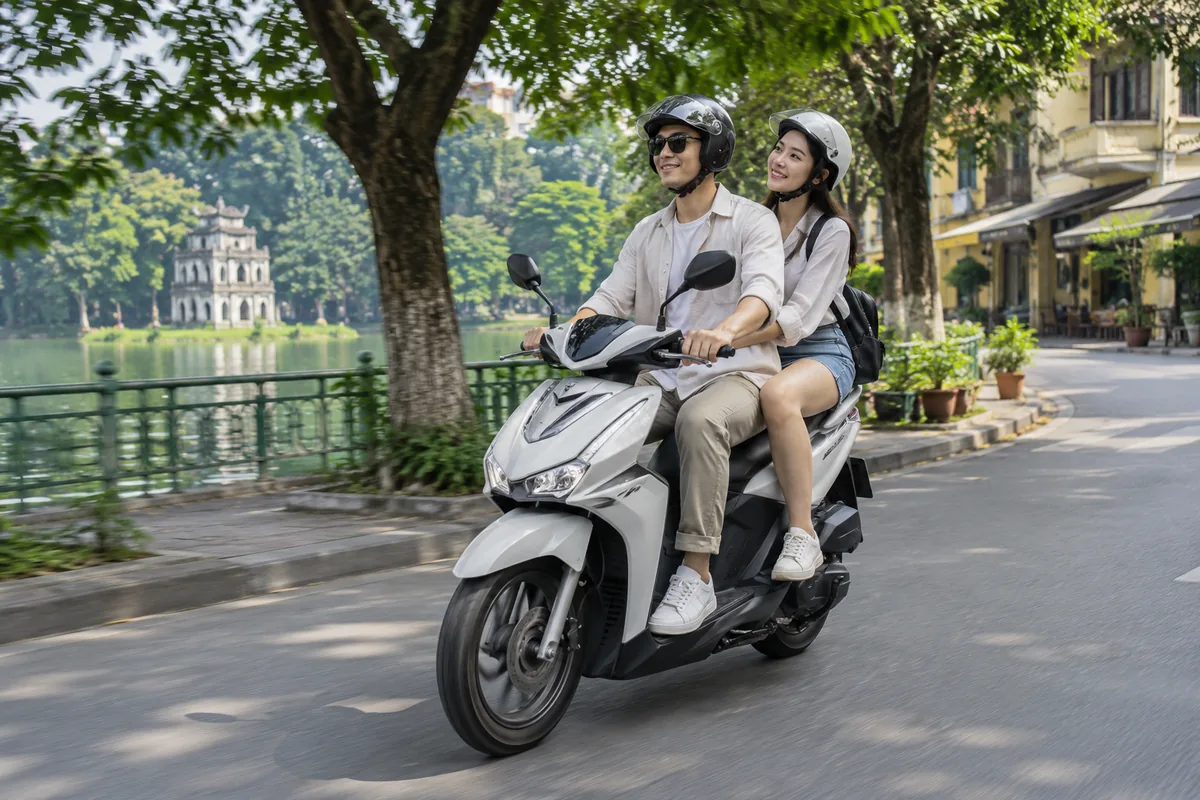
The rules were checked in November 2026. Anything a rental shop arranges, such as helmets or who may ride, is a matter of agreement.
The rule: one passenger, with listed exceptions
The baseline is Article 33(1) of Law 36/2024/QH15 on Road Traffic Order and Safety: the rider of a two-wheeled motorcycle or moped (xe gắn máy) may carry only one person, except in listed cases where up to two may be carried. The rider is not counted, and the rule covers 50 cc mopeds and larger motorcycles alike.
When a second passenger is allowed
Four cases allow a second passenger; Decree 168/2024/ND-CP repeats the list when it sets the fine:
- A sick person being taken for emergency care
- A child under 12
- An elderly or disabled person (the Vietnamese, người già yếu, means old and frail and sets no age)
- A person being escorted for breaking the law
The exceptions are written as cases, not as a head count. Read naturally, a rider carrying an adult friend and a child under 12 is within the exception: a listed case is present and the total stays at two passengers. Two adults with no listed case are not. The text does not spell out every combination, so treat these as readings, not as a statement from the traffic police.
Three or more: never
Count passengers, not heads. A rider plus two passengers (three people) is lawful only when a listed case is present. A rider plus three passengers (four people) is never lawful: the law caps passengers at two even where an exception applies, and the decree lists no exception for three or more. A family of four cannot lawfully share one scooter, whatever the children’s ages.
Fines for extra passengers
The fines are in Article 7 of Decree 168/2024/ND-CP, which penalizes motorbike and moped riders. Decree 238/2026/ND-CP amended parts of Decree 168 from 15 August 2026 but not Article 7, so these amounts are current. The rider is the one fined.
| Offense | Fine | License points | Decree 168/2024/ND-CP |
|---|---|---|---|
| Two passengers, no listed case | 400,000–600,000 VND | None listed | Article 7(2)(g) |
| Three or more passengers | 600,000–800,000 VND | 2 points | Article 7(3)(b), points in 7(13) |
Two passengers outside the exceptions: 400,000–600,000 VND
Two friends on the back of one scooter, neither a listed case, is a common mistake. Article 7(2)(g) sets the fine, and the points clause, Article 7(13), does not name it, so no license points are listed.
Three or more: 600,000–800,000 VND plus 2 points
Article 7(3)(b) sets the fine and Article 7(13) adds 2 points on the rider’s license. The sources checked do not explain how a points deduction is recorded against a foreign license or an International Driving Permit. The Decree 168 fines guide lists the other motorbike fines.
Helmets for passengers
Helmet rules bind passengers as well as riders and can produce two fines for one missing helmet. The Vietnam helmet law guide covers the national standard, fastening and exemptions in depth.
The rider is fined for an unhelmeted passenger
Under Article 7(2)(i), a rider who carries a person not wearing a motorcycle helmet faces 400,000–600,000 VND, separate from the rider’s own helmet fine in Article 7(2)(h). A rider who wears a helmet can still be fined because the passenger does not.
The passenger can be fined separately
Article 12(5)(b) of the same decree provides a fine of 400,000–600,000 VND for the passenger. One missing helmet can therefore lead to two fines. The sources checked do not say whether officers issue both at a single stop, only that the text provides for both.
Exemptions, including children under 6
The rider’s fine in Article 7(2)(i) does not apply when the unhelmeted person is a sick person being taken for emergency care, a child under 6 or a person being escorted for breaking the law. Article 12(5)(b) does not repeat that list, and the sources checked do not say how officers read the two together for a very young child.
Riding with children: scenarios by age
Two age lines matter: at 6 the helmet exemption ends, and at 12 the second-passenger exception ends. They are separate rules, so a 7-year-old needs a helmet but still counts as a child under 12. Neither rule sets a minimum passenger age, but a child must be able to sit upright and hold on without help.
| Child’s age | Helmet | Second-passenger exception |
|---|---|---|
| Under 6 | Rider not fined without one | Yes, as a child under 12 |
| 6 to 11 | Required and fastened | Yes, as a child under 12 |
| 12 and over | Required and fastened | No |
Common combinations, read against the text:
- Rider and two children under 12: two passengers, both listed cases, so lawful. Each child from age 6 needs a helmet.
- Rider, one adult and one child under 12: two passengers with a listed case present, lawful on the natural reading.
- Rider and two adults, or one adult and a child of 12 or older: two passengers with no listed case, so the 400,000–600,000 VND fine applies.
- Rider and three passengers: never lawful, even if all three are children.
Under 6: exempt from the helmet rule, safety still matters
For a child under 6 the rider is not fined without a helmet, but that is a rule about fines, not about heads. Child-size helmets exist, and an adult helmet that slides on a small head protects little, so arrange a correctly sized one before the trip.
Ages 6 to 11: helmet required, within the second-passenger exception
From the sixth birthday a child needs a fastened helmet, and a 7-year-old without one exposes the rider to the Article 7(2)(i) fine. The same child still counts as under 12 for the second-passenger exception. Whether a rental shop can supply a child size is a matter of agreement.
12 and over: a regular passenger
From the twelfth birthday a child is an ordinary passenger who does not trigger the exception. Two 13-year-olds behind a rider are two passengers with no listed case, which is the fine. An 11-year-old and a 13-year-old are different: the younger child is a listed case, so on the natural reading two passengers are allowed.
Bike choice and load with a passenger
The passenger rule is the same for every bike, but the bike changes how two-up riding feels. The motorbikes page shows what HANOI MOTO offers; availability is confirmed directly.
50 cc or 110–125 cc with a passenger
The one-passenger rule applies to mopeds and motorcycles alike, so a 50 cc scooter may carry a passenger on the same terms as a larger bike. The difference is physical: a 50 cc engine is the smallest of the common rental classes, and two adults plus bags will feel slow on acceleration or on a ramp or flyover. A 110–125 cc automatic has more reserve but is heavier at low speed, and a semi-automatic adds gear changes to a new rider’s workload. The 50cc vs 110cc comparison covers power, passengers and hills.
Footrests, seat space and luggage
Two-up riding depends on things the law does not measure. Before leaving the shop, have your passenger sit on the bike and check that both feet reach the footrests and that there is a secure place to hold. Bags on the handlebars or at the rider’s feet reduce control. Ask the shop, or check the owner’s manual, for the maximum load, which must cover rider, passenger and luggage.
Insurance for passengers
Do not assume a passenger is covered because the bike is registered and rented. Compulsory motorbike insurance and travel insurance are different things; the guide to compulsory versus travel insurance explains who pays for what. Ask the shop what insurance applies to the bike under the rental agreement; this guide assumes none.
Questions for the passenger’s insurer
Put these to the insurer before the trip, in writing if possible:
- Does the policy cover me as a passenger on a rented motorbike or scooter, and are there engine-size limits?
- Does cover depend on the rider holding a valid license for that vehicle class, and does an International Driving Permit count?
- Is a helmet a condition of cover even where the law exempts the passenger, and is a claim refused if local law was broken, such as by an extra passenger?
- Are children covered as passengers, and do they need a separate plan or an add-on?
The rider’s license and claims
World Nomads’ help page on riding a motorbike or scooter (a summary, last updated February 2024) shows how a passenger’s cover can hinge on the rider. It says a passenger is covered only if the rider holds the appropriate valid license for the vehicle, lists riding unlicensed, breaking local laws and not wearing a helmet among exclusions, and excludes theft of or damage to the bike. Other insurers’ wording was not checked, and policy wording governs over any help page. Since a passenger’s claim can depend on the rider’s paperwork, the rider’s license and permit should be in order first.
Passengers on a rental: what to agree
The law sets the limits above; the rest is an agreement between you and the shop. HANOI MOTO’s terms for a rental are by agreement, so raise passengers before you book, not at handover. For the general process, see the how to rent page.
Helmets for each passenger, including children
Count helmets before you count bikes: one for every person who needs one, including every child aged 6 or older. Whether HANOI MOTO can supply extra helmets or a child size is by agreement, so ask in writing rather than assume.
Telling the shop how many people will ride
Say how many people will ride and how old the children are, so that helmet sizes and the right model can be discussed. Say who will ride too: rental agreements usually name the people allowed to ride, and swapping seats with an unnamed passenger can cause problems under the agreement and with insurance. The scooter rental agreement guide explains the usual clauses on riders. A message can be as short as this:
Hello, I would like to ask about a scooter from [date] to [date]. One adult will ride, with one passenger, a child aged 7. Which model would you suggest, and are helmets in adult and child sizes available?
Riding as a family or a pair? Tell HANOI MOTO through the contact page, on Zalo at +84 857 255 868 or by email to motoopen12@gmail.com how many people will ride and how old they are, so that helmets and a suitable model can be discussed before you decide.
Frequently asked questions
Can I carry an adult and a child on one scooter in Vietnam?
If you ride and the child is your only passenger, the basic rule applies. If a second adult rides along, the law allows two passengers when a listed case is present, and a child under 12 is one; that is the natural reading, since the text does not spell out this exact combination. With a child of 12 or older there is no listed case and the two-passenger fine applies.
Does a 5-year-old need a helmet on a motorbike?
Not to avoid the rider’s fine: Article 7(2)(i) exempts a rider carrying a child under 6 without a helmet. The passenger’s own fine in Article 12(5)(b) does not repeat that exemption, and the sources checked do not say how the two fit together. A properly sized helmet is still the safer choice.
Who is fined if my passenger will not wear a helmet?
Potentially both of you. The rider can be fined 400,000–600,000 VND under Article 7(2)(i) and the passenger the same range under Article 12(5)(b). The sources checked do not say how officers handle the two at a stop. The simplest fix is to settle helmets before you set off.
Is carrying two adult passengers ever allowed?
Only when a listed case applies: an emergency patient, an elderly or disabled person or a person under escort. Two ordinary adults are not allowed, and the rider faces 400,000–600,000 VND. Three passengers are never lawful.
Does a passenger need a license?
No. License rules apply to the person who rides, and a passenger does not operate the bike. What matters is who rides: a passenger with a license should not take over unless the rental agreement allows an additional rider.
Sources and last checked
- LuatVietnam (English), Decree 168/2024/ND-CP penalties for violations related to road traffic order and safety (Article 7), accessed November 2026
- Thu Vien Phap Luat, Decree 238/2026/ND-CP amending Decree 168/2024/ND-CP (Vietnamese text), accessed November 2026
- Nghe An Provincial Public Administration Service Center, republishing Chinhphu.vn, From 1 January 2025: when may a motorbike rider carry up to two people? (Vietnamese article, title translated; quotes Law 36/2024/QH15, Article 33(1)), accessed November 2026
- World Nomads, Am I covered by travel insurance if I’m riding a motorbike or scooter? (help page, last updated 15 February 2024), accessed November 2026
Part of the guide: Rental Documents, Licenses and Insurance Questions
Conversation