
Automatic Scooter Controls, Smart Keys and Fit: Check Before You Ride
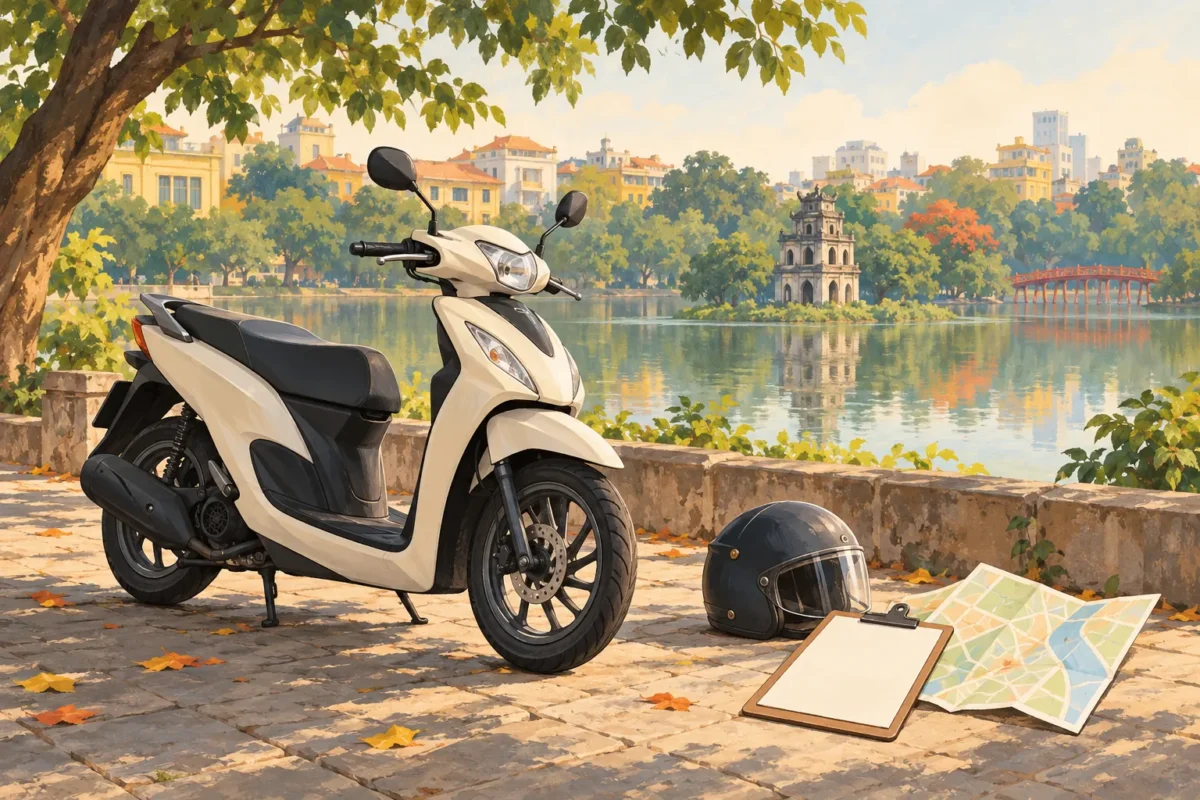
Featured image: original AI-generated editorial illustration, not a photograph of HANOI MOTO premises or inventory.

Before you ride a rental automatic scooter away, you should be able to turn the key or smart key knob, start the engine, work both brakes, use the stands, switch the signals on and off, open the seat and fuel lid, and sit on the bike with your feet down. Do these at the handover, in that order, with the shop beside you in a quiet spot. Models differ, so every feature below is an “if your bike has it” item, and the shop’s answers about the exact bike matter most.
Not sure how the rental scooter’s controls work? Ask HANOI MOTO on WhatsApp to confirm the available model and request a key, brake and starting-control demonstration at handover. Every model may differ, so check the actual vehicle and your eligibility before riding.
The ride-away routine at a glance
Order of checks: key, start, brakes, stand, signals, storage, fit
The order follows a normal trip: unlock, start, roll, stop, park, carry, sit. It suits the automatic scooters in the HANOI MOTO fleet and any other automatic.
| Step | Do this | Look for or ask |
|---|---|---|
| 1. Key | Turn the key or knob through every position | Which position starts the bike, locks the steering and opens the seat |
| 2. Start | Start with the throttle closed and the stand up | Whether a brake lever must be held; whether idle-stop is fitted |
| 3. Brakes | Squeeze each lever at rest, then at walking pace | Which lever is which; combined braking or ABS |
| 4. Stand | Raise and lower the side stand; center stand if fitted | Any engine cut-off; how heavy the bike feels |
| 5. Signals | Signals, horn, low and high beam | Front and rear lights; how to cancel a signal |
| 6. Storage | Open the seat and the fuel lid | Where each release is; whether your helmet fits |
| 7. Fit | Feet down, reach the levers, turn the bars to full lock | Any strain means asking for another bike |
What to test yourself and what to ask the shop
You can test the controls yourself. Only the shop can say whether the bike has a smart key, a spare key, idle-stop, combined braking or ABS, which fuel it takes, which documents stay with it and whom to call if something fails. Ask before you sign.
Keys: mechanical key or smart key?
Treat the key type as a rental question, not only a feature. A mechanical key can be duplicated from a spare, while a smart key fob is a paired electronic part. Which key a particular Vision, Air Blade, Click, Mio or 50cc automatic uses is something to ask about the exact bike you are offered.
Mechanical key positions and the seat release
A mechanical ignition has positions for ON, OFF, steering LOCK and, on many models, a separate one that opens the seat and fuel lid. Honda’s 2015 PCX150 manual describes that layout and lets the key out only in OFF or LOCK. Do not turn the key while riding, as Honda’s Navi manual says, and do not leave it on ON with the engine off, which drains the battery.
Smart key: knob positions and keeping the fob on you
A smart key swaps the key slot for a knob that works only with the fob nearby. Honda’s PCX150 manual gives a working range of about 2 m (6.6 ft), and Honda Vietnam’s Air Blade guide says the fob can start the engine and unlock the seat, steering and fuel lid. Both say to keep the fob on you. The Air Blade guide adds that it should not be left in the storage box and warns that with the knob at ON, anyone can ride off without it. Some fobs have an ON/OFF button, and in the PCX manuals a red LED means the system is inactive.
Weak fob battery: ask how the bike starts
Honda’s PCX125 manual lists a depleted fob battery among the situations in which the smart key may not work properly. No emergency start method could be confirmed for the Vision, Air Blade, Click or Mio versions, so do not assume one exists. Ask how this exact bike starts if the fob stops responding, whether a spare fob exists and who replaces the battery.
Spare key and loss questions to settle at handover
Honda’s 2015 PCX150 manual tells owners to record the key number and keep a spare, because losing every key and the number can mean replacing the ignition switch. For a rental, ask how many keys or fobs come with the bike, who holds the spare and what you would owe if one is lost. HANOI MOTO handles these points by agreement, so get the answers in writing, and do not assume a spare is supplied.
| Question | Mechanical key | Smart key |
|---|---|---|
| Parking | Take the key; lock the steering | Take the fob; lock the steering; never leave it in the bike |
| Likely failure | Worn key or stiff lock | Weak fob battery, fob switched off or fob missing |
| If lost | A duplicate can be cut from a spare or the key number | The fob is a paired part; ask what replacement involves |
| Ask the shop | Is there a spare, and who holds it? | How does the bike start with a dead fob? |
Starting and stopping the engine
Holding a brake lever before pressing start (check your model)
Many automatic scooters will not crank unless a brake lever is held, and the lever differs by model. Honda’s PCX manual says the starter works only with the rear lever squeezed and the side stand up, and to press start with the throttle fully closed. Its Navi manual says the front lever. Start the bike yourself with the shop watching; if it will not start, stop and ask.
Idle-stop on some versions: what a silent engine means
Honda describes idle-stop as switching the engine off at brief stops and restarting it when you turn the throttle. Its manuals say an indicator flashes while the engine is paused, the headlight stays on and a switch turns the feature off. If you operate the side stand while the engine is paused, it will not restart on the throttle. If your bike has no idle-stop, an engine that dies at a red light is a fault to report.
Switching off and locking the steering
Turn the key or knob to OFF and lock the steering; Honda’s Navi manual says to lock it when parking to help prevent theft. Ask the shop to show how the lock engages and releases, and never force the key.
Brakes and throttle
Which lever works which brake, and combined braking
On most automatic scooters the right lever works the front brake and the left lever the rear. Some versions add combined braking (CBS), where the rear lever also applies some front braking, and some have ABS. One model name can cover several versions, so ask which system yours has and feel where each lever bites.
Throttle response at walking pace
An automatic scooter moves as soon as the throttle opens. With the engine off, turn the grip and release it: it should turn smoothly and spring fully closed. When you roll off, open it in small movements.
A slow-speed brake test in a quiet space
With the shop’s agreement, roll at walking pace on a clear, flat, dry stretch and squeeze one lever at a time, then both. Each should slow the bike progressively, with no squeal or grab. Do not test hard braking on a public road, and do not accept a lever that touches the grip or feels wrong.
Stands and moving the bike by hand
Side stand and any engine cut-off
Check that the side stand swings fully up and the bike is steady on it. Honda’s manuals describe a side-stand cut-off on some scooters: no start with the stand down, and the engine stops if you lower it. The 2015 PCX150 manual says the engine should stop as the stand goes down and that a bike where it does not needs inspection. If yours has the cut-off, ask the shop to demonstrate it.
Using the center stand without strain
On firm, level ground with the engine off, stand on the left, hold the left grip and the rear grab rail, press the stand’s lever down with your right foot, then pull the bike back and up until the rear wheel lifts. To come off, squeeze the brake and push the scooter forward, as Honda’s Ruckus manual describes. If you are not confident, ask the shop to do it once while you watch, and use the side stand instead.
Walking the scooter backwards out of a parking row
Hanoi’s parking rows are often tight. Straighten the front wheel, stand on the left with one hand on the grip and one on the grab rail, keep a finger on the left brake lever and walk the bike straight back. If the row is too tight, ask staff for help.
Lights, signals, horn and switches
Turn signals: switching on and canceling
The signal switch is usually a slider on the left grip, and in the Honda manuals checked, pressing it in cancels the signal. Cancel after every turn and check that the front and rear indicators flash.
Headlight and high beam
Find the dimmer, switch between low and high beam, and look for the high-beam indicator. Ask the shop to squeeze each brake lever while you watch the rear light. The pre-ride motorbike inspection checklist covers the checks worth repeating each ride day.
Horn and any hazard or passing switches
Press the horn once. Some versions add a hazard, passing-flash or idle-stop switch near the grips, so ask the shop to name every switch on the bars.
Seat, fuel lid and hooks
Opening the seat and the fuel cap
Seat latch and fuel cap positions vary by model: on some bikes the cap is reached through the seat, on others a separate lid opens from the key or knob. Ask the shop to show both releases, then open them yourself once. On a smart key bike the fob can unlock them too.
Where the helmet goes when you park
Check whether the underseat space takes your helmet and lets the seat close without force. A helmet hook is a parking convenience, not a carrying place.
Bag hook and floor deck: what they are for
The bag hook is for a light bag while parked or moving slowly. Anything heavy or swinging near the front wheel is a hazard. Keep luggage off the floor deck if it blocks your feet, and ask the shop for the load limits that apply.
A three-point fit check before you sign
Fit is three quick tests with the engine off, not a verdict on your riding. For height, experience and route, see the guide to choosing a rental bike in Hanoi.
Feet on the ground at a stop
Sit upright with both feet down. You should hold the bike steady and lean it slightly each way without feeling you will lose it. Tiptoes on both sides is a reason to ask for a lower or lighter bike.
Reach to levers and mirrors
With your hands on the grips, squeeze both levers fully and turn the throttle through its range without straining your wrists. Set the mirrors to show the lane behind you, not your own arms.
Lifting off the stand and turning at full lock
Take the bike off its stand, then turn the bars to full lock each way while it is held upright. If it pulls you over, it is too heavy for you today. Ask for another bike, which needs its own checks.
Questions to settle before riding away
Fuel type and current fuel level
Note the gauge reading and ask which fuel the bike takes. Under Circular 50/2025/TT-BCT, unleaded gasoline in Vietnam must be blended as E10 from 1 June 2026, while E5 RON92 may be sold until 31 December 2030. The Ministry of Industry and Trade said in June 2026 that preliminary reviews found most gasoline vehicle models sold in Vietnam compatible with both. No Honda or Yamaha Vietnam guidance for the rental models was found, so ask the shop which grade it wants. For an electric model, ask for a separate walkthrough.
Which documents travel with the bike
Ask which papers stay with the bike and which you keep. Document handling is by agreement with HANOI MOTO, and the rental documents checklist covers what the law asks of you as a rider.
Who to contact if a control fails
Ask whom to call if the bike will not start, a brake feels wrong or the fob stops responding, and save the number before you ride. The breakdown procedure is by agreement. If the handover is away from the shop, the pickup and delivery page and the hotel handover checklist cover the logistics.
When you book your handover time with HANOI MOTO through the contact page, on Zalo at +84 857 255 868 or by email to motoopen12@gmail.com, ask for a few minutes in a quiet spot to go through these controls before you ride away. Handover is by appointment, and the rental steps explain what to prepare.
Frequently asked questions
Why won’t my rental scooter start when I press the button?
Work through the basics: key or knob at ON (with a smart key, the fob on you and active), the correct brake lever squeezed, the side stand fully up, the throttle fully closed, the engine stop switch at RUN if fitted, and fuel in the tank. If the lights dim when you press start, the battery may be weak, so call the shop.
What should I do if the smart key fob stops working?
Check that the fob’s LED is not showing inactive, as in Honda’s PCX manuals, and that you are close to the bike. If it still does not respond, do not force anything; call the shop. What happens next is by agreement, and no emergency start method was confirmed for the fleet versions.
Should I leave the smart key in the scooter when I park?
No. Honda Vietnam’s Air Blade guide says to carry the fob, not leave it in the storage box, and warns that with the knob at ON anyone can ride away. Switch off, lock the steering and take the fob.
Is it normal for the engine to switch off at traffic lights?
Only if the bike has idle-stop: the engine pauses when you stop with the throttle closed, an indicator flashes, and opening the throttle restarts it. Without that feature, an engine that dies at idle is a fault to report.
Do I need to check the controls again if the shop swaps my bike?
Yes. A bike with the same model name can differ in key type, idle-stop or brakes. Repeat the key, start, brake and fit steps, and ask for the swap to be noted on the handover record.
Sources and last checked
- Honda Motor Co., PCX150 Owner’s Manual (2019 edition), accessed November 2026
- Honda UK, PCX125 Owner’s Manual (2021), accessed November 2026
- American Honda Motor Co., 2015 PCX150 Owner’s Manual, accessed November 2026
- American Honda Motor Co., 2022 Navi (NVA110B) Owner’s Manual, accessed November 2026
- American Honda Motor Co., 2012 Ruckus (NPS50) Owner’s Manual, accessed November 2026
- Honda Vietnam, Air Blade owner’s guide (Vietnamese), accessed November 2026
- Honda Global, Idling Stop System, accessed November 2026
- Thu Vien Phap Luat, Circular 50/2025/TT-BCT on the biofuel blending roadmap, accessed November 2026
- Ministry of Industry and Trade of Vietnam, Most vehicles in Vietnam compatible with E10, strengthening biofuel roadmap (17 June 2026), accessed November 2026
Part of the guide: Automatic Scooter Fit, Controls and Rental Checks
Conversation