
Scooter Fit by Height and Experience: Choosing a Rental in Hanoi
The best scooter for short riders, tall riders and experienced motorcyclists alike is the one you can hold upright, steer at full lock and stop smoothly on the day you collect it, not the one with the most familiar model name. Fit comes from a handful of in-person tests: sit on the bike in your riding shoes, see where your feet, knees and hands land, lift it off the stand, walk it, turn it, brake it and think about where you will park it. This guide gives you those tests, explains what to recheck if you ride bigger motorcycles at home, and ends with a short plan for what to tell HANOI MOTO before you arrive.
Fit before model names: why the spec sheet is not enough
Versions, seats and suspension change the feel
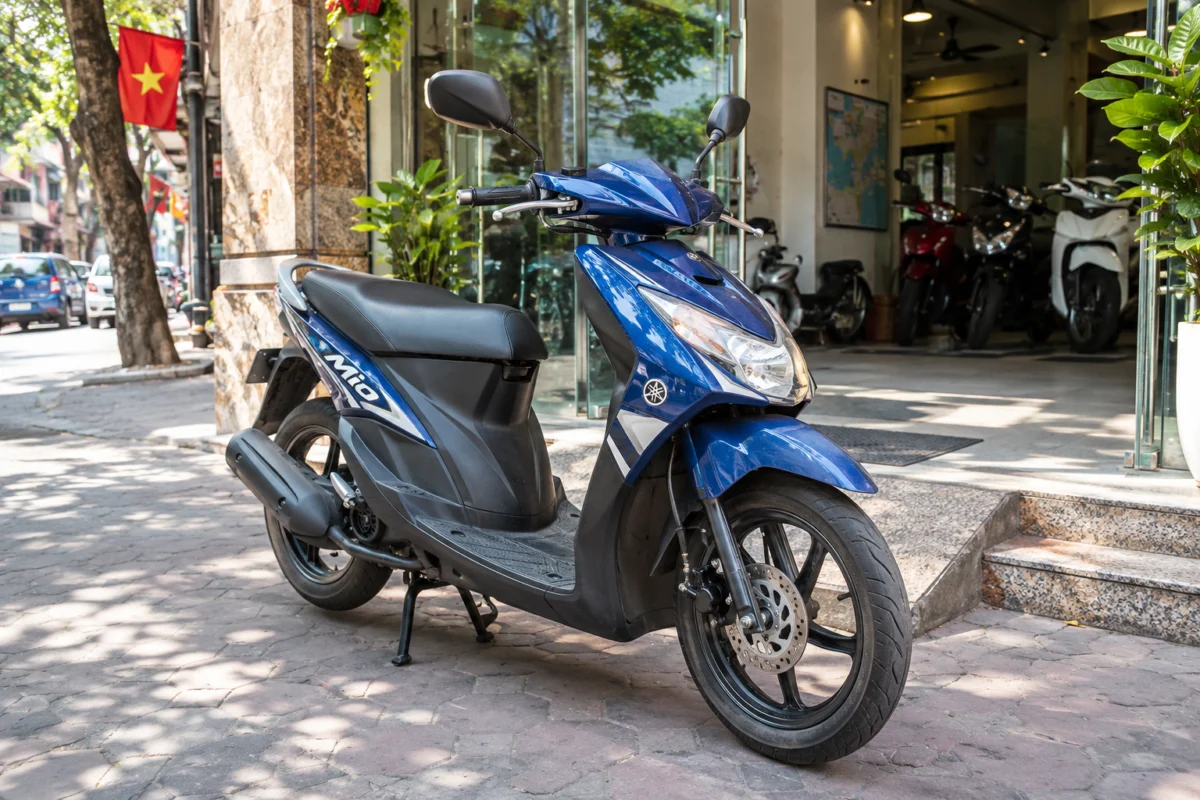
Brochure numbers describe one version of a new bike. A rental bike may be an older version, with a replaced seat, worn tires or suspension that has settled. HANOI MOTO’s owner-confirmed fleet list names its models (Honda Wave/RSX, Vision, Air Blade, Click or Mio, 50cc automatic scooters and electric options) but gives no seat heights, weights or engine sizes, so treat any figure as a starting point and the bike you are offered as the real test.
Here is what Honda Vietnam publishes for two of those names on its own product pages, accessed November 2026:
| Honda Vietnam figure | Vision | Air Blade (160/125 page) |
|---|---|---|
| Seat height | 785 mm | 775 mm |
| Curb weight | 97 kg | 113 kg |
| Ground clearance | 175 mm | 142 mm |
| Wheelbase | 1,277 mm | 1,286 mm |
| Tire sizes, front and rear | 80/90-16 and 90/90-14 | 90/80-14 and 100/80-14 |
Read the table for what it shows. The two seats are only 10 mm apart, so seat height hardly separates these bikes, while the 16 kg weight gap and the 33 mm clearance gap are large enough to notice. The Air Blade page covers both the 160 and the 125 and prints one table; which version, if either, matches HANOI MOTO’s Air Blade is something to ask, and this guide states no engine size for any HANOI MOTO bike. It quotes no figures for the Click, Mio, Wave/RSX or 50cc models, because it does not rely on unofficial numbers.
What you only learn by sitting on the bike
A catalog measures a bike, not you. It cannot show how wide the seat is where your thighs rest, how far your knees sit from the front panel, how the grips fall to your hands or how the bike feels when you take its weight. Give each bike you might rent about five minutes: engine off, bike upright on level ground, your riding shoes on.
A shorter version of these checks sits in the automatic scooter controls and fit checklist, and the guide to choosing a rental scooter places fit within the wider choice of bike and route. This page goes deeper on the body, the handling and the parking.
Seat height and reach: the sit-and-stop test
Sit as you would to ride, both hands on the grips, then put your feet down and note what happens.
Flat feet, balls of the feet or tiptoe: what each means in traffic
| What you feel | What it means at a stop | Practical verdict |
|---|---|---|
| Both feet flat | You can steady the bike, shift your weight and absorb a jolt | Comfortable, including on sloping road edges |
| Balls of both feet down | Stable on level ground, with less margin on uneven surfaces or when loaded | Acceptable for most city riding |
| Ball of one foot, other foot only toes | You hold the bike with one leg | Marginal: sit on another bike before accepting this one |
| Tiptoe only | Little control if the bike tips or a bump pushes it | Choose a different bike |
This table is a rule of thumb for fit, not a legal or manufacturer standard. The real question is whether you can hold the bike, with a bag on it, when the surface slopes away from your foot; many Hanoi stops are on cambered lanes, patched asphalt or wet painted lines.
Seat width matters as much as height
A wide seat pushes your legs apart and costs you reach even when its height is modest, while a narrower front section lets your legs drop straight down. Notice whether your thighs press against the sides of the seat, whether you slide into the handlebars or against the rear lip, and whether you can shift forward at a stop without using your hands.
Reach to the bars, levers and mirrors
- With the bars straight, your elbows should be slightly bent, not locked.
- Turn the bars to full lock each way without leaning your torso or lifting off the seat.
- Squeeze both brake levers with two or three fingers; needing your fingertips or a stretched wrist means small hands will tire quickly.
- Set the mirrors and look: you should see the lane behind you, not your own elbows.
Weight at walking speed: a stationary handling check
Scooters tip at walking pace, not at 40 km/h: backing out of a crowded parking row, turning in a narrow lane, rolling onto a ramp.
Lift it off the stand and hold it upright
Take the bike off its stand yourself, with the shop’s permission, and hold it upright for about ten seconds with both feet down and the brake squeezed. Could you do this at the end of a long day, with a helmet and a bag on the bike?
Walk it forward, turn at full lock, push it back
- With the engine off, walk the bike straight forward about ten meters, holding the grips.
- Turn the bars to full lock and walk a full circle in a clear space.
- Walk it backward into a gap and out again, as you would in a parking row.
If it feels heavy now, it will feel heavier in traffic
Add a passenger, a bag, a slight slope and tired legs, and the same bike asks for more. If you had to fight it during these steps, choose a lighter one. Honda’s published curb weights for the Vision and Air Blade differ by 16 kg, a difference you can feel by hand before starting the engine; the Vision versus Air Blade comparison shows how it affects the choice.
Ground clearance: curbs, ramps and speed bumps
Where low scooters can scrape
Honda lists 175 mm of ground clearance for the Vision and 142 mm for the Air Blade, so scooters clearly differ. A catalog figure is static, though: with a rider and passenger aboard the suspension compresses, and a tired rear shock makes it worse. Scrapes happen where a surface changes angle quickly: the lip where a ramp meets the street, a steep driveway apron, a speed bump with a tall crown, or a pothole edge taken fast.
Checking the underside for existing scrape marks
With the bike cold, crouch and look at its lowest parts: usually the stand feet, the exhaust and its guard, and the underside of the engine casing. Fresh scratches or a dented guard mean it has grounded out before. Scratches alone do not prove the bike is safe or unsafe; ask the shop to inspect any concerning damage and photograph the marks with your handover records so an old mark is not blamed on you.
Routes and parking ramps to approach with care
- Basement and rooftop parking ramps with a sharp change of angle at the top or bottom.
- Dropped curbs and driveway aprons at hotels, shops and lots.
- Speed bumps and raised crossings, especially with two people on the bike.
Approach these slowly, with the front wheel straight. If a ramp looks as though it will scrape, parking elsewhere is a perfectly good answer.
Starts and stops on an automatic: what experienced riders should recheck
If you ride geared motorcycles at home, some habits your hands and feet already know are wrong on an automatic scooter.
No clutch to cover: braking habits to relearn
On a scooter the left-hand lever is a brake, not a clutch. Reaching for it out of habit as you slow will brake the bike, so confirm what each lever does on your bike. There is no gear to downshift either, and the engine slows the bike far less than a geared motorcycle does, so begin braking earlier.
Throttle at walking pace and rolling starts
An automatic picks up drive as the revs rise, so a sharp twist from a standstill can feel like a lurch. For starting, follow the exact scooter’s controls and instructions; release the brake smoothly as you apply gentle throttle, without holding throttle against the brake. In a tight walking-pace turn, a steady light throttle with a touch of rear brake keeps the bike stable. If legally qualified and already trained, familiarise yourself only in a safe, permitted space with the shop’s approval; the first-ride plan for Hanoi sets out a sequence.
Both brakes at every stop
Squeeze both levers together at every stop and keep them held while stationary, so the bike cannot creep forward on a slight slope. The front brake does most of the work and the rear steadies the bike. If the bike has combined braking, ask how one lever affects the other.
Shorter riders: what to shortlist and how to ride it
Compare model types by sitting on them
Searching for a scooter for short riders tempts you to look for one model name, but seat height is only one of three factors; seat width and the weight you must hold up are the others. Use the table as an order of testing, not a ranking.
| Rider | Sit on these first | Why | Watch for |
|---|---|---|---|
| Shorter rider | The Vision, then any Click, Mio or 50cc automatic offered | Honda lists the Vision at 97 kg, 16 kg under the Air Blade, and a lighter bike is easier to hold upright; weigh the others by hand | Seat width, tiptoe stops, lever reach |
| Taller rider | The Air Blade and the Vision side by side, then a Wave/RSX | Knee room and reach decide the result more than seat height | Knees on the front panel, cramped elbows |
| Experienced motorcyclist | Any automatic, with a quiet-space rehearsal | Braking and throttle habits differ | Reaching for a clutch lever, weak engine braking |
Availability is confirmed directly with HANOI MOTO, so ask for the models you want to try when you ask about dates. The fleet page lists the model names.
Sliding forward and choosing a foot at stops
Shorter riders gain reach by moving toward the front of the seat just before a stop and sliding back as they move off; practice this before the first street, not at a junction. Choose one foot to put down each time. On sloping or uneven ground, pick the side where the surface is higher or flatter, since your foot usually reaches that side securely. Wear closed shoes with a grippy sole, not sandals.
When a 50cc or a different automatic fits better
A 50cc automatic scooter is on HANOI MOTO’s fleet list. Whether it is lower or lighter than a larger automatic depends on the actual bike, so run it through the same tests. It is also a different legal class, with its own license and age rules, so confirm those before choosing it for fit alone. If no available bike passes, ask for another model rather than planning to adapt on the road.
Tall riders: knee room, reach and stability
Tall riders rarely struggle to reach the ground. Their problems are cramped knees, a bike that feels small and a top-heavy feel at walking pace, so a rental scooter for tall riders is found by testing legroom and reach, not by hunting for a taller seat.
Knees against the front panel
Sit with the bars straight, then turn them to full lock each way. Do your knees touch the front body, mirror stalks or handlebar ends? If they do at full lock, a U-turn in a lane will be awkward. A floorboard lets many riders stretch their legs forward, but for others the position bends the knees up against the front panel.
Bars too close in tight turns
Check that your elbows do not squeeze against your thighs in a full-lock turn and that you can sit upright without hunching to the grips. A taller body raises the combined center of gravity, so do the stationary weight test with care.
Larger automatic or semi-automatic: try both
Start with the Air Blade and the Vision, whose Honda-published wheelbases differ by only 9 mm, so neither is meaningfully longer. Then sit on a Wave/RSX if one is available: it is a semi-automatic with a gear lever and footrests rather than a floorboard, which may put your legs in a more familiar position but adds gear changes with no clutch lever. Try both types stationary before you decide.
Parking on a slope: a safer routine
An automatic scooter has no gear to hold it, so on a slope the brakes, the stand and your choice of space do all the work. This routine is general technique, not manufacturer or HANOI MOTO guidance. If you doubt the bike will stay put, the space is too steep: choose another.
Pick the flattest space available
Prefer a level spot, then a gentle slope, over a ramp, and avoid loose gravel, wet tiles and surfaces that fall away sideways. Do not park across a pavement or lane to find a flatter spot: under Decree 168/2024/ND-CP, as amended by Decree 238/2026/ND-CP, stopping or parking that obstructs traffic, or illegal parking on a sidewalk, carries a fine of 400,000 to 600,000 VND for a motorbike rider. The scooter parking guide covers the wider rules and fees.
Facing and stand side: avoid a roll-off
Common advice for any motorcycle on a side stand is to park facing uphill rather than downhill, because a bike facing downhill is more likely to roll forward and fold its stand. Avoid parking across a slope, where the stand can leave the bike leaning too far or too little. Where the layout allows, face uphill, turn the handlebar toward the curb or the slope and engage the steering lock if the bike has one. After you set the stand, take your weight off slowly while keeping a hand on the bike, then release the brake lever gently. If the bike creeps, move it to a flatter space. Do not rely on the stand alone.
Parking brake lock: ask whether the bike has one
Some scooters have a lock that holds a brake lever in place so the bike stays put while parked; others do not, and HANOI MOTO has not published which of its bikes have one. Ask at handover how to engage and release it. If a bike has none, make testing for creep a habit each time you park.
Leave room to roll out under control
Parking rows can be tight, and a bike that rolls or falls can push its neighbors over like dominoes. Choose a space where you can walk the bike out without pushing another one. To leave, grip both brake levers, take the bike off its stand, check behind you and release the brakes gradually.
Your fit plan for inquiry and handover day
What to tell the shop before you arrive
Give HANOI MOTO what a shop cannot see from a message: your height, the kind of bikes you ride at home, and whether you will carry a passenger or luggage. A short message does the job:
Hello, I am [height] tall and usually ride [type of bike]. I would like a scooter from [date] to [date]. Could I sit on and walk the bike at handover before I confirm it? I may carry [a passenger / a bag].
Swap before you ride, not after the first day
Whether you can try several models at handover, or swap if the first bike does not fit, is by agreement with HANOI MOTO and depends on what is available that day. Ask before you travel, and decide at the shop with the engine off instead of riding away on a bike that failed a test.
Note what made you choose
Write down which bike you took, which foot you put down, how the weight test went and what you disliked. It makes a later swap request or extension easier to explain.
Include your height and riding experience when you contact HANOI MOTO through the contact page, on Zalo at +84 857 255 868 or by email to motoopen12@gmail.com, and ask to sit on and walk the bike at handover before you confirm it. For the automatic models HANOI MOTO offers, see the automatic scooter rental page.
Frequently asked questions
What if my feet only reach the ground on tiptoe?
Treat tiptoe on both feet as a no. You need at least the ball of one foot firmly planted on a surface that may slope or be wet. Try a bike with a narrower seat or a lighter frame; if none passes the sit-and-stop test, ask for a different model rather than adapting on the road.
Is a heavier scooter more stable for a tall rider?
Not automatically. A heavier, longer bike can feel steadier once moving but is harder to hold up and steer at walking speed, where scooters tip. For a tall rider, knee room and reach usually matter more than weight, so choose the heavier bike only if the walk-and-turn test is effortless.
Can I ask to sit on several scooters before choosing?
You can ask. Whether HANOI MOTO can arrange it depends on what is available when you come and is settled by agreement. Pickup is at 114 Nguyen Van Cu, Bo De Ward, open 09:00 to 21:00 daily with handover by appointment, so mention it when you propose a time.
How do I stop a parked scooter rolling down a ramp?
Choose the flattest space, park facing uphill where possible, turn the handlebar toward the curb, use the steering lock and any parking brake lock, and test for creep with a hand on the bike. If it moves, find another space; never rely on the side stand alone on a ramp.
I ride big motorcycles at home: what catches experienced riders out on an automatic scooter?
The left lever is a brake, not a clutch; there is no gear to downshift; the engine slows the bike much less; and a sharp throttle from a standstill can lurch. Spend ten minutes in a quiet space on walking-pace turns and rolling stops before joining traffic.
Sources and last checked
Last checked November 2026. No seat height, weight or clearance figures other than Honda Vietnam’s published ones for the Vision and Air Blade are quoted.
- HANOI MOTO, owner-confirmed fleet list and pickup details, recorded 31 October to 1 November 2026 (confirm when you book)
- Honda Vietnam, Vision product page (in Vietnamese; specification table as listed), accessed November 2026; the retrieved page copy was dated 19 October 2026
- Honda Vietnam, Air Blade 160 and 125 product page (in Vietnamese; specification table as listed), accessed November 2026; the retrieved page copy was dated 30 September 2026
- Luat Viet Nam, Decree 168/2024/ND-CP on penalties for road traffic violations (English version; Decree 238/2026/ND-CP amends it but did not change the motorbike rider article), accessed November 2026
Part of the guide: Automatic Scooter Fit, Controls and Rental Checks
Conversation