
Lost Key, Lost Helmet or Missing Registration Paper on a Rental Scooter: What Happens and What to Do
If you lose the key, a helmet or the registration paper on a rental scooter, the first move is the same for all three: stop, search the places you have been, and tell the rental shop quickly and in writing. What it costs depends on your rental agreement, because Vietnamese law does not set a price list for a replacement key or a rental helmet. A replacement charge or deduction should be discussed against the rental agreement and the documented loss or replacement work, not assumed to be a unilateral shop price. Ask for a written itemization and the agreed deposit-reconciliation terms before accepting a charge.
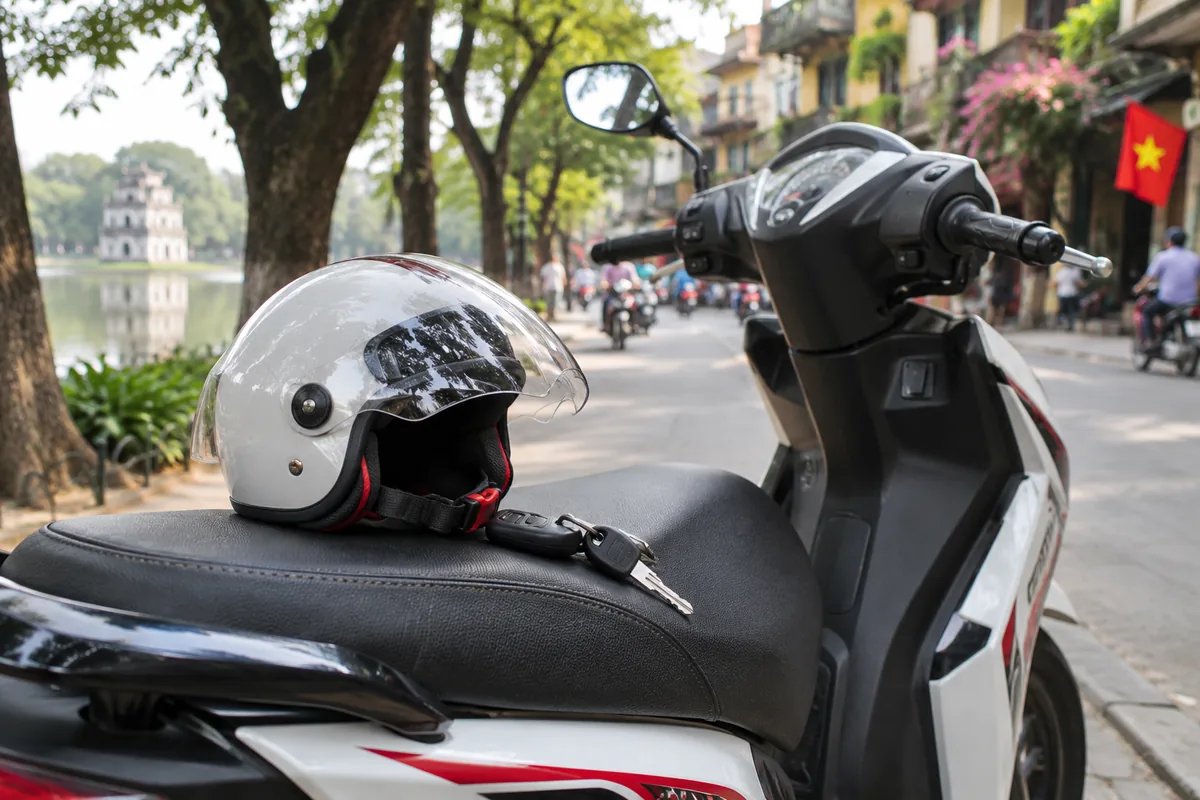
This guide explains what usually happens in each case, which questions to ask about keys, helmets and papers, how charges are normally assessed, and which habits stop most losses before they happen. It does not contain a price list, because inventing one would mislead you: replacement costs differ by model, by key type and by shop, and any proposed amount should be checked against your agreement, the replacement details and applicable rules; request the actual quote and a receipt.
Immediate steps: stop, search, call the shop
The first ten minutes decide whether this is a small annoyance or a long afternoon. Work through these steps in order.
- Stop riding if the scooter is running and you are about to leave it. If you lost the key while the scooter is parked, do not try to force the ignition or the steering lock.
- Search methodically: pockets, bag, the seat storage compartment, the front basket or hook, the table where you last ate or paid, and the ground around the parking spot.
- Retrace your last stops. Ask the cafe, parking attendant or hotel front desk whether anything was handed in.
- Contact the shop before you start improvising. HANOI MOTO can be reached on Zalo at +84 857 255 868 or by email at motoopen12@gmail.com, and the pickup premises are open 09:00 to 21:00 daily. Tell them what you lost, where you are and what you have already tried. What the shop can arrange from there is by agreement, so ask instead of assuming.
- Take photos of where the scooter is parked, its plate and its surroundings, and send them with your message. It shows that the scooter is safe and gives both sides the same facts.
- Do not hire a random locksmith or mechanic to bypass the ignition without telling the shop. Drilling or cutting a lock can create damage that is then billed to you, and it may be hard to prove what was already broken. See how damage charges are assessed for why before-and-after evidence matters.
- Keep a written record. A short message thread with times and what each side said is enough, and it becomes your evidence if the charge is later questioned.
If the scooter was left somewhere unattended and you cannot find the key at all, also consider whether it could have been stolen along with a bag or phone. In that case the situation changes from loss to theft, and the habits in preventing scooter theft during a Hanoi rental apply, along with reporting it to the shop immediately.
Spare-key and key-code questions: smart key versus ordinary key
Not every rental scooter uses the same kind of key, and the type changes both the options and the questions you should ask. Which type a particular bike has is something to confirm at handover, not something this page can promise for any model.
Ordinary metal key
Many semi-automatic and older automatic scooters use a conventional key that turns an ignition and a steering lock, and often also opens the seat. Copies of this type can sometimes be cut from an existing key, which is why one useful habit is to ask at handover whether a spare exists and who holds it. If the only copy is lost, replacing it may mean cutting a new key from the lock or changing the lock set, and whether that is possible, how long it takes and who arranges it are all questions for the shop.
Smart key or keyless fob
Some newer automatic scooters use a smart key, a fob the scooter recognizes by proximity. A fob usually cannot be copied at a street kiosk, and a replacement may need to be paired to the scooter. That tends to make a lost fob a bigger item than a lost metal key, but how much bigger is not something to guess. Ask the shop what a replacement involves for your specific model. For a general look at how these systems behave, see the automatic scooter controls and smart key checklist.
Questions to ask the shop about a lost key
- Is there a spare key, and where is it held?
- Does this model need a new key cut, a lock replaced, or a fob paired to the scooter?
- Who would do the work, and does the work happen at the shop or at a third party?
- Roughly how long would the scooter be unusable, and does the rental period continue to count in the meantime?
- What is the total charge, how is it made up, and can I have it in writing or in a message before I agree?
- Is the cost deducted from the deposit, charged separately, or reduced if I find the key later?
Be careful with the word “key code”. Some people expect to give a number and receive a new key, but whether that works depends on the key type and on what the shop holds for that scooter. Do not assume the option exists; ask.
Helmet replacement and standards
A lost helmet creates two separate problems: you need a replacement to keep riding legally, and the shop needs to be made whole for the one that went missing. Treat them separately.
Riding without a helmet is the bigger risk
Under Decree 168/2024/ND-CP, a rider without a helmet, or with it unfastened, faces a fine of 400,000 to 600,000 VND, and a passenger without a helmet can be fined within the same range. Do not ride off bareheaded because the original was lost. If the shop cannot hand you another, buy one locally before you ride on. For the wider rules and exemptions see Vietnam’s helmet law for riders and passengers.
What a replacement should meet
Since 1 January 2024, helmets for motorcycle and moped riders are expected to meet the national technical regulation QCVN 2:2021/BKHCN, issued under Circular 04/2021/TT-BKHCN. A compliant helmet carries the CR conformity mark with, at minimum, the abbreviation of the certifying body and the certificate number. The regulation covers nine sizes with head circumference from 460 to 620 mm. The fine, if any, for a helmet that carries no mark is unverified, so check the mark yourself rather than relying on the price or the shop’s reassurance. The practical inspection steps are in checking a rental helmet: fit, condition and standards.
Will you lose your deposit over a lost helmet?
Not automatically. Whether any amount is taken from your deposit is a matter for your agreement and the shop’s reasoning. A fair conversation covers whether helmets were included in the rental, what the missing one is worth, and whether the figure matches a like-for-like replacement or something more. If the shop proposes a deduction, ask what it is based on. Do not guess at a figure here; the amount that applies to you is the one in your agreement.
Missing papers: police stop risk
In practice, the “papers” for a rental scooter are the vehicle’s registration document and the plate on the bike, along with your own license and passport. The registration paper belongs to the scooter, and it is normally kept by the owner or provided to you under the rental arrangement. How HANOI MOTO handles document copies and who carries what is by agreement, so ask at handover which papers are with the bike and which stay at the shop.
Can you keep riding without the registration paper?
You should not treat it as a risk worth taking. Vietnamese rules require a rider to produce the licence and vehicle papers that apply to that vehicle and rider, including legally integrated electronic documents where eligible. Under Article 48(3) of Decree 168/2024/ND-CP, in certain cases presenting valid documents by the official appointment deadline can avoid a missing-document penalty; transport-business cases are handled differently. This procedure does not excuse riding without valid documents or guarantee that a fine will be waived. A stop is also a bad time to discover the paper is missing, because police may ask you to wait while it is checked. For what these stops look like and what is usually asked, read traffic police stops: what to expect as a foreign rider.
What to do if the paper is missing or lost
- Tell the shop immediately and ask whether a copy or digital version is available that you can show.
- Ask whether the shop prefers you to stop riding until the paper is sorted out, and who arranges any replacement.
- If you are stopped, remain calm and present the documents lawfully requested for your situation. Explain that the scooter is rented and contact the owner to help supply valid vehicle papers; a phone call does not replace the documents that law requires.
- Ask the shop in writing what is being charged for any replacement and whether any time or fee applies.
Your own license, International Driving Permit or passport is a different problem. If you lose any of them, that is a matter for your embassy, the police and the document issuer, and it can affect whether you are allowed to keep riding at all. Do not ride without a valid license for the class of scooter you have rented.
How charges are usually assessed: ask for the written basis
Because no public tariff exists, charges for lost items are normally built from one of a few logic patterns. None of these is a rule, and a given shop may use a different one, but they give you something concrete to compare against.
| Item | What the charge may be based on | What to ask for |
|---|---|---|
| Key | Cost of a new key or lock set, any pairing work, labor, and sometimes the days the scooter was off the road | The itemized parts and work, and whether the old lock is also changed |
| Helmet | Cost of a comparable replacement helmet | What the helmet cost, and whether it was included in your rental |
| Registration paper | Cost and effort of obtaining a replacement or copy, and any time the scooter is unusable | Who requests it, what the process involves, and the time and cost of it |
A reasonable shop can explain each line. These are the points worth getting in writing:
- What exactly is being charged for, listed item by item.
- The amount, and whether it is a fixed fee or a real cost with a receipt.
- Whether the amount comes from the deposit or is charged on top of it.
- What happens if you recover the lost item afterward.
- Whether the daily rental continues while the scooter is waiting for a key or paper.
Keep payments traceable. Ask for a receipt or a message confirming the amount, in the same way as for the deposit itself. For HANOI MOTO’s own deposit and refund conditions, see the rental, deposit and refund conditions page; owner-confirmed rates as of 31 October 2026 show a deposit of roughly 2 to 5 million VND depending on the model, and you should confirm the exact figure when you book. The deposit is refunded under the agreement’s conditions at return, which is why any loss deduction should be written down before you hand the scooter back.
If you and the shop cannot agree, the next step is a calm, documented dispute rather than an argument at the counter. Disputing a scooter rental charge in Vietnam walks through what to gather and how to word it.
Preventive habits
Most lost-item stories are avoidable with a few habits formed on the first day.
- Photograph the key, the fob and any spare at handover, and note whether a spare exists and who holds it.
- Photograph the helmet or helmets you receive, with their condition and the CR label, so there is no later doubt about what was handed over.
- Ask which papers travel with the scooter, and photograph them, front and back, in good light. A photo is not a replacement for the original, but it helps the shop identify it quickly.
- Use one fixed place for the key every time: a zipped pocket or a lanyard, never a loose pocket with coins and a phone.
- Never leave the key in the ignition, even for a minute, and never leave a helmet hanging on the mirror when you walk away; use the seat compartment or take it with you.
- Pocket-check before you leave any stop. Say it as a habit: phone, wallet, key, helmet.
- Keep the shop’s number saved under a clear name so you can reach it in one tap, and write down the scooter’s plate.
- Before you return the scooter, collect everything together and check it against your handover photos so nothing is missed on the day.
These habits cost almost nothing, and they also make a charge discussion much easier if something does go wrong, because both sides begin from the same record.
To ask what HANOI MOTO can arrange for your dates, send your dates, preferred model, license type and handover preference through the HANOI MOTO contact page, on Zalo at +84 857 255 868 or by email to motoopen12@gmail.com, and ask how lost keys, helmets and papers are handled in the agreement.
Frequently asked questions
What if I lose the scooter key in Hanoi?
Stop, search the places you have been, and tell the shop quickly with photos of where the scooter is parked. Do not force the ignition or hire someone to bypass it without telling the shop. Whether a spare, a new cut key or a replacement fob is needed depends on the key type, and the cost and time are set by your agreement, so ask for the basis in writing.
Will I lose my deposit if I lose the helmet?
Not automatically. Any deduction depends on your agreement and on what the helmet is worth, and the shop should be able to explain the figure. Ask whether the helmet was part of the rental price and whether the amount reflects a like-for-like replacement. In the meantime, do not ride without a helmet, because the fine under Decree 168/2024/ND-CP is 400,000 to 600,000 VND.
Who pays for a new key?
It is a contract question, not a legal rule, so the answer is whatever your agreement says; many agreements put a lost key on the renter, but confirm that for yours. Ask before you rent whether a lost key is charged at cost, at a fixed amount, or in some other way, and get the answer in writing. If the amount seems high, ask for an itemized breakdown.
Can I keep riding without the registration paper?
It is not advisable. Riders are expected to be able to show their license and the vehicle’s papers when stopped, and the exact fine is unverified here. Call the shop right away, ask for a copy or digital version, and avoid riding further than necessary until it is sorted out.
What if the key is found later?
Tell the shop at once. If a charge was already taken, ask whether it is adjusted or refunded in part. Whether that happens is by agreement, so ask for that rule before you pay, not after.
Sources and last checked
- LawNet, The roadmap for applying the new helmet regulation in Vietnam, accessed November 2026
- ThuvienPhapLuat, QCVN 2:2021/BKHCN, national technical regulation on helmets for motorcycle and moped riders, accessed November 2026
- Luat Viet Nam (English), Circular 04/2021/TT-BKHCN promulgating the national technical regulation on protective helmets, accessed November 2026
- Government of Vietnam, Decree 168/2024/ND-CP on administrative penalties in road traffic (helmet fines, Art. 12), accessed November 2026
Part of the guide: Motorbike Deposits, Fees and Refund Records