
Riding With a Passenger in Hanoi: Technique, Comfort and Bike Choice
Riding with a passenger on a Hanoi scooter is safe and comfortable when you treat it as a separate skill from riding alone: the bike is heavier, it brakes later, it pulls away slower, and your passenger’s movements now affect your balance. The routine that works is simple. Choose a bike with a full-length seat and working footrests, brief your passenger before the engine starts, board only when the bike is fully stopped, and leave much more room than you would solo. Only one passenger is the normal legal limit, and both of you need a fastened helmet; the full rules are covered in our guide to passenger rules on Vietnamese motorbikes.
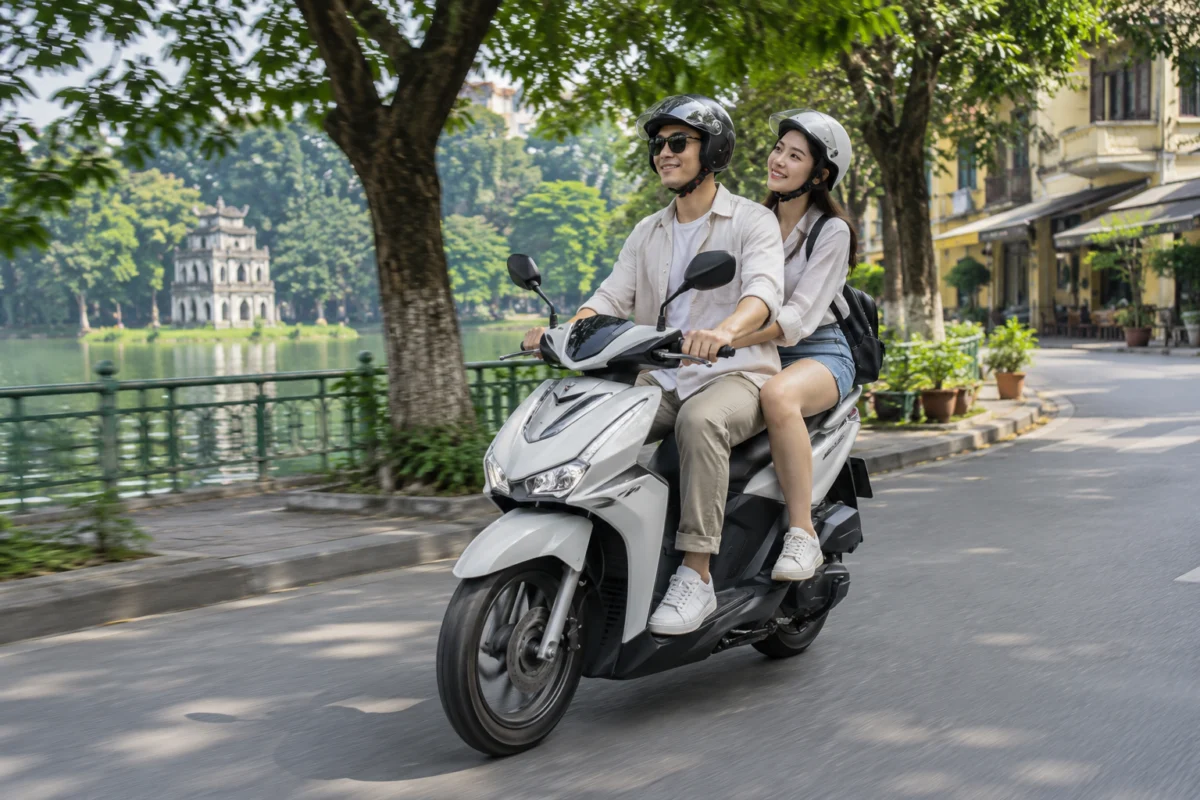
This article is about technique, comfort and bike choice. It assumes you already ride confidently and hold the license that applies to the bike you rent. If you are still learning, ride alone first; a passenger is the wrong way to find out where your limits are.
Is carrying a passenger right for this trip?
Before choosing a bike, decide whether two people on one scooter suits the plan at all. Three questions settle most cases.
Your experience level
Two-up riding amplifies every small mistake. A few weeks of riding is not proof of passenger-carrying skill. Only take a passenger when you already hold the correct license, can control the specific bike confidently with the intended load, and have checked its limits; otherwise choose another way to travel. If you still wobble at walking pace, feel nervous at intersections or have not yet ridden in rush-hour conditions, give yourself more solo mileage first. Hanoi’s busiest streets are the worst place to learn how a loaded bike behaves.
Your passenger’s comfort
Ask your passenger honestly whether they want to ride. A nervous passenger tends to stiffen, grab at the rider and lean the wrong way in corners, which is more dangerous than an empty seat. Someone who has ridden behind a driver before will usually adapt quickly. Consider how long the trip is, too: an hour on a thin rear seat with knees bent is tiring for anyone, and tired passengers shift around.
One scooter or two
Sometimes the better answer is two bikes, or one bike plus a taxi for the legs of the trip that feel risky. The cost and planning side of that choice is covered in renting one scooter or two for two people, so this article will not repeat the arithmetic. As a rule of thumb, two bikes can be useful when both riders are properly licensed and experienced, the route permits motorbikes and each wants flexibility; do not treat expressways as a suitable route for either rental scooter.
The rules in brief
The law is the other half of a safe two-up ride. Here is the short version, based on Law 36/2024/QH15 on Road Traffic Order and Safety and the fines decree, Decree 168/2024/ND-CP, as amended by Decree 238/2026/ND-CP. Decree 238 did not change the article on motorbike riders. For the full detail, exceptions and fine tables, read the passenger rules article.
One passenger, and when a second is allowed
Carrying two passengers on one motorbike is fined at 400,000 to 600,000 VND under Decree 168/2024/ND-CP, Article 7, with stated exceptions: an emergency patient, a child under 12, an elderly or disabled person, and an escorted person. Three or more passengers is fined at 600,000 to 800,000 VND plus 2 points. For a tourist rental, plan on one adult passenger.
Helmets for both
A passenger without a helmet is fined 400,000 to 600,000 VND (Decree 168/2024/ND-CP, Article 12(5)(b)), and so is a rider who carries a passenger without one. Helmets must carry the CR mark under QCVN 2:2021/BKHCN. Children under 6 are exempt from the helmet requirement. If you need a second helmet, ask HANOI MOTO about it before collection; what is supplied is by agreement and the owner should confirm it for your booking.
Children as passengers
A child under 12 is one of the exceptions to the two-passenger limit, which is a legal allowance rather than a recommendation. A small child on a scooter needs a seat position where they can hold on and reach the footrests, and that is a judgment call for the parent, not something this guide can certify. Never ride with a child you cannot keep stable.
Choosing a rental bike for two
The right bike for two is about seat, footrests and power more than brand. You can compare the models on the HANOI MOTO fleet page, but you will learn the most by looking at the actual bike at pickup.
Seat length and footrests
On a good two-up scooter, the passenger’s seat is flat, level with or slightly above the rider’s, wide enough to sit without sliding forward, and there are fold-out footrests at a height that does not pull the knees up high. Check three things at pickup: sit on the bike together with the passenger and see whether either of you is pushed forward or backward; fold out the passenger footrests and make sure they lock and sit level; and look for a grab rail or strap behind the seat. Seat length and footrest design vary by model and by individual bike, so do not assume; check the specific bike you are given.
Engine size and hills
Hanoi is flat, so the engine matters less in the city than on a mountain road. Even so, a heavier load means slower acceleration from a stop and from slow traffic, and that is where a small engine feels stretched: pulling out across a busy intersection, climbing a flyover ramp or overtaking a parked truck. If your plans include hills, a bridge ramp or any day trip, prefer the bigger-engine automatics in the fleet and keep the trip modest. See 50cc vs 110cc scooters for how engine size affects passengers and hills.
50cc scooters and two adults
A 50cc scooter is a moped under Vietnamese law, and it is the smallest engine in the HANOI MOTO range. It can legally carry one adult passenger like any other scooter, but two adults add a lot of weight to a small engine. Expect slow pull-away, slow response on ramps and little spare power for emergencies. If one rider is heavy or you will carry luggage as well, choose a larger scooter instead. If you do want a 50cc, ask HANOI MOTO how it copes with your combined weight and keep your trip short and flat.
Model comparison table (fleet types and owner rates)
Rates below are owner-confirmed rates as of 31 October 2026; confirm them when you book, since availability and final price are agreed directly. The notes are general guidance for two riders, not manufacturer specifications.
| Model | Per day (VND) | Gearing | For two riders |
|---|---|---|---|
| Honda Vision | 200,000 | Automatic | Automatic, easy to ride in the city; check seat room together at pickup |
| Honda Air Blade | 200,000 | Automatic | Automatic; confirm seat and footrest comfort for your passenger at pickup |
| Honda Click / Yamaha Mio | 150,000 | Automatic | Lower daily rate; check seat length and footrests with both riders sitting on it |
| Honda Wave / RSX | 150,000 | Semi-automatic | Needs gear changes; better once the rider is comfortable with them and loaded handling |
| 50cc automatic | 200,000 | Automatic | Smallest engine; best for one rider or a short, flat trip with a light passenger |
Whichever you choose, the deposit and extras differ by model; see HANOI MOTO’s rates and deposits. For a closer comparison of the two most popular automatics, read Honda Vision vs Air Blade.
Passenger comfort: footrests, space and load limits
Footrest position
The passenger’s feet belong on the footrests the entire time the bike is moving, not dangling, because a swinging foot can hit a curb or another bike and the leg hangs in the most exposed position. Both feet, flat, knees roughly level with the hips. If the footrests will not stay folded out or sit at an awkward height, ask for a different bike rather than riding with them tucked in.
Where to hold on
The safest options are the grab rail behind the seat if the bike has one, or the rider’s waist or hips if it does not. Holding the rider’s shoulders pushes their weight forward and makes steering heavier. A passenger who leans back, holds a bag with both hands or uses a phone is a passenger who is not holding on. A small bag worn across the chest is better than one on the lap.
Checking the load limit
Every scooter has a maximum load, usually in the owner’s manual. This guide cannot give you a figure for a specific bike, and published numbers differ by model and year, so ask HANOI MOTO for the limit that applies to the bike you rent and compare it with your combined weight and luggage. If you are near or over the stated limit, choose a different bike or ride separately. The same goes for tire pressure: many scooters recommend a higher pressure when carrying two people, so ask HANOI MOTO what pressure to use with a passenger.
Luggage with a passenger
With two people, there is little room left. Do not hang bags from the handlebars or put them between the rider’s feet, and do not let the passenger carry anything that blocks their hands. For bags, phones and rain gear, see carrying bags, phones and rain gear on a rental scooter. Do not assume heavy luggage belongs under the seat: check the maker’s compartment weight limit and secure only suitable lightweight items there; reduce luggage or choose other transport if the combined load is too high.
Boarding and getting off safely
Many two-up falls happen while the bike is almost stopped: the passenger swings a leg over while the rider is still rolling, or steps off into traffic. A fixed routine prevents most of them.
Stop fully, both feet down, brakes on
- Pull to the curb or a clear spot and come to a complete stop, not a roll.
- Put both of your feet on the ground and hold the brake lever so the bike cannot creep.
- Check that the engine is on idle and the stand is not touching the ground.
- Only then tell your passenger they can get on or off.
A passenger should never climb on while the bike is moving, even slowly, and should never be told to “jump on” at a red light when traffic starts to flow. If a pickup spot has no safe place to stop, move to one that does.
Mounting from the curb side
Boarding from the curb side keeps the passenger out of the traffic lane, so park with the curb beside you and never ask anyone to mount from the street side. The passenger should put a hand on the rider’s shoulder or the grab rail, swing a leg over without kicking the seat or luggage, and settle on the seat before placing both feet on the footrests. Mind the exhaust, which can be hot, while doing this.
Getting off in traffic
The same steps in reverse. Stop fully, brake on, feet down; the passenger waits for your word, dismounts to the curb side, and takes their bag before moving away from the bike. If you need to get off at a busy junction or a pickup point on a crowded street, drive on to a better spot, even if it is a minute away.
The passenger briefing
Spend sixty seconds before the first ride. A briefing makes your passenger predictable, which is the point.
Lean with the rider
Tell your passenger to sit upright and relaxed and to look over your shoulder in the direction of the turn. In a corner they should lean the same way as you, not away from it and not stiffly upright. If you do not tell them, many first-time passengers resist the lean because it feels wrong.
Hands, feet and the hot exhaust
Feet stay on the footrests; the exhaust can get hot enough to burn a bare leg or melt a loose trouser leg, so keep clear of it when mounting and dismounting. Hold on with both hands, keep long scarves, straps and bags well away from the rear wheel, and wear closed shoes rather than slippers.
Signals for slow down or stop
Agree a signal before you move. A firm tap on the rider’s shoulder or hip for “slow down” and two taps for “stop” works. Passengers should speak up early if they are uncomfortable. Ask them to tell you rather than to wait, because a calm “please slow down” is much safer than a sudden grab.
Riding technique with extra weight
Longer braking distances
A loaded scooter needs more distance to stop. Increase your following gap, begin braking earlier and squeeze the levers smoothly; with more weight, rear-brake lock-up and front-wheel dive both become more likely. Whether your bike has combined braking, drums or discs depends on the model, so see scooter brakes explained, and ask the shop how the brakes behave with two people. Do not assume the solo feel carries over.
Slower turns and U-turns
Slow down before the corner, not in it, and keep the lean gentle. Tight U-turns are the most common place for a two-up scooter to tip; if the road is narrow, use a wider turn, let your passenger step off for a moment, or find a place to turn around that is easier. Your own feet should be ready to go down.
Pulling away on slopes
With extra weight, opening the throttle from a stop on a slope can give a slow, heavy start, and a car behind you will not wait. Give yourself room, start from a stop before the slope when you can, and keep the throttle smooth. If the bike struggles on a ramp, a smaller passenger load or a larger bike is the fix, not more throttle.
Common two-up problems and fixes
| Problem | Likely cause | Fix |
|---|---|---|
| Handlebars feel heavy or wobble | Passenger holding the rider’s shoulders or sitting too far back | Passenger holds the grab rail or waist and sits close behind the rider |
| Bike pulls away slowly | Load near the engine’s limit | Plan more gap, avoid hills, or switch to a larger scooter |
| Passenger keeps sliding forward | Seat shape or braking too hard | Brake earlier and smoother; check seat room before accepting the bike |
| Passenger leans against the turn | Never briefed | Brief them again and ride a quiet loop to practice |
| Footrests fold up or sit too high | Worn or poorly adjusted footrests | Ask for a different bike before you leave |
| Rear tire looks flat under load | Pressure set for one rider | Ask HANOI MOTO about the pressure for two riders before you go |
Riding two-up? Tell HANOI MOTO both riders’ heights, your luggage and plans via the contact page, on Zalo at +84 857 255 868 or by email to motoopen12@gmail.com, and ask which model and passenger helmet suit you.
Frequently asked questions
Can I carry two passengers on a scooter in Vietnam?
Carrying two passengers is fined at 400,000 to 600,000 VND under Decree 168/2024/ND-CP, with exceptions such as a child under 12, an emergency patient, an elderly or disabled person and an escorted person. Three or more passengers is fined more heavily and adds 2 points. For a tourist rental, plan on one passenger.
Does my passenger need their own helmet?
Yes. A passenger without a helmet is fined 400,000 to 600,000 VND, and a rider who carries one is fined too. Children under 6 are exempt. Ask HANOI MOTO about a second helmet before pickup, since what is supplied is by agreement.
Is a 50cc scooter strong enough for two adults?
It can legally carry one adult passenger, but a small engine with two adults is slow to pull away and has little power in reserve. For two adults, a larger automatic is the more comfortable and safer choice; ask the shop about your combined weight before you decide.
Which rental models suit two people best?
The automatics with a longer seat and sturdy footrests, such as the Honda Vision and Air Blade, are worth looking at first for two. Check the actual bike at pickup, sitting on it together, as seat length and footrests vary.
When should a passenger get on or off the scooter?
Only when the bike is fully stopped, the rider has both feet down and the brake is held. Never mount or dismount while rolling, and never at a spot in the traffic lane.
Sources and last checked
- Vietnam National Assembly via Thuvienphapluat, Law 36/2024/QH15 on Road Traffic Order and Safety, accessed November 2026
- Government of Vietnam via Thuvienphapluat, Decree 168/2024/ND-CP on penalties for road traffic violations, accessed November 2026
- Government of Vietnam via Thuvienphapluat, Decree 238/2026/ND-CP amending Decree 168/2024/ND-CP, accessed November 2026
- HANOI MOTO, owner-confirmed fleet and rates as of 31 October 2026; confirm when you book, accessed November 2026
Part of the guide: Hanoi Riding Preparation and Day-Trip Planning