
Manual Motorcycle vs Scooter Rental in Vietnam: Controls and Routes
If you already ride a manual motorbike at home, you do not need to rent one in Hanoi: for city riding a scooter or a semi-automatic Honda Wave is easier on your hands and nerves, and a clutch motorcycle earns its place mainly on long mountain routes. The license you need is decided by engine size under Law 36/2024/QH15 (A1 up to 125 cc, A above), not by whether the bike has a clutch lever. HANOI MOTO rents semi-automatic Honda Wave/RSX bikes and automatic scooters and has no manual (hand-clutch) motorcycles, so this guide explains the differences and says what to do when a scooter does not fit your plan.
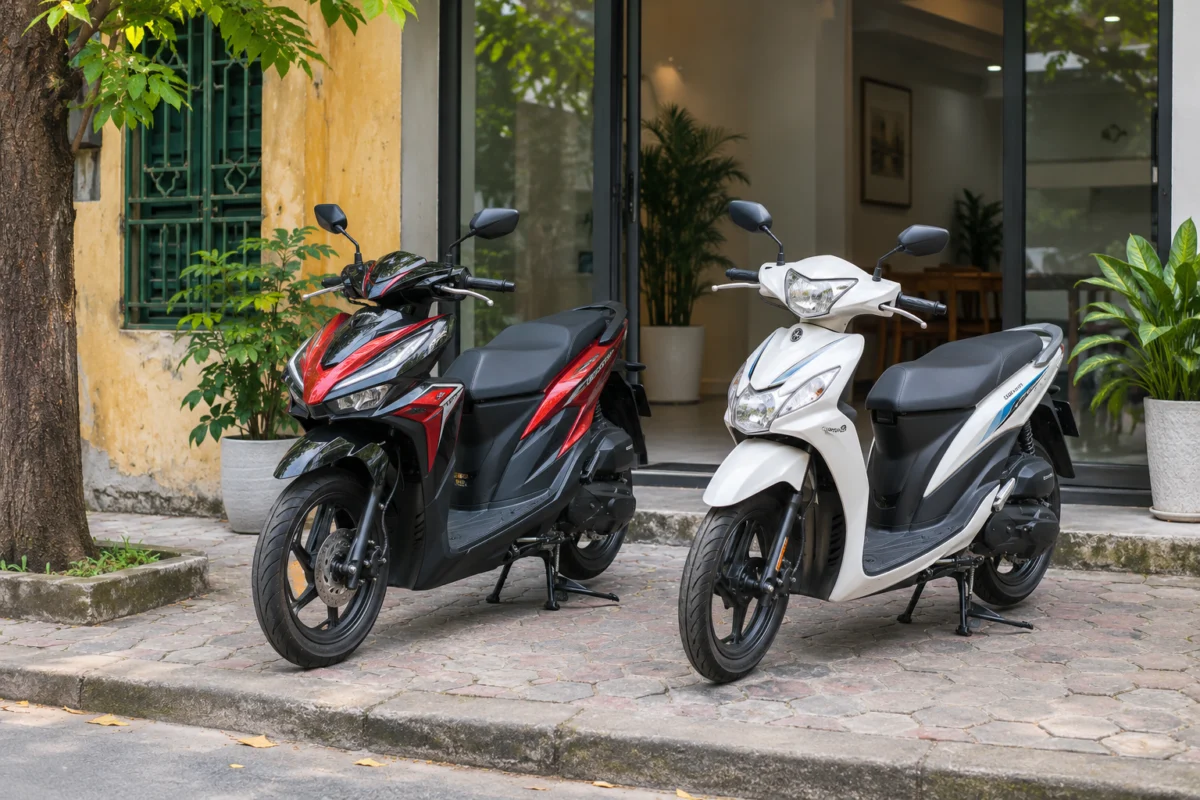
Three control systems in one table
Rental listings use “manual” for two different things. Locals say xe số (“geared bike”) for a foot-shifted bike with an automatic clutch, like the Wave, xe côn tay (“hand-clutch bike”) for a true clutch motorcycle and xe tay ga for a scooter. Visitors usually mean the clutch kind, so check which one a listing describes.
| Feature | Manual | Semi-automatic | Automatic scooter |
|---|---|---|---|
| Left hand | Clutch lever | Plain grip, no lever | Usually the rear brake lever |
| Left foot | Gear lever | Gear lever (a seesaw on many bikes) | Footboard |
| Right hand and foot | Throttle and front brake; rear brake pedal | Throttle and front brake; rear brake pedal | Throttle and front brake; footboard |
| Moving off | Release the lever gradually while adding throttle | Press the lever into first, then roll on | Twist the throttle |
| Main newcomer risk | Stalling, rolling back on slopes, clutch-hand fatigue in queues | Missed shifts, finding neutral | Over-twisting the throttle, little engine braking on long descents |
Manual: hand clutch and foot gears
On a manual motorcycle you pull the left lever to disconnect the engine from the rear wheel, press the left foot lever into first, then release the lever gradually while adding throttle. Miss that friction point and the bike stalls or lurches, which matters most at a crowded junction. In return you get fine control of power at low speed and strong, predictable engine braking.
Semi-automatic: foot gears, no clutch lever
A semi-automatic keeps the gearbox and drops the lever. A published specification listing for the Honda Wave RSX gives a 109.1 cc engine, a four-speed gearbox and an automatic centrifugal dry clutch. The clutch takes up the drive as engine speed rises and lets go as you slow down, so the bike does not stall at a stop. You still choose gears with your left foot, easing off the throttle for each shift. It is the layout of the Wave/RSX in HANOI MOTO’s fleet.
Automatic: twist and go
An automatic scooter has no gear lever: you twist the throttle and the transmission does the rest. The trade-off is mechanical: engine braking is much weaker than on a geared bike, so the brakes do more of the slowing on long descents. Scooters usually put the rear brake on the left-hand lever and the front brake on the right, but confirm that on your bike, because reaching for a clutch that is not there is the classic first-day mistake.
Manual vs semi-automatic: clutch and gear differences
Pulling away and stopping
On a manual you pull the lever, select first, find the friction point and release smoothly. On a semi-automatic you start in neutral, close the throttle, hold both brakes and press the gear lever once for first, then release the brakes and roll on as the clutch takes up the drive. When you stop there is no lever to pull: you brake and the clutch lets go near idle. Slopes are the one place the semi-automatic is less forgiving. On a slope, stop securely using the brakes and follow the bike’s recommended hill-start technique; do not hold throttle against the brake for an extended time. If unsure, get suitable instruction before attempting a hill start.
Changing gear without a clutch lever
To upshift, ease off the throttle, press the gear lever once and roll back on, one gear at a time. To downshift, drop one gear at a time as you slow, before a bend or junction rather than in it. The pattern varies: many bikes use a seesaw lever with a toe pad and a heel pad, and neutral sits between first and second on some and after fourth on others. Ask to be shown the pattern on your own bike before you ride away. The guide to riding a semi-automatic scooter without a clutch walks through the sequence.
Habits that trip up experienced manual riders
- Reaching for a lever that is not there. On a semi-automatic the left grip is empty. On a scooter the left lever is usually a brake, so an instinctive squeeze at a junction can lock the rear wheel.
- Shifting without easing off. On a manual the clutch smooths a shift; here the throttle does that job, and a shift at full throttle jerks the bike.
- Feathering the clutch for slow control. Creeping in a jam or turning in a tight space takes a steady throttle and a touch of rear brake.
Scooter vs motorcycle in Hanoi city traffic
Hanoi traffic is dense, slow in the center and full of sudden stops from every direction, which favors a bike that asks little of your hands and feet. For the comparison most visitors make, see automatic vs semi-automatic scooters for Hanoi.
Stop-start queues and low-speed control
In stop-start traffic a manual rider works a clutch hand, a gear foot, a throttle and two brakes while mopeds slide in from side streets. A scooter removes two of those tasks and a semi-automatic removes one. Locals ride manuals every day, but expect more fatigue and more chances to stall at the front of a green-light surge.
Parking, alleys and weight
Scooters generally have a step-through frame and a low seat, which helps when you must walk the bike backward out of a tight parking row or into a narrow alley. Stopping or parking that obstructs traffic, or parking on a sidewalk where it is not allowed, is fined 400,000–600,000 VND under Decree 168/2024/ND-CP, Article 7.
Storage for daily errands
Many scooters have an under-seat compartment that takes a helmet or a small bag. Semi-automatic bikes typically offer little or none, so errands mean a backpack.
Routes: when a manual motorcycle makes more sense
Mountain passes and long descents
On a long descent, engine braking holds your speed so the wheel brakes stay cool. A manual lets you choose a low gear before the descent and keep it, and a semi-automatic gives much the same through its foot gears while the clutch stays engaged. An automatic scooter has far less engine braking, so the brakes do the work and can overheat on a long run. On the climb, a gearbox lets you pick the gear where a small engine pulls best. None of this makes a manual inherently safer, and mountain technique is a separate subject this guide does not teach.
Multi-day loops in the north
Loops such as the Ha Giang loop or the Northwest loop add days of riding, luggage, mixed road surfaces and distance from workshops. A touring motorcycle with a comfortable seat, larger wheels than most scooters and a luggage rack suits that job; a city scooter is built for short trips. Your license class, the insurer’s wording, the shop’s permission and a breakdown plan are part of the same decision. The guide on whether a city scooter is up to the ride to Sapa applies these questions to one real route.
Questions to ask before taking any scooter on a long route
- Is the route allowed? Whether a rental may leave Hanoi is the shop’s decision, so get the answer in writing and name the route.
- What is the exact engine size, and do your license and insurance cover it?
- What happens, and who do you call, if the bike breaks down far from the city? Does your travel insurance exclude touring or unsealed roads?
License class: engine size, not the clutch, decides
Law 36/2024/QH15 on Road Traffic Order and Safety, in force since 1 January 2025, sets motorcycle license classes by engine size and electric power (Article 57). A clutch lever changes nothing.
| Class | Two-wheel motorcycles covered | Examples in this guide |
|---|---|---|
| A1 | Up to 125 cc, or electric up to 11 kW | A Wave-class semi-automatic and scooters up to 125 cc |
| A | Above 125 cc or above 11 kW; also covers A1 | Larger manual motorcycles and larger scooters |
A1: up to 125 cc
A1 covers a semi-automatic Wave, automatic scooters up to 125 cc and a manual motorcycle of the same size. Several popular scooter models are sold in more than one engine size, so ask for the cc of your specific bike and check it against the registration paper. The guide to license classes A1, A and B covers the wider picture.
A: above 125 cc
Class A is needed above 125 cc or above 11 kW, where many touring and sport manual motorcycles sit. Under Decree 168/2024/ND-CP (as amended by Decree 238/2026/ND-CP), Article 18, riding a bike up to 125 cc without a valid license carries a fine of 2–4 million VND. Above 125 cc the band is 6–8 million VND and includes holding a license that does not suit the vehicle.
IDP and home license must cover the vehicle
Under Article 57, a foreign rider needs either an International Driving Permit from a state party to the 1968 Convention on Road Traffic, carried with the matching national license, or a national license from a country with a recognition agreement or treaty with Vietnam. The IDP is valid for up to three years and never beyond the national license (Article 57(8)(a)), so it cannot add a class your home license lacks. A 1949 Geneva permit does not meet the 1968 requirement, and issuers in the United States, Canada, Australia and New Zealand issue the 1949 version.
Some countries also issue motorcycle licenses restricted to automatic bikes after a test on a twist-and-go. If yours carries a restriction, ask the issuing authority and your insurer whether a foot-shifted semi-automatic falls inside it before you choose a Wave.
Insurance: why the vehicle class matters
Travel insurance license condition
World Nomads’ help page says its plans cover riding a motorbike, moped or scooter only if you hold a valid license in your home country for that class of vehicle, obey local road rules and wear a helmet. Theft of or damage to the bike is excluded, and a passenger is covered only if the rider holds the appropriate license. That page was last updated in February 2024 and the brand changed hands when the IMG acquisition completed on 1 October 2026, so read the current wording. Other insurers set their own conditions, and some cap engine size or exclude touring. The travel insurance checklist for scooter riders in Vietnam lists what to look for.
Compulsory insurance covers third parties only
Vietnam requires compulsory civil liability insurance for motor vehicle owners under Decree 67/2023/ND-CP, amended by Decree 220/2026/ND-CP from 1 July 2026. It pays other people for injury or property damage the bike causes, not the rider’s own injuries or bike. As originally issued, the decree also lists cases where the insurer is not liable, including a driver without a valid license of the class the vehicle requires.
What HANOI MOTO rents and what it does not
These are owner-confirmed rates as of 31 October 2026 — confirm them when you book. Availability is confirmed directly with HANOI MOTO.
| Model | Controls | Rate per day (VND) |
|---|---|---|
| Honda Wave | Semi-automatic: foot gears, no clutch lever | 150,000 |
| Honda Vision | Automatic | 200,000 |
| Honda Air Blade | Automatic | 200,000 |
| Honda Click / Yamaha Mio | Automatic | 150,000 |
| 50cc automatic scooter | Automatic | 200,000 |
| Electric motorbike / e-bike | Ask which model | On request |
Semi-automatic Wave/RSX and automatic scooters
Those are the two control systems HANOI MOTO offers. The motorbike fleet page shows the range, and the automatic scooter rental page covers the twist-and-go models. Wave-class bikes of this type are around 110 cc by the published specification, but confirm the cc and license class of the specific bike you are given.
No manual motorcycles in the fleet
HANOI MOTO does not rent manual (hand-clutch) motorcycles, and nothing here implies it can source one. If a clutch motorcycle is essential for your route, you will need to look elsewhere and apply the license, insurance and route questions above to that bike.
Route permission by agreement
Whether a HANOI MOTO rental may leave Hanoi is by agreement, not a fixed public policy. If your plan goes beyond the city, say so in your first message and ask for the answer in writing.
Which to choose: rider scenarios
Manual rider staying in Hanoi
Choose the semi-automatic Wave if you want to keep shifting with your foot, or an automatic scooter if you would rather spend your attention on traffic. Both sit in the same A1 class as a 125 cc manual. Only a legally qualified and competent rider should familiarise themselves with a rental bike in a safe, permitted setting; beginners should take instruction before riding in public traffic.
First-time rider
An automatic scooter has the fewest controls to learn, but Hanoi traffic is a demanding place to begin. A lesson never replaces a valid license, and HANOI MOTO does not offer riding lessons.
Planning a northern loop
Decide the route first, then the bike, then check the license, the insurance and the shop’s permission. A scooter or a Wave can be pushed into a loop, but neither is designed for it.
Riding with a passenger
A passenger lengthens braking distances and makes gear changes on a small engine more laborious. The passenger must wear a helmet; going without one is fined 400,000–600,000 VND under Decree 168/2024/ND-CP, Article 12.
If a scooter suits your plans, send your dates, license details and intended routes through the HANOI MOTO contact page, on Zalo at +84 857 255 868 or by email to motoopen12@gmail.com, and ask which bike fits.
Frequently asked questions
Can I rent a manual motorcycle from HANOI MOTO?
No. The fleet is semi-automatic Honda Wave/RSX bikes and automatic scooters, including a 50cc automatic, with electric options on request.
What does “semi-automatic” mean on a rental listing?
A geared bike with a foot gear lever and no clutch lever. The clutch engages by itself, so you change gears with your foot but never pull a lever. Some listings call the same bike “manual” or xe số, so check the controls.
Is a semi-automatic a good bridge if I can ride a manual?
For city riding, usually yes: the foot-shifting rhythm carries over and your left hand is free. Expect to relearn slow-speed control and easing off the throttle for every shift.
Is a manual motorcycle safer on mountain roads?
Not automatically. A gearbox makes it easier to hold a low gear and use engine braking, which an automatic scooter lacks, but bike condition, familiarity, weather, load and fatigue usually matter more than the transmission.
Can I take a rental scooter on a multi-day loop?
Only if the shop agrees. HANOI MOTO’s route permission is by agreement, so give your dates and route before you book and ask for the answer in writing. Also check your license class and whether your insurer excludes touring.
Sources and last checked
- Vietnam Law & Legal Forum (LuatVietnam), English translation of Law on Road Traffic Order and Safety No. 36/2024/QH15, accessed November 2026
- LuatVietnam, Decree 168/2024/ND-CP penalties for violations related to road traffic order and safety, accessed November 2026
- LuatVietnam, Decree 67/2023/ND-CP compulsory insurance for motor vehicle owner’s civil liability, accessed November 2026
- LuatVietnam, Decree 220/2026/ND-CP amending Decree 67/2023/ND-CP, accessed November 2026
- World Nomads, Am I covered by travel insurance if I’m riding a motorbike or scooter?, accessed November 2026
- ZigWheels Vietnam, Honda Wave RSX specifications, accessed November 2026
Part of the guide: Rental Motorbike Models and Comparisons