
Is It Safe to Ride a Motorbike in Hanoi? An Honest Self-Assessment
Riding a motorbike in Hanoi is safe enough for riders who already control a scooter confidently in dense traffic, hold a license that is valid in Vietnam for the bike they will ride, and have checked their insurance. It is a poor idea for a first-ever ride, for anyone without a valid license for the bike’s class, or for anyone who might ride after a drink. This guide gives you a 24-point self-assessment across skills, legal status, insurance and trip habits, then three outcomes: ride, practice first, or do not ride. Legal points are dated November 2026, and because HANOI MOTO is a rental business, the guide is built so that you can decide against renting too.
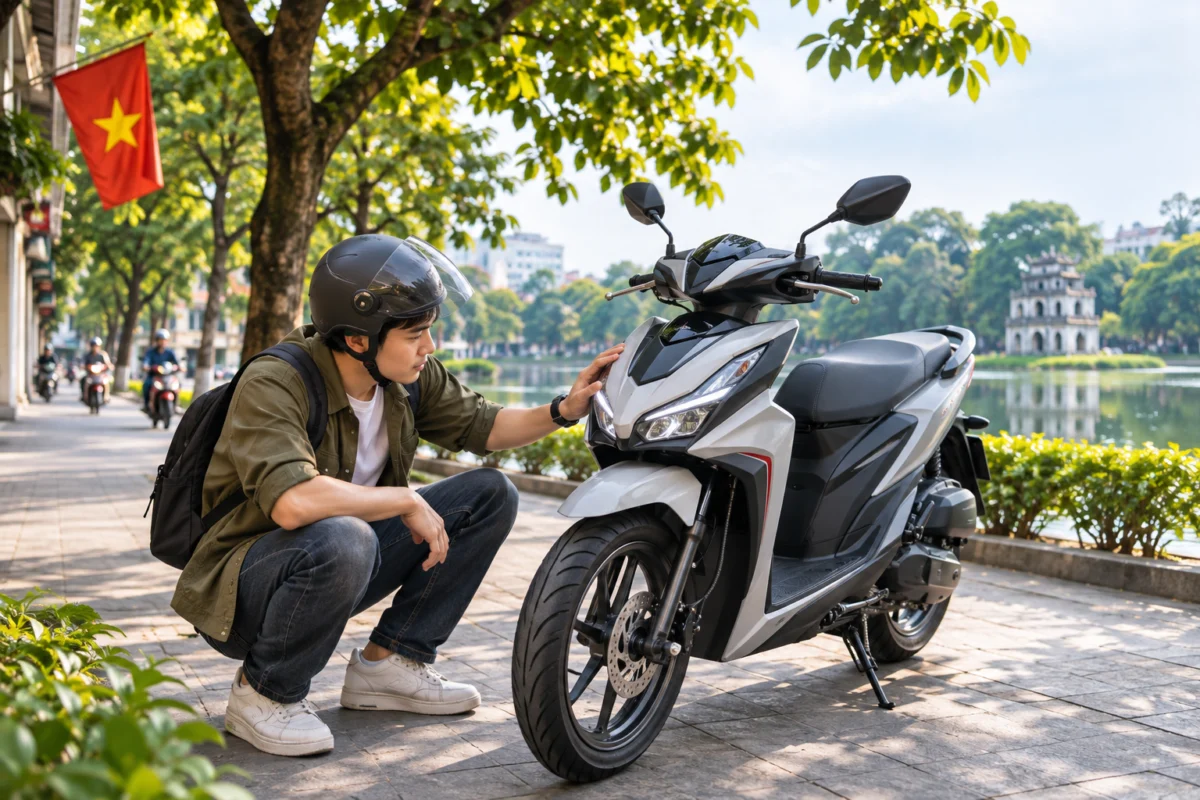
Not sure whether to ride a scooter in Hanoi? Ask HANOI MOTO on WhatsApp about an appropriate model, a pre-ride demonstration, rental dates, price and deposit. Do not rent to learn riding in live traffic; check your licence and insurance before riding.
The short answer: safe enough for some riders, not for everyone
Nobody can promise that a ride will be safe, and official advice is blunt. The UK Foreign, Commonwealth and Development Office says that traveling by motorbike in Vietnam is much riskier than in the UK, that motorbike accidents are common, and that you should not hire a motorbike if you are not an experienced rider (checked November 2026). That is the honest baseline for anyone asking whether Hanoi traffic is dangerous.
Risk drops when your skills, paperwork, bike and habits line up, and it climbs when one of them is missing. The four self-assessments below score each area, and a few stop rules override the total. Treat the grid as a decision aid written for this guide, not as an official test.
What makes riding in Hanoi different
Traffic density and flow
DTiNews (Dan Tri) reported on 7 May 2026 that Hanoi has more than 6.9 million motorcycles, and that more than 450,000 of them are concentrated inside Ring Road 1, the central belt. Traffic there moves as a continuous stream with few gaps, lane markings are followed loosely, and scooters, bicycles, pedestrians, cars and trucks share the same space.
What keeps a rider safe in a stream is predictability: a steady line, a steady speed, early braking and constant scanning of both sides. Sudden stops and sudden swerves are what other riders cannot anticipate.
Junctions, horns and unwritten habits
A short horn tap usually means I am here, not anger. Vehicles enter from side streets, alleys and sidewalks without stopping, and right of way is negotiated rather than granted: bigger and faster vehicles tend to go first. Slow down at every junction and assume someone will cross in front of you.
You will see local riders break rules that you cannot afford to break. Under Decree 168/2024/ND-CP, running a red light costs 4–6 million VND plus 4 points, riding the wrong way or on the sidewalk costs 4–6 million VND plus 2 points, and holding a phone while riding costs 800,000–1,000,000 VND plus 4 points. The Decree 168 fines guide has the full table. The FCDO also notes that compliance with road laws is poor, so keep your speed down and stay alert.
Weather, night riding and air quality
Rain turns painted lines and manhole covers slick, and downpours can arrive quickly. Slow down, double your following distance and consider a taxi when the rain is heavy. At night, pedestrians, bicycles and parked vehicles can be hard to see, headlights glare, and tiredness after a flight dulls reactions. Air quality varies by day, so check a live reading before a long ride and bring a mask you can breathe through.
Rules that changed in 2025 and 2026
- Law 36/2024/QH15 on Road Traffic Order and Safety took effect on 1 January 2025 and set the current license classes.
- Decree 168/2024/ND-CP, the fines decree, also took effect on 1 January 2025. Decree 238/2026/ND-CP amended it from 15 August 2026 but did not change the Article 7 rider fines quoted in this guide.
- Hanoi’s Low Emission Zone pilot began on 1 July 2026. In Zone 1, around Hoan Kiem Lake and the Old Quarter night-market streets, all road vehicles including motorcycles, mopeds and cars are barred from 19:00 to midnight every Friday, Saturday and Sunday, with exemptions for priority vehicles. Phase 1 runs to 31 December 2026 and later phases are only planned. See the Low Emission Zone guide for scooter renters.
Self-assessment 1: your riding skills
Score each row 0, 1 or 2. Be strict with yourself.
Balance and control at walking pace
Slow-speed control is the skill that dense traffic tests most. Try these drills in an empty parking lot on a scooter you are legally allowed to ride, before you travel:
- Ride 20 meters in a straight line at walking pace without putting a foot down.
- Make a U-turn within the width of a narrow street.
- Stop smoothly with both brakes from brisk walking pace, without skidding.
- Look over your shoulder and hold your line for three seconds.
- Start on a gentle slope without rolling back or stalling.
If you have never ridden, learn on private land with a licensed rider beside you, not on Hanoi streets.
Experience in dense traffic
Riding in orderly city traffic is not the same as riding in a stream of scooters entering from every side. Ask yourself how you react when a rider cuts in close or a horn sounds behind you. If you freeze or brake hard, you need more experience before your first time riding a motorbike in Vietnam.
Automatic, semi-automatic or neither
An automatic scooter has no clutch or gears: you twist the throttle and brake. HANOI MOTO’s fleet includes Honda Vision, Honda Air Blade and Honda Click or Yamaha Mio automatics, plus 50cc automatics, while the Honda Wave or RSX is semi-automatic, with a foot gear shifter and no clutch lever. The extra task of choosing gears makes a semi-automatic harder for a beginner. If you have ridden neither type, your answer is neither. The motorbike fleet page lists the types.
A simple scoring grid
| Skills check | 0 points | 1 point | 2 points |
|---|---|---|---|
| Riding yourself in the last 12 months | Never | A few rides on quiet roads | Regular rider |
| The five drills above | Cannot do most | Most, with effort | All, smoothly |
| Dense mixed traffic | None | Some, in orderly traffic | Regular |
| The bike type you would rent | Never ridden it | Ridden something similar | Ridden the same type |
Self-assessment 2: your legal status
The right license class
Under Law 36/2024/QH15, Article 57, class A1 covers two-wheel motorcycles up to 125 cc or electric up to 11 kW, and class A covers anything above that. A foreign visitor needs an International Driving Permit issued under the 1968 Vienna Convention, carried with the matching national license, or a national license from a country that has a recognition agreement with Vietnam. The 1985 ASEAN agreement is one such agreement. A permit is valid for up to three years and not beyond the national license. Ask HANOI MOTO for the engine size of the exact bike, because the class you need depends on it. The foreigner license rules guide goes deeper.
1968 vs 1949 IDP
Many US and Australian drivers carry a permit issued under the older 1949 Geneva convention. The wording of Law 36/2024 recognizes the 1968 convention, so on our reading a 1949 permit does not qualify, and older forum posts saying it is accepted do not reflect the current law. UK riders need the 1968 permit and their UK license, according to the FCDO. See 1968 vs 1949 permits explained.
Riding a 50cc moped without a license
A moped (xe gắn máy) has a design speed up to 50 km/h and a combustion engine up to 50 cc, or an electric motor up to 4 kW. Riders aged 16 and over need no license, though the vehicle is registered with plates. Anything above those limits is a motorcycle: registered, ridden by someone 18 or older, with a valid license. No license does not mean no skill, and your insurer may still ask for a license valid at home. The 50cc classification guide explains the practical limits.
What riding unlicensed can cost
Decree 168/2024/ND-CP, Article 18, sets a fine of 2–4 million VND for bikes up to 125 cc or 11 kW, including riding with the wrong class or an expired license, and 6–8 million VND above that (as of November 2026). The larger cost comes after a crash. The FCDO warns that an accident can bring criminal charges, compensation to injured people even for minor injuries, and a possible travel ban during the investigation, and World Nomads lists riding unlicensed as not covered.
| Legal check | 0 points | 1 point | 2 points |
|---|---|---|---|
| License for the bike’s class | None, wrong class, expired, or a 1949 permit only | No license, but a qualifying moped only | Valid home license plus 1968 permit, ASEAN-recognized or Vietnamese license |
| Bike class confirmed | Not checked | Told verbally | Engine size confirmed in writing and matched to your license |
Self-assessment 3: insurance and money at risk
Compulsory insurance covers third parties only
Compulsory civil liability insurance under Decree 67/2023/ND-CP, amended by Decree 220/2026/ND-CP, exists to compensate other people hurt or damaged by the bike. It does not pay for your own injuries and it does not repair the bike you are riding. Riding without valid compulsory insurance can be fined 200,000–300,000 VND under Decree 168, Article 18, so ask to see the bike’s certificate.
When travel insurance may not pay
World Nomads’ help page, checked in November 2026, says its plans cover riding a motorbike, moped or scooter only if you meet the policy conditions. As rider you need a license for that class back home and a helmet. As passenger, the rider must hold a valid license. No cover applies for riding unlicensed, breaking local laws, not wearing a helmet, theft or damage to the bike, or fines and payouts if you injure someone else. Other insurers set their own engine-size limits, add-ons and exclusions, so before you rely on any policy, ask the insurer in writing:
- Am I covered as the rider of a scooter, and up to what engine size?
- Which license must I hold, and does a moped need one?
- Is a passenger covered, and is damage to a rental bike excluded?
Deposit and damage exposure on a rental
HANOI MOTO’s owner-confirmed deposits as of 31 October 2026 range from 2 to 5 million VND depending on the model, so confirm the figure when you book. The deposit is refunded under the agreement’s conditions at return. A deposit is not a cap on what you could owe, because damage, theft and fines are settled by the rental agreement and by law. Read the agreement before you ride and ask who pays in each case.
| Insurance and money check | 0 points | 1 point | 2 points |
|---|---|---|---|
| Travel insurance for riding | None, or the insurer says no | Policy exists, riding clause unread | Insurer confirmed in writing that you are covered as rider |
| Rental agreement | Not seen | Skimmed | Read, and you know who pays for damage, theft and fines |
| Money cushion | Could not pay for treatment or the bike beyond the deposit | Could, with difficulty | Could, without hardship |
Self-assessment 4: your trip and habits
Short city stay vs month-long stay
On a one- or two-day stay you would learn the bike and the city at the same moment, which is when mistakes happen. A week or a month gives you time to build up gradually, though it also means more hours of exposure. If you plan trips outside Hanoi, ask HANOI MOTO whether your agreement allows them rather than assuming.
Alcohol, fatigue and night riding
Vietnam prohibits any alcohol for motorbike riders. Under Decree 168, Article 7, the lowest level is fined 2–3 million VND plus 4 points, the highest 8–10 million VND plus a license suspension of 22–24 months, and refusing a test also costs 8–10 million VND. World Nomads, for one, excludes cover when you break local laws. Fatigue, jet lag and unfamiliar night streets compound the risk, and on Friday to Sunday evenings the central Zone 1 is closed to motor vehicles from 19:00.
Carrying a passenger
Carrying two passengers (three people on the bike) is fined 400,000–600,000 VND, with exceptions such as a child under 12, and carrying three or more is fined 600,000–800,000 VND plus 2 points. Rider and passenger both need a fastened helmet, with fines of 400,000–600,000 VND. A passenger changes balance and braking distance, and World Nomads covers passengers only if the rider is properly licensed. Ride solo until the bike feels routine.
| Trip and habits check | 0 points | 1 point | 2 points |
|---|---|---|---|
| Time in Hanoi | One or two days | Three to six days | A week or more |
| When you ride | Late nights or evenings out | Some evening riding, sober | Daylight and early evening, taxi after dinner |
| Passenger and route | Two or more passengers, or a long provincial trip | One adult passenger or an out-of-town day trip | Solo, short city trips |
Reading your result: ride, practice first, or do not ride
Add the four tables for a total out of 24 (skills 8, legal 4, insurance and money 6, trip and habits 6).
| Total | Outcome | What to do |
|---|---|---|
| 19–24 | Ride | Fix any row where you scored 0, then follow the first-week plan below |
| 12–18 | Practice first | Raise your lowest area and start on an automatic |
| 0–11 | Do not ride yet | Use the alternatives below and return when your score improves |
Three stop rules override the total. Any chance you would ride after drinking means do not ride. A 0 on the license row means you cannot legally ride a motorcycle, whatever your total. A 0 on the five drills means practice first at best.
Ready: how to start with low risk
Start with an automatic, a daylight handover and a short loop on wide roads, away from rush hours. Keep the first days solo and sober, and add distance gradually.
Almost ready: practice and bike choice
Practice the drills until all five are smooth. HANOI MOTO does not offer riding lessons, and third-party beginner sessions exist, so check what they include. A lesson never replaces a valid license.
Not ready: alternatives that still work
Skipping the rental is a legitimate result. You can see Hanoi well without riding, and the next section shows how.
Alternatives to riding a scooter in Hanoi yourself
Walking the central wards
Hoan Kiem Ward (the Old Quarter area, formerly Hoan Kiem District) is compact enough to explore on foot. Cross at a steady pace without stopping or darting, and riders will steer around you. On Friday to Sunday evenings plan to walk the last stretch into Zone 1, because motor vehicles are barred from 19:00.
Ride-hailing and taxis
Ride-hailing apps and taxis operate across the city, and you can check the fare shown in the app before you confirm. A motorbike taxi (xe om) puts you on the back of someone else’s bike: you still need a helmet, and World Nomads warns that you may be without cover as a passenger, because the rider must hold the right license.
Local drivers and guided rides
A car with a driver, or a guided tour where a local rider carries you, removes the riding decision. Terms vary, so ask about helmets, the operator’s insurance and whether the driver holds the right license.
Buses and metro
Hanoi has two urban rail lines in service, Line 2A and the elevated section of Line 3. Subsidized public bus routes are free for passengers traveling within Ring Road 1 from 1 July 2026 to 30 June 2027, while commercial and tourist buses are excluded. Fares and schedules change, so confirm them with the operator.
If you decide to ride: your first-week plan
- Before you collect: finish the drills, confirm your license and permit, get your insurer’s answer in writing and ask for the exact bike’s engine size.
- At handover: HANOI MOTO’s premises are open 09:00–21:00 daily with handover by appointment, so ask for daylight. Check the helmet fit, brakes, lights, horn, tires and mirrors, and note any existing damage in writing.
- Day 1: ride a 20–30 minute loop on wide roads outside rush hours, practicing stops and turns.
- Days 2 and 3: short errands in daylight, with generous following distance.
- Days 4 and 5: one longer trip and a first early-evening ride, sober, avoiding Zone 1 on Friday to Sunday.
- Days 6 and 7: review honestly. If a near miss shook you or you are tired, switch to the alternatives for the day.
- Every day: helmet fastened, no phone in hand, zero alcohol.
If your self-assessment says you are ready, read how renting works, then send HANOI MOTO your dates and riding experience through the contact page, on Zalo at +84 857 255 868 or by email to motoopen12@gmail.com, and ask which bike suits you. If you scored lower, there is no need to rent.
Frequently asked questions
Can a complete beginner learn to ride a scooter in Hanoi?
Hanoi’s streets are a poor classroom. A beginner needs the right license or a qualifying moped, a quiet place to learn and time. Learn on private land first, preferably on an automatic. HANOI MOTO does not offer riding lessons, and the FCDO advises against hiring a motorbike if you are not an experienced rider.
Is a 50cc scooter safer, or only legally simpler?
Mostly legally simpler. A qualifying moped needs no license for riders aged 16 and over, but traffic, wet roads and the need for skill are the same. A lower top speed may reduce crash energy, yet it does not replace practice, and your insurer may still ask for a license valid at home.
Will my travel insurance cover a scooter crash in Vietnam?
It depends on your policy. World Nomads’ page, checked in November 2026, requires a license for that class back home and a helmet, and excludes riding unlicensed, breaking local laws, theft or damage to the bike, and fines or payouts for harming others. Compulsory insurance covers third parties only, so ask your insurer in writing.
Is the Old Quarter a good place for a first ride?
Not ideal. The streets are narrow, crowded with pedestrians and parked bikes, and Zone 1 bars all motor vehicles from 19:00 to midnight on Friday to Sunday during phase 1, which runs to 31 December 2026. HANOI MOTO’s pickup premises at 114 Nguyen Van Cu, Bo De Ward (former Long Bien District) are outside the Low Emission Zone areas, so begin with a short daylight loop.
What is the fine for riding without a valid license in Vietnam?
Decree 168/2024/ND-CP, Article 18, sets 2–4 million VND for bikes up to 125 cc or 11 kW, including the wrong class or an expired license, and 6–8 million VND above that, as of November 2026. After a crash, insurance and compensation can cost far more.
Sources and last checked
- Office of the National Assembly of Vietnam (Official Gazette), Consolidated Text No. 55/VBHN-VPQH: Law on Road Traffic Order and Safety (Law 36/2024/QH15), accessed November 2026
- LawNet (thuvienphapluat.vn), Law 36/2024/QH15 on Road Traffic Order and Safety, English translation, accessed November 2026
- LawNet (thuvienphapluat.vn), Decree 168/2024/ND-CP on penalties for road traffic violations, English translation, accessed November 2026
- LawNet (thuvienphapluat.vn), Decree 238/2026/ND-CP amending Decree 168/2024/ND-CP, accessed November 2026
- LawNet, Fines for operating a motorcycle without a driver license from 1 January 2025, accessed November 2026
- LawNet (thuvienphapluat.vn), Decree 67/2023/ND-CP on compulsory civil liability insurance for motor vehicle owners, accessed November 2026
- LuatVietnam, Decree 220/2026/ND-CP amending Decree 67/2023/ND-CP, accessed November 2026
- World Nomads, Am I covered by travel insurance if I’m riding a motorbike or scooter?, accessed November 2026
- GOV.UK (Foreign, Commonwealth and Development Office), Vietnam travel advice: Safety and security, accessed November 2026
- ASEAN Secretariat, Agreement on the Recognition of Domestic Driving Licences Issued by ASEAN Countries, accessed November 2026
- DTiNews (Dan Tri), Hanoi reveals motorcycle numbers in inner city areas, 7 May 2026, accessed November 2026
- Vietnam Government Portal, Ha Noi begins restricting fossil-fuel vehicles in low-emission zones, accessed November 2026
- Vietnam Government Portal, Ha Noi free bus travel within Ring Road 1 for one year, accessed November 2026
- VietnamPlus, Hanoi offers five days of free bus, metro rides for National Day, accessed November 2026
Part of the guide: Hanoi Riding Preparation and Day-Trip Planning
Conversation