
Before You Ride in Hanoi: License, Insurance, LEZ and Bike Checklist
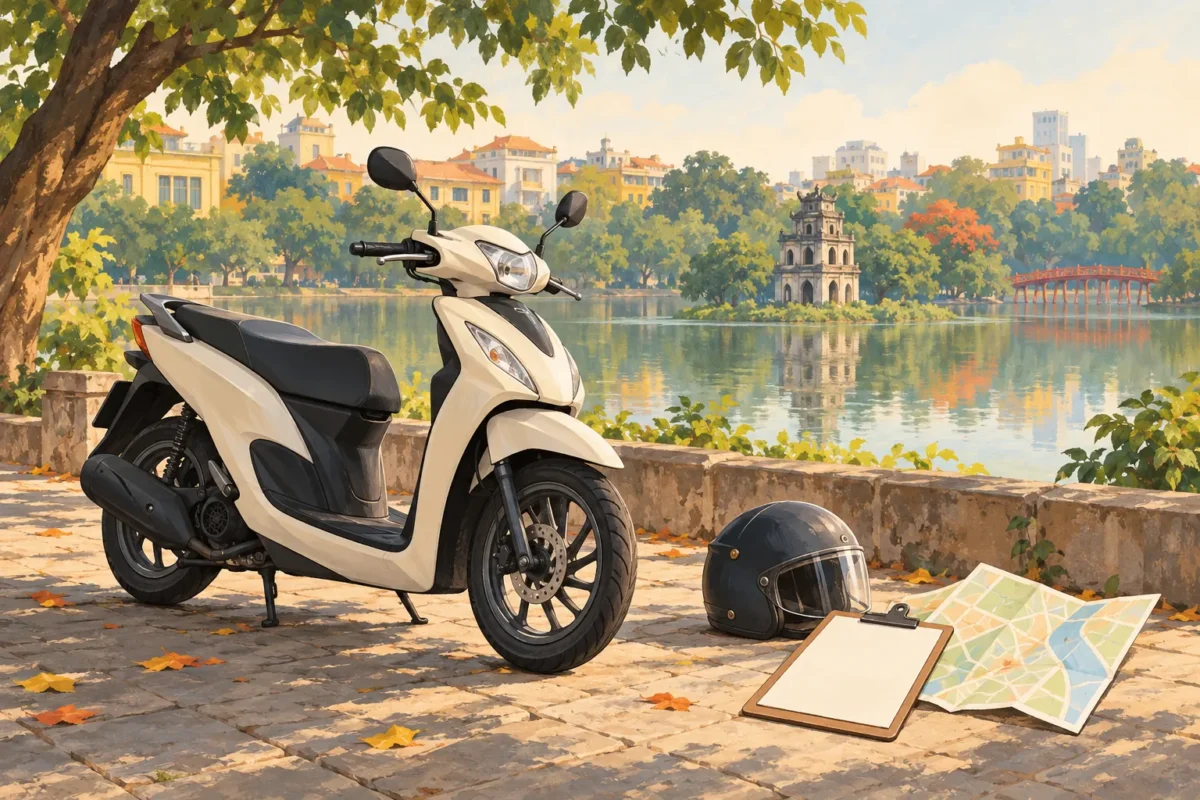
Featured image: original AI-generated editorial illustration, not a photograph of HANOI MOTO premises or inventory.
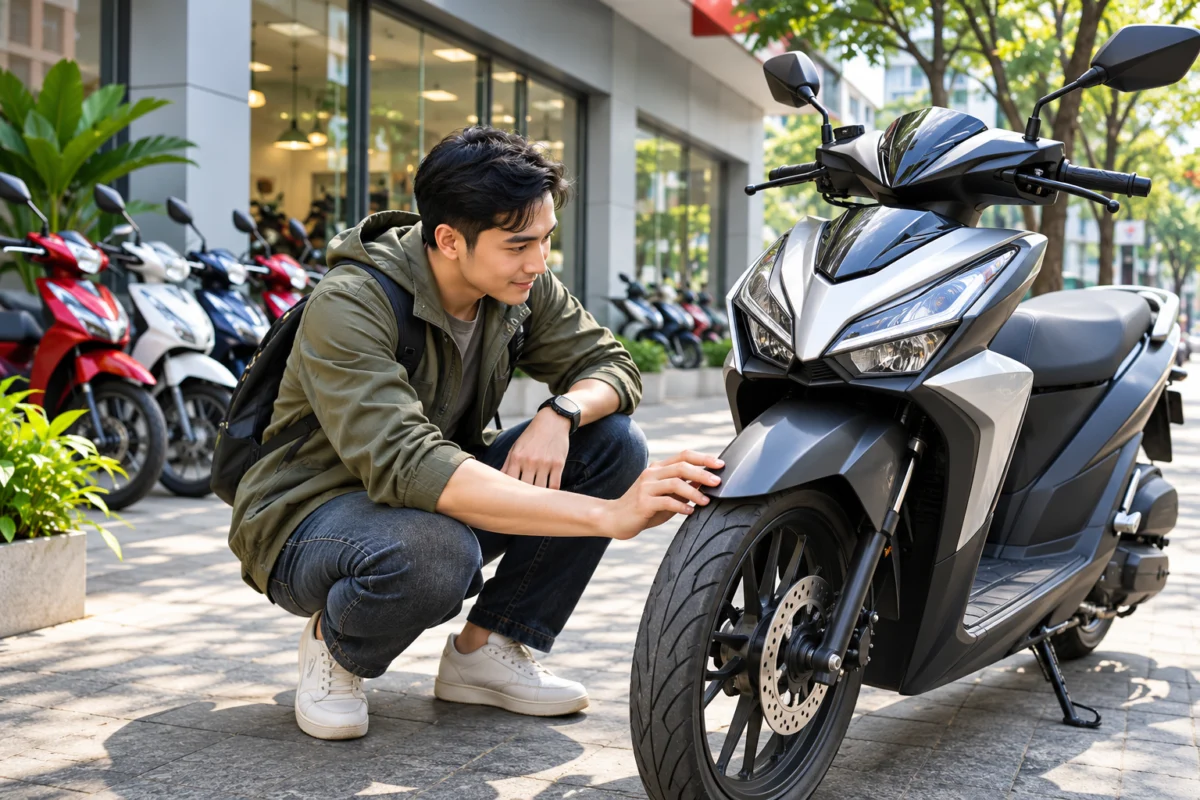
There are six things to know before renting a motorbike in Hanoi: whether your license covers the bike (for most visitors, a home license plus a 1968-convention International Driving Permit), what your insurance really pays for, whether the 2026 Low Emission Zone changes your evening plans, which bike fits your route, whether you can handle the traffic, and whether the rental agreement is clear. Score each gate go, pause or change: pause means fix it before paying a deposit, and change means use other transport. Rules are stated as of November 2026.
Checking your rental before you ride? Message HANOI MOTO to confirm the exact scooter, required renter and vehicle documents, dates, deposit and handover checklist. Independently verify your legal riding eligibility and insurance cover; a rental inquiry does not establish either.
The six-gate checklist at a glance
Summary table: the six gates
| Gate | Go when | Pause or change when |
|---|---|---|
| 1. License | Class covers the bike; foreign license recognized, or a true 50 cc moped at age 16+ | Expired, wrong class or only a 1949 permit |
| 2. Insurance | Third-party-only cover understood; your own policy read | Policy unread or needs a license you lack |
| 3. Low Emission Zone | Evening plans avoid Zone 1 on Friday to Sunday | Route needs a vehicle in Zone 1, 19:00–24:00 |
| 4. Bike choice | Bike, engine size and fit to route and load named | New controls, or wrong bike for the load or roads |
| 5. Traffic readiness | Experienced, rested, sober, at ease in dense traffic | New to heavy traffic, tired or drinking |
| 6. Rental agreement | Price, deposit, return time, riders and breakdown steps in writing | Anything vague or only spoken |
How to read a pause result
Go means the gate is clear. Pause means something can be fixed before you collect the bike, so hold off on the deposit. Change means the gap cannot be closed in time or the plan does not suit you, so use other transport for that day. A confident rider with an unresolved permit should still defer riding, and a tired traveler with valid documents can choose a non-riding arrival day.
Gate 1: Is your license valid for the bike you want?
Short answer: yes, but only if its class covers the bike’s engine size and, for a visitor, Vietnam recognizes it. Check the actual bike against Law 36/2024/QH15 on Road Traffic Order and Safety (in force since 1 January 2025), not a post claiming every scooter is exempt.
A1 up to 125 cc vs A above 125 cc
License A1 covers motorcycles up to 125 cc (or electric up to 11 kW); license A covers anything larger and also A1 (Article 57). Some popular models come in more than one engine size, so ask for the exact figure. Riding without a valid license for the bike’s class (wrong class, expired or fake) is fined 2–4 million VND up to 125 cc and 6–8 million VND above, under Decree 168/2024/ND-CP, Article 18, as amended by Decree 238/2026/ND-CP (in force since 15 August 2026).
1968 IDP vs 1949 IDP in one paragraph
A visitor may ride on a home license carried with an International Driving Permit issued under the 1968 Vienna Convention, or on a license from a country Vietnam recognizes by agreement, such as other ASEAN states (1985 ASEAN agreement). A permit under the 1949 Geneva Convention, the type the United States issues, falls outside the law’s 1968 wording, whatever older forum threads claim. Read the guides to 1968 versus 1949 permits and to whether foreigners can ride a motorbike in Vietnam.
No license: what a 50 cc moped allows
A moped (xe gắn máy) is the one category riders aged 16 and over may ride without a license: design speed up to 50 km/h with a combustion engine up to 50 cc or an electric motor up to 4 kW (Law 36/2024/QH15, Articles 34, 56 and 59). Exceed either limit and it is a motorcycle needing a license and a rider aged 18 or over.
Quick self-test: can you state your license class, the bike’s engine size and your permit’s convention? If not, pause.
Gate 2: Are you insured for what can actually go wrong?
Short answer: probably not for most of it. Compulsory liability insurance can cover eligible third-party loss and passenger injury or death, while travel insurance has separate riding conditions. Responsibility for the rental bike depends on applicable law, any separate cover and the rental agreement.
Compulsory insurance covers third parties and eligible passenger injuries
Decree 67/2023/ND-CP, as amended by Decree 220/2026/ND-CP, makes civil liability insurance compulsory for motor vehicle owners. It has scope for third-party losses and passenger injury or death under Article 7 of Decree 67/2023/ND-CP, but not the driver’s own medical costs or loss of or damage to the insured bike. A rider without valid cover can be fined 200,000–300,000 VND (Decree 168/2024/ND-CP, Article 18(2)(b)), so ask the shop to confirm the bike’s certificate covers your dates.
Travel insurance conditions: home-country license and helmet
World Nomads’ help page, read in November 2026, says cover depends on a license valid for that vehicle class at home and in the destination, following local law and always wearing a helmet; passengers are covered only if the rider is properly licensed. Other insurers set their own terms, which this guide has not checked, so ask yours in writing.
Damage to or theft of the rental bike is an agreement matter
World Nomads excludes theft of or damage to the bike, and compulsory cover does not include it. HANOI MOTO has no insurance package; damage, theft, breakdown and refund terms are by agreement (see Gate 6).
Quick self-test: can you say who pays if you injure a pedestrian, if you are hurt and if the bike is stolen? If not, pause.
Gate 3: Does the 2026 Low Emission Zone change your plans?
Short answer: only if you want to ride into the Hoan Kiem Lake and Old Quarter night-market area on a Friday, Saturday or Sunday evening. Vietnam Law Magazine wrote on 10 October 2026: “For now, Hanoi has not banned petrol-powered motorcycles in the pilot areas.”
Zone 1: all motor vehicles out 19:00–24:00 Friday to Sunday
Phase 1 runs from 1 July to 31 December 2026. The Vietnam Government Portal reported on 2 July 2026 that all road vehicles, including motorcycles, mopeds and cars, are barred from 7:00 p.m. to midnight every Friday, Saturday and Sunday in Zone 1, around the lake walking zone and the Old Quarter night-market streets. Priority vehicles keep access, and press reports say electric motorbikes are covered too. No LEZ-specific penalty had been published in the sources checked; a no-entry fine under Decree 168/2024/ND-CP is likely, but that is our inference. Street lists differ, so check a map.
Zone 2: limits encouraged, not a ban on private scooters
In Zone 2, the streets linking the lake area and the Old Quarter, limits are only encouraged: for app-based motorcycle taxis, and for motorcycles made before 2008 and mopeds made before 2016. Nothing in Phase 1 bars a private scooter.
What outdated pages still get wrong
Many English pages still describe the April 2026 draft or a full petrol-motorbike ban inside Ring Road 1. That was a target in Directive 20/CT-TTg (12 July 2025), not a rule in force. Phase 1 ends on 31 December 2026 and later phases may change, so recheck before planning evenings in 2027. The Low Emission Zone guide for scooter renters explains the scheme in full.
Quick self-test: will your hotel, dinner or route put you inside Zone 1 on a Friday to Sunday evening? If yes, walk in from outside.
Gate 4: Which bike fits your route and experience?
Short answer: match the bike to what you have already ridden. A first-timer in city traffic is usually better on an automatic scooter; a semi-automatic suits someone comfortable shifting gears. The guide to choosing a rental bike by fit, controls and route goes deeper.
Automatic scooter vs semi-automatic Honda Wave
Automatic scooters such as the Honda Vision, Air Blade, Click and Yamaha Mio need no gear changes: you twist the throttle and brake. A semi-automatic such as the Honda Wave or RSX has no clutch lever, but you shift with your left foot, which adds a task each time you start, stop and crawl through traffic. An automatic removes gear selection but leaves every other riding task in place.
Passengers, hills and engine size
Engine size sets your license class (Gate 1). A 50 cc moped has a design speed of no more than 50 km/h, which suits slow city hops better than faster roads. Carrying two passengers is fined 400,000–600,000 VND, as is a passenger without a helmet (Decree 168/2024/ND-CP, with limited exceptions). For day trips beyond Hanoi, where hills tax a small engine, route permission is by agreement, so ask first.
Electric options and charging questions
HANOI MOTO’s fleet includes electric options, priced on request by model. Ask for the motor’s power, real range and charging plan: up to 4 kW can qualify as a moped, and up to 11 kW falls under class A1.
Quick self-test: can you name the bike type, its engine size and one reason it suits your route and passengers?
Gate 5: Are you ready for Hanoi traffic?
Short answer: a valid license does not make Hanoi traffic easy. If you have never ridden in dense, mixed traffic, the city is a poor place for a first lesson.
Honest self-assessment questions
- Have you ridden a motorbike or scooter regularly in the past year?
- Can you brake hard in a straight line, make a slow U-turn and check over your shoulder without wobbling?
- Are you at ease among buses, trucks, bicycles, pedestrians and scooters entering from every side?
- Are you rested and sober? A long flight dulls reaction time.
- Will you and any passenger wear fastened helmets on every ride?
A no to any of the first three means pause. The scored self-assessment of riding in Hanoi goes further.
The rules with the highest fines: alcohol, red lights, phones
Decree 168/2024/ND-CP, as amended by Decree 238/2026/ND-CP, sets these fines (as of November 2026):
- Alcohol: any level is prohibited. Fines run from 2–3 million VND at the lowest level to 8–10 million VND plus a 22–24 month license suspension at the highest.
- Red light: 4–6 million VND, or 10–14 million VND if it causes a crash.
- Hand-held phone while riding: 800,000–1,000,000 VND.
- No helmet, or an unfastened one: 400,000–600,000 VND.
When Grab, a taxi or a guided tour is the better choice
Choose another way to get around when a gate is paused, you are tired from a flight, rain is heavy, you have had any alcohol, or your evening plan sits inside Zone 1. A taxi or a ride-hailing app such as Grab keeps you off the controls, and a guided tour or a driver suits long day trips. A backup plan keeps the rental supporting the trip instead of forcing you to ride because you have paid for the day.
Gate 6: Is the rental agreement clear before you pay?
Short answer: not until every term is in writing. The law covers your license and insurance duties; the rest is what you and the shop agree. The how to rent page walks through the booking steps.
Deposit, payment and documents by agreement
The deposit, payment method, which documents the shop checks or holds, extension and early-return terms, the breakdown procedure and refund conditions are all set by agreement, not by a fixed public rule. Ask for each in writing. If a shop asks to hold your passport, ask why and how it is returned: Decree 282/2025/ND-CP, Article 21(3)(b), fines pledging or accepting a pledge of a foreigner’s passport 3–5 million VND, though applying that to rental deposits is an interpretation, not settled law.
Who may ride the bike
Name every rider in the agreement. Each rider needs their own valid license for the bike (Gate 1), so a friend who just moves it is still a rider. Tell the shop about any passenger before the agreement is finalized.
Photos at pickup and at return
Walk around the bike with the shop before you leave. Photograph every scratch and dent, the tires, plate, odometer and fuel level, and check brakes, lights, horn and steering. Decline a bike with an unresolved safety defect. Repeat the photos at return in the same order.
Quick self-test: can you state the price, deposit, return time, riders and breakdown steps without looking? If not, pause.
How HANOI MOTO fits into these checks
Below is what the owner has confirmed about HANOI MOTO; everything else is by agreement.
Models and indicative rates as of 31 Oct 2026
The fleet includes the Honda Wave and RSX (semi-automatic), Honda Vision, Honda Air Blade, Honda Click or Yamaha Mio (automatic), 50 cc automatic scooters and electric options. These are owner-confirmed rates as of 31 October 2026 — confirm when you book: daily rates run from 150,000 VND (Wave, Click, Mio) to 200,000 VND (Vision, Air Blade, 50 cc automatic), with deposits of 2 to 5 million VND by model. Weekly and monthly rates are on the rental prices page.
Pickup in Bo De Ward, handover by appointment
Pickup is at 114 Nguyen Van Cu, Bo De Ward, Hanoi (the former Long Bien District), open 09:00 to 21:00 daily, with handover by appointment. The premises lie outside the Low Emission Zones. HANOI MOTO does not offer riding lessons.
What is confirmed only by direct message
Availability, exact model and engine size, the deposit for your dates, payment, documents, who may ride, city or provincial routes, delivery, cancellation, early return, breakdown procedure and refund conditions are by agreement and confirmed by direct message. Nothing here is a quote.
Once you have passed the six gates, send HANOI MOTO your dates, preferred model and license type through the HANOI MOTO contact page, on Zalo at +84 857 255 868 or by email to motoopen12@gmail.com, and ask what can be arranged.
Frequently asked questions
Is the whole Old Quarter closed to scooters in 2026?
No. During Phase 1 (1 July to 31 December 2026), only Zone 1, around the Hoan Kiem Lake walking zone and the Old Quarter night-market streets, is closed to all motor vehicles, and only 19:00–24:00 on Fridays, Saturdays and Sundays. Zone 2 and the rest of the Old Quarter stay open to private scooters under the scheme.
Do I need insurance from the rental shop to ride legally?
The bike must carry valid compulsory civil liability insurance, which is the owner’s duty under Decree 67/2023/ND-CP, so ask the shop to confirm it covers your dates. That cover includes eligible third-party losses and passenger injury or death, not medical costs of the driver or damage to the insured bike. Your own medical cover and any bike-loss liability require checking actual insurance, applicable law and the rental agreement.
Is a semi-automatic Honda Wave harder to ride than an automatic?
It adds one skill: shifting gears with your left foot. If you have never shifted by foot, an automatic is simpler in stop-and-go traffic; if you have, the Wave is easy.
What should I have ready before I message a rental shop?
Your dates and pickup time, the model you want plus a second choice, the number of riders and passengers, your license class and permit type, and where you plan to ride. Ask for the price, deposit, refund conditions and breakdown procedure in writing.
If I fail one gate, should I cancel the idea of renting?
Not necessarily. A pause is fixable before you pay, such as confirming engine size or getting terms in writing; a change means other transport for that day. Gates 1 and 5 are firmer: without a valid license or basic riding skills, do not ride a motorbike yourself on this trip.
Sources and last checked
- Office of the National Assembly of Vietnam (Official Gazette), Consolidated Text 55/VBHN-VPQH: Law 36/2024/QH15 on Road Traffic Order and Safety, accessed November 2026
- LawNet, Decree 168/2024/ND-CP on road traffic penalties (Vietnamese), accessed November 2026
- Vietnam Official Gazette, Decree 238/2026/ND-CP amending Decree 168/2024/ND-CP (Vietnamese), accessed November 2026
- LawNet (thuvienphapluat.vn), Decree 67/2023/ND-CP on compulsory civil liability insurance, English translation, accessed November 2026
- LuatVietnam, Decree 220/2026/ND-CP amending Decree 67/2023/ND-CP, accessed November 2026
- LuatVietnam, Decree 282/2025/ND-CP (Vietnamese), accessed November 2026
- ASEAN Secretariat, Agreement on the Recognition of Domestic Driving Licences Issued by ASEAN Countries, accessed November 2026
- World Nomads, Am I covered by travel insurance if I’m riding a motorbike or scooter?, accessed November 2026
- Vietnam Government Portal, Ha Noi begins restricting fossil-fuel vehicles in low-emission zones (2 July 2026), accessed November 2026
- Vietnam Law Magazine, Low emission zones and motorcycle inspections: a new approach to urban air quality (10 October 2026), accessed November 2026
- HANOI MOTO, owner-confirmed rates, deposits, fleet, address and opening hours, recorded 31 October 2026
Part of the guide: Rental Documents, Licenses and Insurance Questions