
Judging a Rental Scooter by Age and Condition: What to Check
Age is a weak signal on its own. A rental scooter that is a few years older can be the safer, smoother choice if it is well maintained, and a newer one can still arrive with worn tires or a weak rear brake. Judge the bike in front of you: confirm its model and version, check its condition against a short list, and only then let age matter, which it does in a few specific places in 2026 to 2028, such as Hanoi’s low emission zone guidance and the planned motorcycle emission tests.
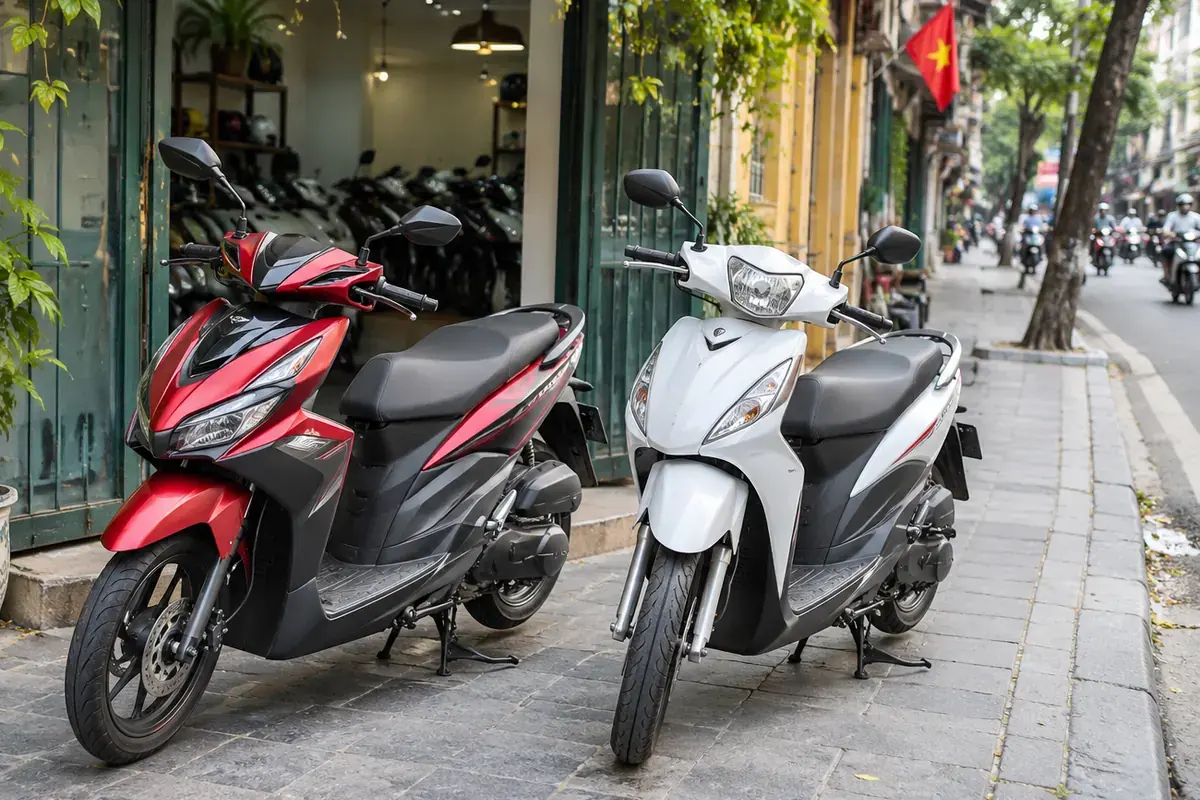
This guide shows how to read a rental scooter’s age and condition directly, what a model year or engine version really changes for a renter, how fuel injection and carburetors differ in daily use, and which questions to ask before you accept any bike. It is written for anyone comparing offers, whoever the shop is. For the models HANOI MOTO lists, see the fleet page.
Does age matter on a rental scooter?
Sometimes, but less than most renters expect. Age tells you roughly which generation of design you are riding. It says little about how the specific bike was used, serviced or repaired. Two scooters of the same model and year can be in very different shape.
What a newer bike may change
- Features. Newer versions of a model may add a smart key, a USB port, LED lighting, a combined braking system or a different fuel system. Which of these a given bike has depends on the version, not only the year.
- Starting and idling. Many recent scooters are fuel injected and start easily from cold. Many older ones use a carburetor and can need a little more patience (more on that below).
- Fewer worn-out parts. A bike with a lower odometer reading has had less time to wear brake pads, tires, the drive belt and the suspension, although a low reading can be wrong or reset, so treat it as a clue, not proof.
- Rules that follow age. Some Hanoi guidance and future emission tests refer to when a bike was made, covered in the section on where age does matter.
What it does not ensure
A newer bike does not ensure good brakes, correct tire pressure, a charged battery, a clean air filter or a sensible previous rider. Rental scooters are used hard, so a year-old bike with a heavy rental history can be in worse shape than a well-kept older one. Age also does not tell you whether the shop services bikes between rentals. Only a check of the bike and a few direct questions do.
When an older bike is a sensible choice
An older scooter can suit you when the basics are sound and your trip is simple. Short city rides, a first week while you get used to traffic, or a budget-conscious monthly stay are all reasonable cases. It makes less sense when you plan hills, long distances, heavy luggage or a passenger, where a bike in the best mechanical shape you can find matters more. If a shop offers you an older bike at a lower rate, treat the discount as a trade you can evaluate: compare it with the checklist below, and with the cost items in how to compare Hanoi scooter rental quotes.
How to find a bike’s model year and version
Rental shops often describe a bike by its model name alone, such as “Vision” or “Air Blade”. That name can cover several years and several versions. Ask which version you are being offered and how the shop knows.
Registration certificate details (format to verify)
Every registered motorbike has a registration certificate (giấy đăng ký xe) that records identifying details such as the plate number, the frame number and the engine number. Exactly which fields it prints about model and manufacturing year, and in what format, is something we could not verify for this guide, so do not assume a particular layout. What you can do is ask to see the paper, check that the plate on the bike matches the plate on the document, and ask the shop to point to where the year or version is shown. Do not ask to keep the document; the rental paperwork and documents are agreed separately, as covered in how to rent a motorbike in Hanoi.
Model badges and version features
The body panels, badges, instrument cluster, key type and lighting often show which generation you have. Compare what you see with the manufacturer’s published specifications for that model, not with a forum post. If the shop says “same as the 2020 version”, ask what is actually the same. Be careful with badges alone: panels can be swapped after a crash, and a replaced panel can make a bike look newer or older than it is.
Asking the shop and what a useful answer looks like
A useful answer is specific. “It is the automatic 110cc version, here is the registration paper, and the fuel system and service dates are as follows” is useful. “It is the new one, no problem” is not. Good questions include:
- Which model and version is this bike, and what engine size is it?
- Do you know the manufacturing year, and can you show me where it is recorded?
- When was it last serviced, and what was done (oil, brake pads, tires, belt or chain)?
- Is it fuel injected or carbureted, and which fuel does the shop recommend?
- If I find a problem after pickup, how is it handled (by agreement, and in writing)?
If the shop cannot answer the first two, take that as information about how the bike is managed, and decide whether you are comfortable.
Engine variants: match the model year and specifications
Brochure specifications describe a particular version. A rental can differ from the spec sheet you found online, which is one reason the same model can feel different from the one you know at home. Matching the bike to its real specifications helps you avoid surprises in power, range and license rules.
When one model name covers several engine versions
Manufacturers update popular scooters over the years, changing engine size, fuel system, braking system, lighting and keys while keeping the model name. Vietnam-market versions can also differ from the same name sold in other countries, which is why a bike may feel different from its namesake at home. Do not assume. Ask for the version and compare the engine size on the paperwork with the engine size the shop quotes.
Why the variant matters for your license
Engine size decides license class. Under Law 36/2024/QH15, a two-wheel motorcycle up to 125 cc (or electric up to 11 kW) falls under class A1, and above that you need class A. Below that sits the moped category (up to 50 cc combustion, or electric up to 4 kW), where riders need no license but must be at least 16. If a scooter’s real engine size is not what you were told, your license may not cover it, with fines and insurance consequences. Our guides to license classes A1, A and B and checking that a scooter is really 50cc explain the details.
Features that vary: brakes, keys, lights
Check three things that vary most between versions. First, the braking setup: drum, disc, combined braking or ABS change how the bike stops, and the lever feel matters if you are used to something else (see scooter brakes explained). Second, the key: a smart key or a push-button seat release behaves differently from a plain key, so ask for a demonstration. Third, the lights: confirm that the headlight, tail light, brake light and indicators all work, whatever type they are.
Fuel injection vs carburetor: questions about a rental bike
Both systems get the same job done: mixing fuel and air for the engine. A fuel-injected engine measures and sprays fuel electronically. A carbureted engine mixes it mechanically. For a renter, the practical differences show up in starting, idling and how forgiving the engine is. Neither is automatically better. A well-maintained carbureted bike beats a neglected fuel-injected one. Do not assume which system a given model has; many models changed over time, and the version decides. Ask.
Cold starts and idling
| Situation | Fuel injected (typical) | Carbureted (typical) |
|---|---|---|
| Cold morning start | Usually starts promptly with the start button | May need a moment, a slightly open throttle or a second try |
| Idle after starting | Usually settles on its own | May idle high or low at first and then settle |
| Stop-start traffic | Smooth and steady when healthy | Can stall or hesitate if the carburetor is dirty or poorly adjusted |
| What a fault feels like | Warning light or uneven running; often needs diagnosis | Rough running, black smoke or hesitation; often a cleaning or adjustment |
These are general tendencies, not rules. At pickup, start the bike cold if you can, since a warmed-up engine hides starting trouble. Let it idle for a minute, rev it gently and listen for misfires, stalling or an unsteady idle.
Fuel: E10 or E5 RON92, check the manual
Under Circular 50/2025/TT-BCT, unleaded petrol sold in Vietnam has been blended as E10 from 1 June 2026, while E5 RON92 may still be sold until the end of 2030. Both are normal pump fuels. We found no guidance from Honda Vietnam or Yamaha Vietnam on E10 for specific models, so we cannot say how a particular bike will behave. The practical step is to check the owner’s manual for the fuel recommendation, or ask the shop which fuel it expects. Older engines with older fuel-system parts are the ones people most often ask about, so it is a fair question for an older bike. Current prices and a fuller explanation are in our rental scooter fuel guide.
What to ask if the bike runs roughly
If the bike hesitates, surges or stalls, say so before you ride off. Useful questions: when was the air filter and spark plug last changed, is the problem the same cold and warm, and has it had fuel-system cleaning or a recent repair? A rough engine on the first day of a rental is a reason to ask for another bike, not to hope it improves.
Condition beyond age: a 10-point acceptance check
Do this at handover, in daylight, before you sign or pay. It takes ten to fifteen minutes. Photograph anything that is already damaged, as described in photographing a rental scooter at pickup, and use the daily routine in the pre-ride inspection each morning afterward. This section is about whether to accept the bike at all.
Brakes, tires and wheels
- 1. Front and rear brakes. Each lever should engage firmly, not travel to the grip, and the bike should stop in a straight line during a slow test. A spongy, squealing or grinding brake is a no.
- 2. Tires. Look for visible tread across the whole surface, no cracks in the sidewall, no bulges and no embedded nails. Very old tires can be hard and cracked even with tread left.
- 3. Wheels. Spin each wheel and watch for wobble, check the spokes or alloy for bends, and listen for bearing noise.
Chain or drive, suspension and steering
- 4. Drive. Most scooters use a belt or a sealed drive, while semi-automatic bikes like the Wave use a chain. A chain should not sag heavily or look dry and rusty. A belt-drive scooter should accelerate smoothly, without shuddering or a loud whine.
- 5. Suspension. Press down on the seat and front end. They should rebound once and settle, with no leaking fork oil and no bouncing.
- 6. Steering. Turn the bars lock to lock. They should move smoothly, without notches, and the bike should roll straight with your hands off lightly at walking speed.
Lights, horn, mirrors and switches
- 7. Lights and indicators. Headlight (low and high beam), tail light, brake light on both levers, and all four indicators.
- 8. Horn, mirrors and switches. The horn must be audible, both mirrors usable and adjustable, the kill switch and ignition working, and the seat locking properly.
Leaks, smoke and unusual noises
- 9. Leaks and smoke. Look under the bike for oil or fluid drips and check the exhaust: thick blue or white smoke after warm-up is a warning sign.
- 10. Noises and charging. Listen for knocking, rattling or scraping when idling and moving off, and check that the battery starts the bike repeatedly and the electrics do not flicker.
Also check the basics around the bike: a working helmet that fits (see checking a rental helmet), and the fuel level at pickup. If even one critical safety check fails, such as brakes, tires or steering, do not accept or ride the bike; ask for a safe replacement or choose another option. Record minor cosmetic marks separately. Minor cosmetic scratches are normal on a rental; record them and move on. Mechanical and safety faults are different.
Where age does matter: LEZ guidance and emission tests
Age becomes relevant in rules that treat older bikes differently. At the time of writing in November 2026, none of these bans a petrol scooter from being rented, but they are worth understanding so a model year does not surprise you.
LEZ Zone 2: motorcycles made before 2008 and mopeds before 2016 encouraged to limit
Hanoi’s Low Emission Zone pilot, approved by the People’s Council on 15 June 2026, runs in Phase 1 from 1 July to 31 December 2026. In Zone 2, private motorbikes are encouraged to limit use if they are motorcycles made before 2008 or mopeds made before 2016. That is guidance, not a ban, and private petrol motorbikes are not banned in the pilot areas. Zone 1 is different: all motor vehicles, including electric ones, are banned there from 19:00 to 24:00 on Fridays, Saturdays and Sundays, whatever their age. A shop can reasonably tell you the manufacturing year of a bike so you know whether Zone 2 guidance would apply. Our low emission zone guide for scooter renters covers the zones and hours, and the details may change when Phase 1 ends.
Emission testing from 1 July 2027 and level 2 from 2028
Under Decision 13/2026/QĐ-TTg, motorcycles and mopeds in Hanoi and Ho Chi Minh City are due to begin emission testing from 1 July 2027, and from 1 January 2028 bikes there must meet at least emission level 2. How testing will be run for rental fleets, and which bikes will need work to pass, has not been spelled out in the sources we reviewed, so avoid assuming that a particular model year will pass or fail. For a renter this mainly affects very long rentals that run into 2027 and beyond: ask the shop how a test would be handled for the bike you hold.
Planned 2030 limits may change
Plans reported for 2030 would restrict private petrol motorbikes below a certain emission level (QCVN 99:2025/BNNMT), but these phases have already been adjusted once and may change again. Treat 2030 as a planning horizon rather than a rule, and read the Hanoi petrol motorbike roadmap for the current picture.
Long rentals: maintenance history beats model year
For a rental of a month or more, how the bike is looked after matters far more than its year. A bike that is serviced on a schedule and repaired promptly will treat you better than a newer one that nobody checks.
Service records and who pays (by agreement)
Ask whether the shop keeps service records and can show recent work. Who pays for routine servicing, wear parts such as tires and brake pads, and breakdown repairs during a long rental is a matter for the rental agreement, not a fixed rule, so get it in writing before you start. Our guide to who pays for maintenance on a long-term rental lists what to cover.
Swapping a bike mid-rental
If the bike turns out to have recurring faults, ask whether it can be swapped. Whether a swap is possible, and on what terms, is by agreement with the shop, so ask before you pay rather than after. Keep the same photographs and notes you made at pickup for the replacement bike.
Questions to ask before accepting an older bike
- What is the exact model and version, and what is the engine size?
- When was it made, and where is that recorded on the paperwork?
- When was the last service, and what did it include?
- Is it fuel injected or carbureted, and which fuel should I use?
- Does it start cleanly cold, and does it idle steadily once warm?
- How old are the tires, and when were the brake pads last changed?
- What happens if it breaks down or I want another bike (by agreement)?
- Are there existing scratches or damage recorded in writing?
To inquire about a bike, send your dates, preferred model and pickup plan through the HANOI MOTO contact page, on Zalo at +84 857 255 868 or by email to motoopen12@gmail.com, and ask which model and version is being offered. Allow time at handover to check the bike against the list above.
Frequently asked questions
Is an older scooter more likely to break down?
Not necessarily. Maintenance history and the way a bike has been used predict breakdowns better than age alone. Older bikes have had more time to wear, so check tires, brakes, drive and electrics carefully, and ask when it was last serviced.
How can I tell if a bike has been well maintained?
Look for even tire wear, firm brakes, clean oil and chain, steady idling, no leaks, and a seller who can say when the last service happened. Records help, and a shop that answers questions plainly is a good sign.
Will an older carbureted scooter run on E10?
We found no model-specific guidance from Honda Vietnam or Yamaha Vietnam, so we cannot say. E10 has been the standard blended unleaded petrol since 1 June 2026, and E5 RON92 may be sold until the end of 2030. Check the owner’s manual or ask the shop which fuel it expects.
Can I ride a motorbike made before 2008 in Hanoi’s LEZ?
Yes, as of November 2026. Zone 2 guidance only encourages owners of private motorcycles made before 2008 to limit use, and private petrol motorbikes are not banned. Zone 1 has time-based bans for all motor vehicles on Friday to Sunday evenings, whatever the age. Rules may change after Phase 1 ends on 31 December 2026.
Does an older bike mean a lower rental price?
Sometimes, but not always, and it depends on the shop. Price reflects the model, term and what the shop agrees to include. Ask what the price covers rather than assuming age sets it; owner-confirmed HANOI MOTO rates as of 31 October 2026 are on the rental prices page, and you should confirm them when you book.
Sources and last checked
- Vietnam, Law 36/2024/QH15 on Road Traffic Order and Safety (vehicle classes and license classes), as summarized in our linked license guides, accessed November 2026
- Government of Vietnam (Vietnam Government News), Govt releases timelines for vehicle emission inspections, accessed November 2026
- Vietnam News, Hà Nội today launches low-emission zone within Ring Road 1, accessed November 2026
- Automotive World, Hanoi scales back motorcycle ban with phased LEZ approach, accessed November 2026
- Ministry of Industry and Trade, Circular 50/2025/TT-BCT on E10 petrol blending (as reported in Vietnamese press and summarized in our fuel guide), accessed November 2026
- Decision 13/2026/QĐ-TTg on motorcycle and moped emission testing (as reported by Vietnamese media), accessed November 2026
Part of the guide: Rental Motorbike Models and Comparisons