
Hanoi Riding Technique: Junctions, Following Distance and Missed Turns
To ride a scooter in Hanoi traffic well, you do not need to be fast or aggressive. You need to be predictable: slow down early at junctions, keep a gap you can actually stop in, treat painted lines and metal covers as slippery, pull fully out of the traffic line before you check your phone, and carry on past a missed turn instead of braking or reversing. This guide gives you one rule for each of those five situations, plus the fines that follow the most common mistakes.
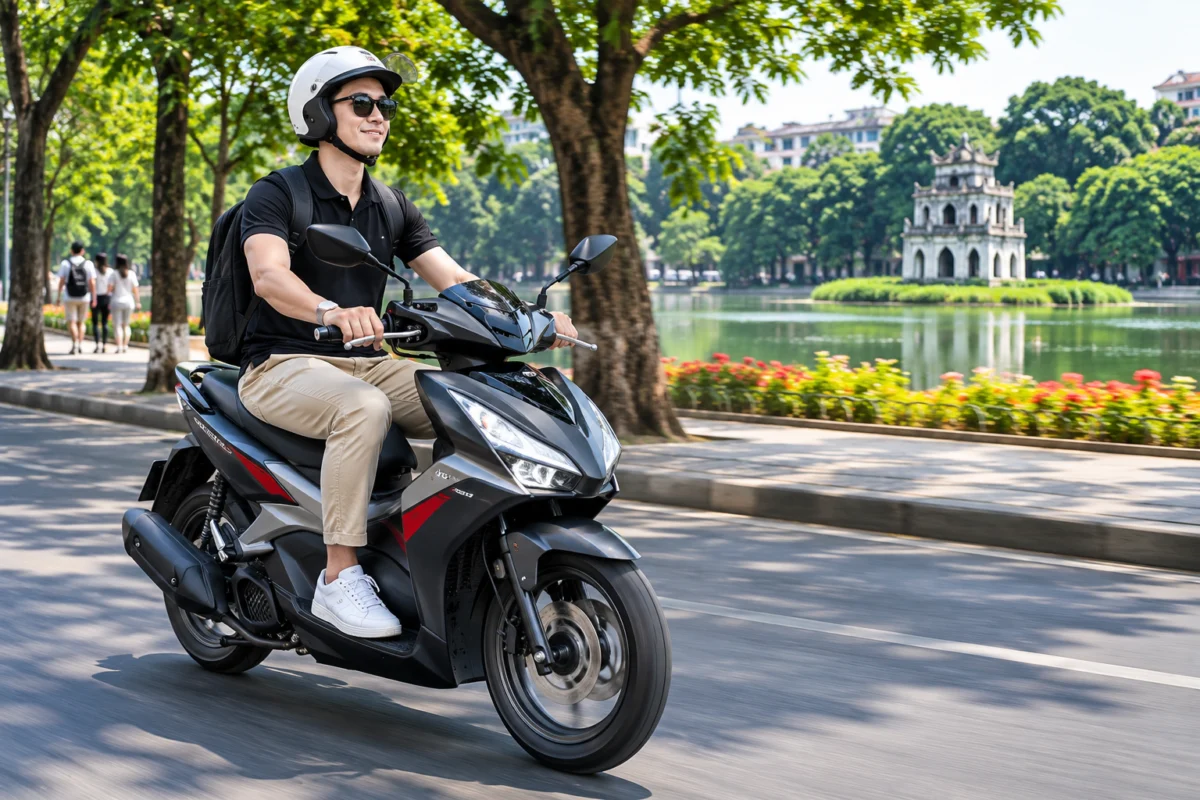
Everything here is general riding technique, not an instruction to do anything in a specific moment. Traffic is local and changing, so use your own judgment, ride within your skill and stop if you feel overwhelmed. For the wider picture of what to check before you ride, start with the Hanoi motorbike rental guide.
The core habit: predictable, smooth and visible
Hanoi traffic looks chaotic to a newcomer, but it runs on a shared habit: everyone makes small, early, gradual adjustments and expects others to do the same. Streams of scooters merge and part like water. The riders who get into trouble are usually the ones who do something abrupt: a hard brake, a sudden swerve, a stop in the middle of a lane.
Three habits cover most of what follows.
- Predictable. Hold a steady line and speed. Signal before you change position, and keep the signal short and early rather than late and long.
- Smooth. Squeeze the brakes and twist the throttle gradually. A smooth rider gives everyone behind more time to react.
- Visible. Ride where other drivers can see you, not in the blind spot beside a bus or truck. Use your horn as a short, friendly “I am here” tap, not as a protest. Keep your headlight on and wear a proper helmet; a helmet without a fastened strap is fined 400,000 to 600,000 VND under Decree 168/2024/ND-CP.
A practical consequence: most of your skill is in what you do before the hazard, not during it. Looking far ahead, two or three vehicles past the one in front, is the single cheapest safety tool you have.
Junctions: slow decisions and clear visibility
Junctions are where streams cross, and they are where a visitor’s habits from home matter least. A useful mental rule is: slow down before you can see the problem, not after. Take your speed off while still approaching, cover the brakes with your fingers, and decide what you will do before you reach the crossing line.
Signal-controlled junctions
At a junction with traffic lights, approach at a speed that lets you stop comfortably if the light changes. Do not accelerate toward an amber light to “beat” it; a scooter that stops late stops in the crossing, and a scooter behind you may not expect it.
When you stop at a red light, stop behind the line and out of the crossing. In Hanoi the crowd forward of the line can be dense; resist the push to creep ahead of other riders into the intersection. Keep your feet ready to steady the bike, and watch the cross traffic’s light, not just your own, so you are not surprised by the order of changes.
When the light turns green, look before you go. Another rider who is late or who started early may still be crossing. Pull away smoothly and keep your speed modest until you are clear of the junction.
Uncontrolled junctions and roundabouts
Many Hanoi junctions have no lights or a signal that no one is watching. Here the rule is to be slow, visible and ready to give way in practice, whatever you think the formal priority is. This guide does not set out the detailed right-of-way rules from Law 36/2024/QH15; those are not covered in the verified sources used for this article, so treat any claim that “I had priority” as a poor protection against a larger or faster vehicle. If you want the rule for a specific situation, check the Law’s text or ask the shop, and keep the habit of yielding to anything bigger than you.
For uncontrolled junctions:
- Slow down well before the corner and look left and right early.
- Take a position where drivers on the cross street can see you, rather than creeping out half-hidden behind a parked vehicle.
- Edge forward only as far as you need to see, then commit smoothly once there is a gap that does not require anyone else to brake hard.
- Do not stop in the middle of the junction; if the exit is blocked, wait before entering.
Roundabouts follow the same logic. Enter at a speed that lets you stop, hold your lane through the circle, and look at where the traffic wants to go rather than at where you want to go. If you feel pushed along by the flow and miss your exit, go around again or take the next exit; see the section on missed turns below.
Turning across traffic
Turning across the stream is the riskiest thing a new rider does. A simple approach:
- Signal early, then move to the side of the lane that matches your turn once it is safe to do so.
- For a turn across oncoming traffic, slow down and wait for a gap you can use fully, not one that leaves you half across. If there is a protected waiting space inside the junction, use it; if not, do not improvise one by stopping in the middle of a through lane.
- Look over your shoulder for scooters on your inside before you turn. Mirrors miss the rider who is closing in.
- Complete the turn at a steady, low speed and straighten up before accelerating.
If a turn does not look manageable, the safe option is to go straight and re-plan. A longer route is not a penalty.
Red lights and the fine
For a motorbike or moped rider, running a red light is fined 4 to 6 million VND plus 4 points under Decree 168/2024/ND-CP, Article 7. If it causes a crash, the fine rises to 10 to 14 million VND. Decree 238/2026/ND-CP, which amended Decree 168 from 15 August 2026, did not change the fine amounts discussed here, so these figures stand as of November 2026. For the fuller table of rider fines, see Vietnam motorbike fines under Decree 168.
The practical point is not the fine; it is that the decision to run a light is made in a fraction of a second, so make it in advance. If you are unsure whether a light will change, assume it will and slow down. There is nothing to gain by being first away from the junction.
Following distance in stop-start traffic
In free-flowing traffic you can use a time gap. In Hanoi’s stop-start traffic you mostly use a space gap, because the vehicle ahead can stop or turn at any moment and others will fill any gap you leave. The goal is to keep enough room that you can stop without an emergency, and enough room to the side that you have somewhere to go.
Space ahead and an escape gap
Two rules you can recall while riding:
- See the rear tire. When you stop behind another vehicle, stop far enough back that you can see where its rear tire meets the road. If you cannot, you are too close to react if it rolls back or if something hits you from behind.
- Keep an escape gap. Whenever you can, leave a gap on at least one side so you are not boxed in. A rider who has a gap to the left or right can avoid a sudden stop ahead; a rider wedged between two vehicles cannot.
At higher speed, build in more space. The faster you go, the longer it takes to stop, and a wet or dusty road makes it longer again. A commonly taught general guide is to leave a gap of roughly two seconds on a dry road and more in the rain; this is general technique, not a legal measure, and the right gap for you depends on your bike, your brakes and the surface. If you rent a scooter with drum brakes, assume you will need more space than on a bike with discs; the brakes explainer covers the differences.
Do not tailgate to stop others cutting in. In dense Hanoi traffic someone will pull into any gap, and that is normal. Let them in, take a breath and rebuild your space.
Filtering: when and when not
Filtering means moving past slower or stopped vehicles in the gaps between them. It is common in Hanoi and a lot of riders do it constantly. For a visitor, the safer approach is to filter rarely and only at very low speed.
Filter only when all of these are true: the gap is clearly wide enough for you and your mirrors, the vehicles beside you are stopped or very slow, you can see far enough ahead to know the gap continues, and no vehicle is about to turn or open a door into you. Do not filter beside a bus or truck that might swing out, do not push through a gap that closes while you are in it, and never ride on the sidewalk to get ahead. Riding on the sidewalk is a separate offense, fined 4 to 6 million VND plus 2 points under the same Article 7 as riding the wrong way.
If you are not sure, stay in the line. A few minutes saved is not worth the risk.
Buses and trucks
Large vehicles need special handling because their drivers see less and their stopping and swing patterns are different.
- Stay out of the blind spots: directly beside the front corner, close behind, and immediately in front.
- Give extra room when a bus is pulling in to or away from a stop; it may cut across your line.
- Do not overtake a large vehicle that is signaling or turning, and do not squeeze between it and the curb.
- Pass only when you can see the road ahead is clear for the full distance you need, and move back into your line smoothly.
Your own mirror does not tell you whether a bus driver can see you. Keep clear of the bus’s blind spots, allow extra space, and never assume the driver has noticed you, even if you can see the bus’s mirrors.
Recognizing slippery surfaces
Scooters have two small contact patches and light weight, so surface changes matter more than they do on a car. The rule: slow down before the slippery thing, keep the bike upright and avoid braking or leaning hard on it. A surface that is fine at walking pace can drop a wheel if you hit it while braking in a bend.
Paint and metal covers
Painted road markings such as crosswalk stripes, arrows and lane lines, along with manhole covers, drain grates, metal plates over roadworks and utility covers, are the usual culprits. They are often smooth, and when wet they can be very slippery. Rails or grooved metal can also catch a narrow tire.
- Cross them upright, at a steady, low speed, without braking or accelerating hard.
- Avoid placing your turn on a crosswalk stripe or a metal cover; shift your line slightly if you can do it safely.
- Take extra care at junctions, where painted markings and covers are concentrated and you are braking or turning at the same time.
Sand, gravel, leaves and oil
Loose material works like ball bearings under a tire. Sand and gravel collect near construction sites, road edges and corners; dry leaves and mud can hide a slick patch; oil and diesel residue build up near bus stops, junctions and fuel stations and are hard to see.
- Look ahead for shiny patches, dull or darker strips, pale sand fans and rubble at the road edge.
- Slow down before you reach the patch, hold the handlebars lightly but firmly, keep the bike upright and roll through without braking.
- Keep clear of the extreme edge of the road where debris gathers, unless you have to be there.
The first rain after a dry spell
The first rain after a dry spell is a known problem on any road: dust, oil and rubber residue lift into a slick film before the rain washes it away. Treat the opening minutes of a shower as the most slippery time. Slow down more than seems necessary, increase your following distance, avoid sharp braking or lean, and be especially careful around painted markings and covers, which stay slick for longer. For the full approach to wet riding and when to wait it out, see riding a scooter in Hanoi rain.
Roadside stops: choose space before checking your map
The most common unsafe stop is a rider who slows suddenly in the traffic line to look at a phone. The rule is choose the space first, then look at the map. Do not read the screen until you are fully stopped, off the line of traffic, in a place that is safe and legal.
For phones, the law adds a second reason: using a hand-held phone while riding is fined 800,000 to 1,000,000 VND plus 4 points under Decree 168/2024/ND-CP. Ride with the phone out of your hand, in a holder, or use audio directions where that is practical, and see navigating Hanoi on a scooter for map setup and one-way streets.
Signal, slow and stop fully out of the traffic line
- Look for a suitable space well ahead, so you are not forced into a late, sharp move.
- Check behind you, signal clearly and slow down gradually; do not brake suddenly.
- Move out of the traffic line to a spot with enough room for the bike to stand without sticking into the lane.
- Put the bike on the stand, or keep both feet down with the brakes on, and then look at your phone.
Where not to stop
Avoid junctions and their approaches, bends and the top of a rise where others cannot see you, bus stops, narrow lanes, bridges, tunnels and the middle of any lane. Stopping or parking that obstructs traffic, or parking illegally on a sidewalk, is fined 400,000 to 600,000 VND; stopping on a bridge is fined 600,000 to 800,000 VND and in a tunnel 800,000 to 1,000,000 VND under Decree 168/2024/ND-CP. Choose a spot where the bike is plainly out of the way.
Rejoining traffic
Before you pull out, check your mirrors, look over your shoulder and signal. Wait for a gap that lets you reach a normal speed without forcing anyone to brake. Accelerate smoothly and move into the line gradually; do not shoot out from the curb.
Missed turns without sudden maneuvers
Everyone misses a turn in Hanoi. The mistake is not missing it; it is reacting with a sudden brake, a swerve across lanes or a reverse back along the road. Each of these turns an inconvenience into a hazard.
Continue and re-plan
The rule: if you miss it, keep going. Hold your line and speed, put your attention on the road, and let the next safe option come to you. Most of the time the next junction, a roundabout or a side street offers a way back within a minute or two. If you need to re-plan, do it at your next planned stop, following the roadside-stop steps above.
A navigation app that reroutes automatically takes much of the pressure out of this. A missed turn rarely costs more than a few minutes, and a sudden maneuver can cost far more.
Legal U-turn options (verify)
U-turns are allowed only where the signs and road layout permit them. This article does not set out the U-turn rules of Law 36/2024/QH15, because they are not in the verified source set used here. If you need to turn around, look for a place where a turn is clearly signposted or marked, or use a roundabout or a sequence of side-street turns that gets you facing the other way without crossing the traffic stream illegally. If you cannot tell whether a U-turn is allowed, do not make it; continue to the next junction. Check the official text of the Law, or ask HANOI MOTO, if you want a rule for a particular case.
Never ride the wrong way back
Riding a short distance against the traffic to reach the turn you missed is tempting and it is dangerous. It also carries a fine: riding the wrong way, or riding on the sidewalk, is 4 to 6 million VND plus 2 points under Decree 168/2024/ND-CP, Article 7. The traffic is not expecting you, and a head-on collision between two scooters is far worse than a few extra minutes. The same logic applies to cutting over the median or riding the wrong way up a one-way street. Go around.
Practice drills for your first week
Skills improve fastest with deliberate practice in low-risk conditions. Practice only in a safe, permitted controlled area with suitable instruction and permission; a quiet public street is not automatically a training area. Public-road riding requires the appropriate legal qualification and competence; the rush hour guide explains when Hanoi is busiest, and the first ride plan gives a step-by-step way to start.
| Drill | What you practice | What good looks like |
|---|---|---|
| Brake and stop | Smooth braking from low speed, then a firm stop | Bike stays straight, no skid, feet down calmly |
| Space check | Stopping behind a parked vehicle at a distance where you see its rear tire | Consistent gap without thinking about it |
| Slow turn | A low-speed turn at a quiet corner, with a signal and shoulder check | No wobble, no wide swing into the other lane |
| Surface awareness | Crossing a painted line or a flat cover upright, at low speed, without braking | Steady line, no twitch |
| Roadside stop | Signal, slow and pull out of the line to a safe spot before looking at the phone | Phone is never touched until fully stopped |
| Missed-turn habit | Deliberately skipping a planned turn and re-planning at the next safe spot | No braking or swerving, calm decision |
Do each drill a few times on separate days. If a drill feels shaky, repeat it before you add traffic. Practice never replaces a valid license. Use a safe, permitted controlled training area with suitable supervision rather than choosing a quiet public street for drills.
New to Hanoi traffic? Ask HANOI MOTO which bike type is easiest to handle at low speed for your first days, through the contact page, on Zalo at +84 857 255 868 or by email to motoopen12@gmail.com.
Frequently asked questions
Who has right of way at a Hanoi junction?
The detailed right-of-way rules are set out in Law 36/2024/QH15 and the road signs and signals at each junction, and this guide does not restate them because they were not covered in the verified sources used for it. In practice, treat priority as something to confirm with your eyes: slow down, make eye contact where you can, and give way to larger or faster vehicles even when you believe you have priority. Always obey traffic lights; running a red light costs 4 to 6 million VND plus 4 points for a motorbike rider.
How much space should I leave in stop-start traffic?
Leave enough that you can stop smoothly without an emergency and see the rear tire of the vehicle ahead when stopped. Keep a gap on at least one side as an escape route, and widen the space when the road is wet, dusty or your brakes are drum brakes. A commonly taught guide at moving speed is about two seconds on a dry road and more in rain; this is general technique, not a legal figure.
Which road surfaces are most slippery for scooters?
Painted markings, metal covers and plates, sand, gravel, leaves, oil residue and the first rain after a dry spell are the main ones. Slow down before them, keep the bike upright and avoid braking or leaning on them. Wet paint and metal are the most treacherous.
What should I do if I miss my turn?
Keep going. Hold your line and speed, do not brake hard or swerve across lanes, and re-plan at the next safe point or let your navigation app reroute. Use a signposted place or a roundabout if you need to turn around, and do not make a U-turn unless you are sure it is allowed.
Is it legal to ride the wrong way for a short distance?
No. Riding against the traffic or on the sidewalk is fined 4 to 6 million VND plus 2 points for a motorbike or moped rider under Decree 168/2024/ND-CP, Article 7, and it is dangerous because other riders do not expect you. Go around to reach your turn instead.
Sources and last checked
- Government of Vietnam, via Thu Vien Phap Luat, Decree 168/2024/ND-CP on penalties for administrative violations against regulations on road traffic order and safety (English), accessed November 2026
- Government of Vietnam, via Thu Vien Phap Luat, Decree 238/2026/ND-CP amending Decree 168/2024/ND-CP (English), accessed November 2026
- National Assembly of Vietnam, via Thu Vien Phap Luat, Law 36/2024/QH15 on Road Traffic Order and Safety (English), accessed November 2026
Part of the guide: Hanoi Riding Preparation and Day-Trip Planning
Conversation