
Sending a Friend or Driver to Collect or Return Your Rental Scooter: Authorization and Risks
Yes, a friend or driver can sometimes handle a scooter handover for you, but only if the shop agrees in advance, and the safest default is that the person named on the rental is there in person. The rental agreement, the ID check, the deposit and the condition record all attach to one named rider, and a stand-in breaks that chain. At HANOI MOTO, third-party collection or return is not a fixed public policy: it is something to ask about and settle by agreement before the day. This guide explains why the named rider matters, what a written authorization should say, what the collector must show, who carries the risk, and where the deposit goes if someone else returns the bike.
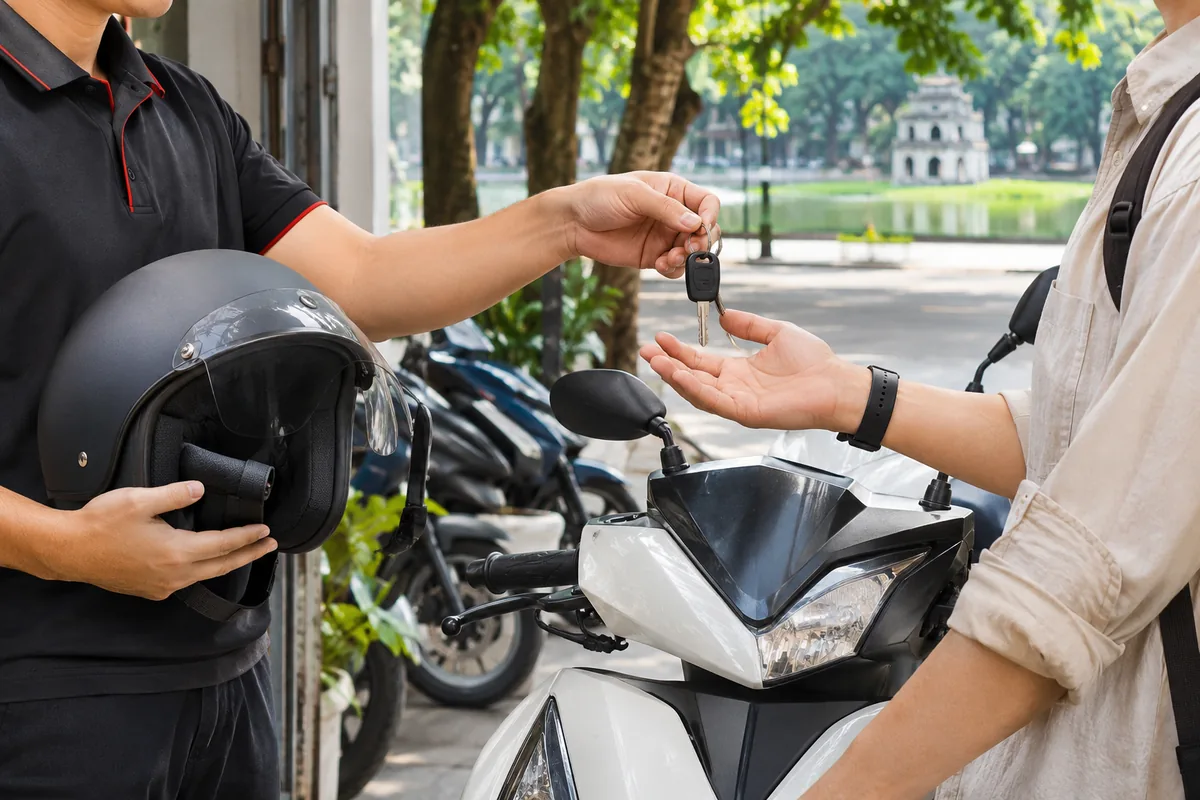
Why the named rider should usually be present
A rental is a small contract with a person at its center. The shop records who the renter is, checks that this person can legally ride the vehicle class, takes a deposit from them and notes the bike’s condition in front of them. Everything that happens later, from a damage dispute to a deposit refund, is argued against that record. Our guide to scooter rental agreements in Vietnam covers the clauses; the point here is that most of them name one rider.
When someone else turns up, four things get harder at once:
- Identity and license. The shop cannot verify that the person who will ride is the person whose license was checked.
- Condition record. The renter never sees the bike at pickup, so they cannot confirm the scratches and mileage noted on the day.
- Money. The deposit is paid by, and normally refunded to, a specific person. A stand-in who pays or receives cash introduces a second party to the transaction.
- Responsibility. If the stand-in rides, they are a second rider the agreement may not cover. If they only deliver the bike to your hotel, the question is who signed for it.
None of this makes third-party handovers impossible. It means they need to be agreed and documented, rather than improvised at a counter or a hotel lobby.
Three situations that look similar but are not
| Situation | Who ends up riding | Main concern |
|---|---|---|
| Friend collects the bike and brings it to you | The friend rides it briefly, then you take over | The friend rides before the shop has checked anyone; the agreement may not cover them |
| Hotel or hostel staff receive the bike at the door | Nobody rides until you arrive | Who signs the condition record, and who is holding the keys |
| Driver collects the bike and delivers it to a different address | The driver rides on a public road | A paid or casual rider the shop never vetted; unlicensed riding is the shop’s and your problem alike |
The third row is the one to be most cautious about. Any time a person other than the named renter rides the scooter, even for ten minutes, all of the license and insurance questions apply to that person too. We come back to this below.
What a written authorization message or letter should contain
There is no standard Vietnamese form that every rental shop must accept, and we are not aware of an official template for scooter rentals. What a shop usually needs is clear evidence that the named renter really did send this particular person, for this particular purpose. A short message from you, sent in advance to the shop’s official contact, plus a signed letter the stand-in carries, covers most of the ground. Whether the shop accepts that is by agreement.
Include these points:
- Your full name exactly as on your passport, your passport number and your phone number or Zalo contact.
- The full name of the person you are authorizing, and their ID document type and number.
- What exactly you authorize: collect only, return only, or both. Be explicit that the person is not authorized to ride the bike beyond the handover, if that is your intention.
- The bike: model, color if known, the plate number once the shop has confirmed it, and the rental dates.
- The place and approximate time of the handover.
- Money: whether the collector may hand over cash for the rental or deposit, and, for a return, who the deposit refund should go to and by what method.
- Your signature and the date, and a way for the shop to reach you directly during the handover.
A message you can adapt:
Hello, this is [your full name], renter of the [model] booked for [dates]. On [date] at about [time], [name of friend or driver] (ID: [type and number]) will [collect / return] the scooter on my behalf at [place]. I authorize this person to [receive the bike and keys / hand the bike back and receive the condition record]. I do not authorize them to ride the bike beyond what the handover requires. Any deposit refund should be paid to [me by the agreed method / name]. You can reach me on [phone or Zalo] during the handover. Please reply to confirm that you accept this arrangement.
Two practical notes. First, a reply from the shop that says “accepted” is worth more than the letter itself, because it shows the shop agreed to this arrangement. Keep it. Second, do not attach a passport scan to a general authorization letter or pass one through a friend or driver. Ask the shop whether it needs to view identity documents directly at handover and how any necessary copies will be handled securely. Our guide to hotel scooter handover lists what a delivery-day checklist normally includes.
ID and license checks for the collector
Expect the shop to check the collector’s identity, not just read your letter. A reasonable shop will want to see the collector’s own ID, compare the name to your authorization, and possibly confirm with you by phone or Zalo while the collector is present. Ask what they want ahead of time, so the person you send is not turned away.
If the collector will ride the scooter even briefly, the shop has a second legal question to answer: can this person legally ride this vehicle? Under Law 36/2024/QH15 on Road Traffic Order and Safety, riders of motorcycles above 50 cc need a valid license of the right class, and foreign visitors need a license that Vietnam recognizes. We explain the classes in riding without a valid license in Vietnam and in our guide to license classes, and the point is simple: a friend who has “ridden for years at home” is not covered unless their license is valid here for that class.
If the collector will not ride, say so in the authorization and make a different plan for moving the bike. Ask the shop what it can arrange by agreement. HANOI MOTO’s delivery coverage, fees and timing are set case by case, not published, so ask on the pickup and delivery page or through the contact details at the end of this article rather than assuming anything.
Liability and who rides
The legal position and the contract position are separate, and it helps to keep them apart.
What the law says
Traffic law attaches to the person riding. A rider without a valid license can face a fine under Decree 168/2024/ND-CP, Article 18, in the range of 2 to 4 million VND for bikes up to 125 cc or 11 kW, and a rider-side problem also affects whether insurance responds. Compulsory third-party motor insurance covers other people, not the rider and not the rented bike. Decree 168 has been amended by Decree 238/2026/ND-CP, which supplements certain provisions of Article 7, and we advise checking the latest text before relying on any figure.
Circular 73/2024/TT-BCA, Article 24, with Circular 13/2025/TT-BCA, Article 11, provides for verification of the vehicle, owner and related people and notice in writing or through VNeTraffic when technical conditions are met. Check who is named on the particular bike’s registration; do not assume it is always the shop. Decree 168, Article 47(8), requires owner cooperation to identify the rider. Police determine administrative responsibility; any reimbursement agreement must comply with applicable law. If a stand-in rode the bike, record who rode and the handover time so any notice can be checked.
What the agreement says
The contract is what decides who pays for damage, a lost key or a late return. Many agreements make the named renter responsible for the bike from the moment it is handed over to anyone on their behalf. If a mishap or a delay occurs during an authorized collection or return, responsibility should be checked against the actual agreement, the identity of the rider and applicable law; do not assume either the renter or the stand-in automatically pays. Whether HANOI MOTO’s agreement treats an authorized collector differently is a matter to confirm with the shop in writing. We are not aware of any fixed public rule on this.
The practical rule: if you would not be comfortable being fully responsible for everything the stand-in does with the scooter, do not authorize them to ride it.
Return by a third party and who receives the deposit refund
Returns are where third-party arrangements cause the most trouble, because the deposit and the final condition check both happen at that moment. Our guides to returning a rental scooter and to deposit receipts and refunds describe the usual record: a condition comparison against the pickup photos, a count of keys and accessories, and a written or messaged confirmation that the rental is closed.
If someone else returns the bike for you, settle these points in advance:
- Who inspects. You are not there, so the shop’s condition check happens without you. Ask whether it can send photos and a summary to you immediately, and keep your own pickup photos ready. Our note on photographing a scooter at pickup explains what a useful set looks like.
- Who the refund goes to. The default expectation is that a deposit goes back to the person who paid it, by the method agreed at the start. If you want the stand-in to receive cash on your behalf, say so in the authorization, and ask the shop to confirm. Otherwise ask for a refund by an agreed method to you directly.
- When the rental ends. The rental usually ends when the shop accepts the bike back, not when the driver leaves it. A bike dropped at a hotel desk with no shop confirmation may still be running on your account.
- What if something is disputed. If the shop finds damage, you will need to dispute it remotely. Our guide to deposit and refund conditions sets out the general terms, and exact refund conditions are by agreement.
Do not leave your passport as a stand-in’s collateral or hand a passport to a driver as a deposit. We cover the legal position on holding passports in a separate article, is it legal to leave your passport as a rental deposit, and the sensible course is to avoid passing identity documents through intermediaries.
Not an excuse for unlicensed riders
Occasionally the idea behind “my friend will collect it” is really “I do not have the right license, but my friend does.” That does not work. The rental is for a rider who can legally ride the bike on Vietnamese roads, and a friend collecting the scooter does not transfer that status to you. If the person who will actually ride does not hold a recognized license for the vehicle class, the authorization letter, however well drafted, does not fix it.
The same applies the other way. Do not authorize someone who lacks the right license to take the bike for a ride on your behalf. The risks include fines for the rider, trouble with any insurance claim, and a dispute with the shop about a breach of the agreement. Read riding without a valid license in Vietnam for the penalties and the options for riders who are not yet licensed, and the license-class article for what each class covers. If neither of you holds a valid license, the answer is to choose a different way of getting around, not a cleverer handover.
A simple plan for a third-party handover
- Ask the shop first whether it accepts a collector or a return by a third party. If the answer is no, you have saved yourself a wasted trip.
- Agree on the details in writing: the collector’s name, the place and time, whether they will ride, and who pays what.
- Send the authorization message to the shop’s official contact, and keep the shop’s reply.
- Give the collector a signed copy of the letter and tell them which ID to bring.
- Ask the shop to send photos of the bike at handover and, at return, photos of the final condition.
- Agree the deposit refund recipient and method before the return, not after.
If it can be avoided, meeting the shop yourself, even for ten minutes, removes most of the risk above. The booking confirmation guide explains what to have confirmed in writing before you travel, and the pickup and delivery section collects related planning guides.
To ask what HANOI MOTO can arrange, send your dates, preferred model, license type and handover preference, including who would collect or return the bike, through the HANOI MOTO contact page, on Zalo at +84 857 255 868 or by email to motoopen12@gmail.com.
Frequently asked questions
Can my friend collect my scooter?
Possibly, but only with the shop’s agreement beforehand. Treat it as a request, not a right: tell the shop who will collect, whether they will ride, and what ID they will bring, and wait for a clear yes. HANOI MOTO has no fixed public policy on third-party collection, so ask in writing before the day.
Can a hotel staff member return my scooter?
Hotel staff are not the rental shop’s agent unless the shop says so. Returning the key to a front desk does not close a rental. If you want hotel staff to hand the bike back, get the shop to agree to the arrangement in writing, ask for a confirmation message when the bike is accepted, and make sure the condition check is recorded with photos.
Who gets the deposit back if someone else returns it?
By default, expect the refund to follow whoever paid it, by the method agreed at the start. If you want it paid to the person returning the bike, state that in your authorization and have the shop confirm. Exact conditions are by agreement, so confirm them before you hand over the cash.
Do I need a written authorization?
There is no universal legal requirement we can point to for a scooter rental, but a written authorization is strongly sensible. It shows the shop that you really sent the person and defines what they may do. A short message to the shop plus a signed letter the collector carries is usually enough, subject to what the shop accepts.
Can my driver or friend ride the scooter to me?
Only if they hold a license valid in Vietnam for that class of vehicle, and only if the shop knows and agrees. If you are not sure, have the bike delivered some other way, or collect it yourself.
Sources and last checked
- National Assembly of Vietnam via Thu Vien Phap Luat, Law on Road Traffic Order and Safety No. 36/2024/QH15, accessed November 2026
- Government of Vietnam via Thu Vien Phap Luat, Decree 282/2025/ND-CP on administrative penalties for security, public order and social safety, accessed November 2026
- Government of Vietnam, Decree 168/2024/ND-CP on administrative penalties for road traffic violations (Article 18), as amended by Decree 238/2026/ND-CP, accessed November 2026
- Ministry of Public Security, Circular 73/2024/TT-BCA (Article 24), as amended by Circular 13/2025/TT-BCA, on handling violations detected by cameras, accessed November 2026
Part of the guide: Motorbike Handover Planning in Hanoi: Meeting Points, Fees and Delays